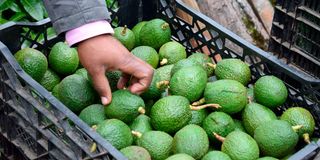
Kenyan avocado traders have been given one week to sell existing stock before the government closes the export window for sea shipments on October 20. This is an attempt to stop the export of unripe fruit and protect the country's reputation in foreign markets.
On Friday, the Agriculture and Food Authority (AFA) announced that it is enforcing the seasonal closure following a countrywide survey that revealed low levels of ripe avocados. This indicates that, after the deadline, only air shipments of select varieties, such as Hass, Fuerte, Pinkerton and Jumbo, will be permitted.
The Authority says that the temporary freeze will help to safeguard Kenya’s export standards, which have been questioned by international buyers in recent years due to consignments of immature avocados.
The Agriculture and Food Authority says that the temporary freeze will help to safeguard Kenya’s avocado export standards.
Photo credit: File | Nation Media Group
The AFA also said that the halt would help stabilise production cycles ahead of the main season early next year.
“The Authority has been monitoring harvesting trends and recently undertook a countrywide survey in the major avocado production zones to determine current production trends and forecast future production for the main season next year,” wrote AFA Director-General Bruno Linyiru in a notice to exporters.
“The findings indicate that there is currently insufficient volumes of the main season crop to warrant sea shipment. This is therefore to notify you that the closing of harvesting season for sea shipment for the 2025/2026 fiscal year will come into force from Monday, 20th October 2025.”
Dr Bruno Linyiru (standing), the director-general of the Agriculture and Food Authority, when he appeared before a National Assembly committee in Nairobi on July 2, 2025.
Photo credit: Dennis Onsongo | Nation
Under the new rules, exporters and processors holding existing oil stocks must arrange for an inspection and demonstrate that the oil was produced before the closure date.
“No permit shall be issued for export of avocado oil processed after closure of the harvesting season,” said the agency, adding that it will review the situation in January next year, depending on maturity trends and production patterns.
Avocado oil.
Photo credit: Pool
Kenya, Africa’s largest exporter of avocados, ships more than 60 percent of its annual output to Europe and the Middle East, with sea transport accounting for the bulk of consignments.
A disruption of the sea export window is therefore expected to slow shipments and could temporarily push prices down in the local market as supply builds up.
In the past, industry players have urged the authorities to adopt staggered closure dates for different regions, on the basis that avocado maturity varies across production zones such as Murang'a, Kisii and Nakuru.
The AFA's decision comes amid heightened scrutiny from key importers, including China and the European Union (EU), who have expressed concerns about the quality of immature harvests.
Key avocado importers, including China and the European Union, have expressed concerns about the quality of immature harvests.
Photo credit: File I Nation Media Group
After a five-month suspension by AFA, the avocado harvest season opened on February 14, 2025, with two varieties – Fuerte and Pinkerton – cleared as ripe for harvest for the export market and shipped out by sea.
In 2023, a total of 123,000 tonnes of avocado were exported, compared with 103,000 tonnes in 2022, earning the country Sh18 billion.
Major export outlets for Hass avocados from Kenya include the Netherlands, Russia, China, Spain, Italy, France, Belgium and the United Kingdom.
The Middle East, Saudi Arabia, Qatar and the United Arab Emirates (UAE) are leading destinations for Kenya’s fresh avocado produce.