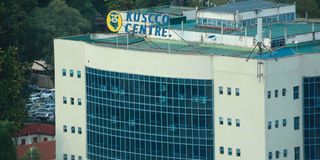
The government is now considering liquidating the Kenya Union of Savings and Credit Cooperatives Limited (KUSCCO) after a forensic audit uncovered an estimated Sh12 billion financial hole, exposing a sprawling web of fraud, ghost saccos, manipulated accounts, fake audits and politically connected networks that siphoned billions of shillings from the movement.
The revelations emerged when Cooperatives and MSMEs Cabinet Secretary Wycliffe Oparanya appeared before the Senate Trade Committee, chaired by Kwale Senator Issa Juma Boy, where officials painted a grim picture of an institution once considered the financial backbone of the country’s sacco sector but now staring at collapse.
Out of the Sh12 billion, the government has said only about Sh4.8 billion may ultimately be recovered from the scandal despite ongoing court cases, debt recovery efforts and disposal of KUSCCO assets.
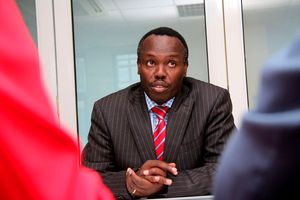
“For us to recover the entire book of around Sh5 billion, which is recoverable, it will not take us not less than 10 years,” KUSCCO Chief Executive Officer Arnold Munene told senators.
Kenya Union of Savings and Credit Co-operatives (Kuscco) Managing Director Arnold Munene.
Photo credit: Billy Ogada | Nation Media Group
The disclosure effectively means that billions of shillings belonging to saccos and ordinary members could be permanently lost, triggering fears of a deeper crisis in a sector that holds savings for millions of Kenyans.
Mr Oparanya told senators that the scale of financial irregularities uncovered at KUSCCO had pushed the government towards dissolving the institution altogether, saying liquidation was now being considered as the most viable option after auditors concluded that billions may never be recovered.
“Due to the nature and complexity, we are now considering liquidating KUSCCO so that we do away with it, and what will be recovered will maybe be given to debtors. That decision will be communicated soon,” the CS told the committee, signalling what could mark the final collapse of the once powerful umbrella body for saccos.
According to documents tabled before the committee, KUSCCO’s liabilities had ballooned to more than Sh17 billion by July 2025, including over Sh15.6 billion in deposits belonging to member saccos.
The committee heard that KUSCCO had over the years, presented itself as financially stable while in reality it was sinking under massive losses hidden through manipulated books, weak oversight and questionable audits.
Mr Munene disclosed that some of the country’s biggest saccos are among the hardest hit. Hazina Sacco tops the list with deposits of about Sh1 billion. Njiwa Sacco follows with Sh829 million, while Invest and Grow Sacco, associated with teachers in Kakamega, had deposited about Sh746 million into KUSCCO.
Njiwa Sacco is widely associated with officers from the National Intelligence Service, adding another sensitive dimension to the unfolding scandal and underscoring how deeply KUSCCO had penetrated critical institutions.
The revelations before senators painted the picture of a financial scheme that continued attracting billions from saccos even as insiders allegedly knew the institution was in trouble.
One of the most explosive disclosures emerged after Vihiga Senator Godfrey Osotsi raised allegations that officials and brokers who mobilised deposits into KUSCCO were allegedly rewarded through kickbacks.
“There was an allegation that during that time, when all this was happening, Saccos used to deposit money in KUSCCO. In return, they were given a bribe for depositing sacco money in KUSCCO,” Senator Osotsi told the committee.
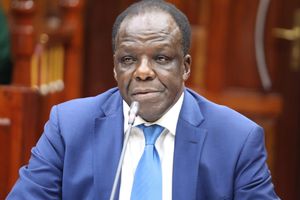
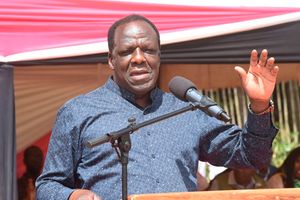
Cooperatives and Micro, Small and Medium Enterprises Cabinet Secretary Wycliffe Oparanya.
Photo credit: Fiie| Nation Media Group
Mr Oparanya confirmed the existence of the scheme and revealed that individuals who brought deposits into KUSCCO allegedly received commissions amounting to three percent of the money deposited.
“Those who brought deposits were being paid three percent finder’s fee. So you get three percent and imagine if you are bringing a billion, you get three percent finder’s fee,” the CS said.
“Because they were taking that money, so it is renewed, again you get three percent finder’s fee. So the allegation that those who brought deposits were being paid three percent of the deposits is accurate,” he added.
The committee further heard that investigators uncovered what appear to be fictitious or collapsed saccos tied to suspicious loans worth hundreds of millions of shillings.
Out of 150 saccos forwarded to the Commissioner for Cooperatives for verification, 42 had no files or registration records at all.
“Forty two saccos did not have any file or any registration number, which means these might have been forged saccos holding a loan portfolio of Sh690 million,” Mr Munene said.
Another 88 saccos were found to be dormant, while 57 were under liquidation. Four had already been dissolved. Mr Munene told senators that only Sh4.8 billion of KUSCCO’s Sh8.4 billion loan book is now considered recoverable, with the rest tied to dormant, collapsed or non existent entities.
“Those are saccos that long died, they did not exist, and saccos that are dormant, and saccos that are on liquidation,” he said.
The committee also heard that the institution is now relying heavily on selling off assets to refund depositors, including housing units in Kitengela and other non-core properties.
“One of the major assets that we have is 120 units in Kitengela, where we only have 72 left to be sold. The process is ongoing, it may take a bit of time,” Mr Munene told senators.
But even the asset recovery process appears slow and uncertain. Ministry documents presented to senators show that KUSCCO has so far refunded only Sh369 million to members over the 2024 and 2025 period despite the scale of losses.
The report also shows that recovery from property auctions has generated only Sh60.4 million, while the sale of vehicles brought in Sh33.67 million. In another startling disclosure, Mr Oparanya claimed KUSCCO’s books had been signed off on for years by an auditor who had already died.
“This KUSCCO was being audited by a dead auditor. He was dead and buried. The man was dead and was still auditing the books,” the CS told senators.
He alleged that after the auditor’s death, clerks continued operating under his name while auditing KUSCCO accounts.
“The auditor was a relative of the CEO. The CEO was also controlling the Saccos Society Regulatory Authority (SASRA). They were relatives. So it was a whole chain,” Mr Oparanya said.
The CS said the scandal had exposed dangerous weaknesses in the regulation of Kenya’s multi-trillion shilling cooperative sector.
“The cooperative movement is moving a lot of money, trillions of money. Unless you have proper regulations and proper legislation, we are indeed going to have problems,” he warned.
Principal Secretary for Cooperatives Patrick Kilemi also hinted at the involvement of powerful figures and influential networks that may be frustrating attempts to prosecute suspects and recover stolen funds.
“If you listen to the list from the CEO, some of the top saccos is the sacco for national intelligence services. So you understand that. It’s a complex matter we are dealing with,” Mr Kilemi told senators in apparent reference to Njiwa Sacco and the powerful institutions caught up in the scandal.
He suggested that some of the accused individuals had used their influence to slow down court proceedings and frustrate investigations.
“We appreciate the fact that we are talking about Sh4.5 billion out there. But they are able to slow down this recovery process. I don’t know what kind of dark arts, but we are trying to prosecute them,” he said.
Mr Oparanya similarly alluded to the involvement of highly connected individuals, saying the complexity of the scandal extended beyond ordinary financial crime.
“You have been told the complexity of this thing we are discussing, that it involves even very senior people,” the CS said.
“Even the cases in court, they are being postponed. Mention is next month, mention is in October. So the cases are not being heard. So you know sometimes when you have a lot of money what you can do,” he added.
The State Department for Cooperatives disclosed that 11 criminal cases linked to the scandal are currently active. Three have already been prosecuted while eight files are before the Office of the Director of Public Prosecutions awaiting action.
Even as the government pushes for liquidation and asset recovery, the senators warned that the collapse of KUSCCO could trigger a crisis of confidence across the sacco movement, which serves millions of Kenyans and controls billions in savings.
For decades, KUSCCO positioned itself as the umbrella body championing cooperative societies through advocacy, financial services and liquidity support. The findings however revealed an institution hollowed out from within, where questionable loans, fictitious entities, inflated deposits and compromised oversight mechanisms thrived unchecked for years.