Africa’s richest man, Aliko Dangote, has for the first time spoken in detail about his decision to invest $16 billion (about Sh2.1 trillion) in an oil refinery in Lamu, revealing how an earlier attempt to enter Kenya’s cement industry was frustrated by an alleged demand for a kickback and how President William Ruto helped persuade him to choose Lamu over Tanzania.
In an interview with the Nation ahead of today's groundbreaking ceremony, the Nigerian billionaire opened up about his long and, at times, frustrating journey into the Kenyan market, including his unsuccessful attempts to establish a cement plant and the decision to build what is set to become one of the largest private investments in Kenya.
Dangote said his earlier efforts to establish the cement business in Kenya were frustrated by demands from an unnamed government official for what he understood to be a kickback, an offer he said he declined.
He did not name the official but said he raised the matter with then President Uhuru Kenyatta after being introduced to him by Dr Ruto, who was then Deputy President.
“Even if somebody asked to do corruption, we will report them to the highest level. And it is left for the highest to deal with that,” Dangote said.
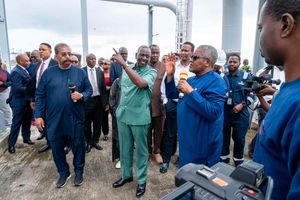
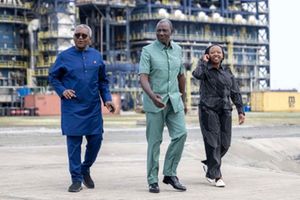
President William Ruto and Dangote Group President and CEO Aliko Dangote during a tour of the Dangote Refinery in Lekki, Lagos State, Nigeria on September 25, 2026.
Photo credit: PCS
“Even back then, when I went to the current President, he was then the Deputy President, he personally put me in his car and told me, ‘Let us go to the President. Tell him what happened,’” said Dangote.
He declined to disclose what followed, saying doing so could “spoil people’s names”.
Dangote's account provides a rare insight into his earlier attempts to invest in Kenya and the obstacles he says he encountered, years before his relationship with Dr Ruto evolved into one of the key factors behind his latest investment decision.
The Nigerian tycoon, whose Dangote Industries conglomerate includes Dangote Cement and the continent's largest oil refinery, had been linked to plans to establish a cement plant in Kenya since 2014.
The investment was eventually put on hold in 2017 amid reports that senior officials in the Jubilee administration had demanded kickbacks to facilitate a mining licence for limestone, a key raw material for cement production.
Dangote said he could not understand why he should pay a bribe to enter a market where his investment would create jobs and generate economic activity.
“The corruption takes two people to activate it….. the person asking and the giver. So we don't give because we believe we are bringing jobs and prosperity to the country. And why should I give a bribe?” he asked, noting that as a listed company, Dangote Industries could face serious consequences if it were found to be involved in bribery.
“And I don't want to go to jail,” he said.
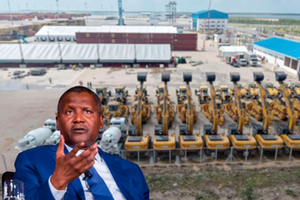
Equipment on site at the Lamu Port on September 28, 2026 ahead of the Dangote East Africa Refinery groundbreaking ceremony set for September 30.
Photo credit: NMG
After the cement project stalled, Dangote eventually returned to Kenya with a much bigger proposition of a refinery with a planned capacity of about 700,000 barrels of crude oil a day.
The project is expected to directly employ about 60,000 people, according to Dangote and could become one of the largest private investments ever undertaken in Kenya and the biggest refinery project in East Africa.
Its planned capacity is comparable to that of the Dangote refinery in Lagos, which has a capacity of about 650,000 barrels of crude oil a day. Mr Dangote said the new refinery would serve markets across eastern and northern Africa, including Egypt, underscoring its ambition to become a regional export hub rather than solely supplying Kenya.
Besides oil from the region’s nascent oilfields in Kenya’s Turkana and Hoima in Uganda, Mr Dangote expects to source most of the crude oil to be refined from as far away as the Middle East.
Dangote revealed that he had initially considered Tanzania's port of Tanga for the refinery because of the proposed crude oil pipeline from the oilfields in Hoima.
He says it was only after discussions with President Ruto and Kenyan officials that he abandoned the Tanga option and turned his attention to Lamu.
“But as you know, the refinery does not have to be where oil is,” Dangote said, citing Singapore as an example of a major refining centre in a country that produces relatively little crude oil.
He also cited India and Nigeria as countries where refining capacity does not necessarily correspond to domestic oil production.
According to Dangote, the decisive factors in Lamu were its strategic location, access to water and depth of the Lamu port. He the port would be capable of handling very large vessels carrying close to two million barrels of crude oil, giving the refinery access to supplies from beyond East Africa.
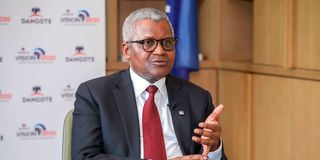
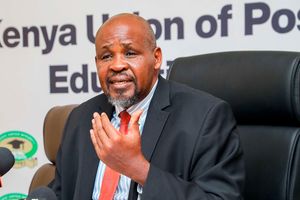
The founder and President of the Dangote Group, Aliko Dangote, during an interview at JW Marriott Hotel Nairobi on Tuesday, September 29, 2026.
Photo credit: Dennis Onsongo | Nation
Dangote said the refinery would not depend solely on crude from Kenya or the wider East African region but would source the commodity from the Middle East and other international markets while serving a regional market stretching across eastern and northern Africa, including Egypt.
“I didn't even know that name (Lamu). By January this year, I had never heard of this name Lamu. I only knew of Lamu when my people came back and said, ‘but there is a place called Lamu,’” he said.
His decision to choose Lamu comes against the backdrop of a long running contest between Kenya and Tanzania over their ports and transport corridors, with both countries seeking to position themselves as the gateway to landlocked markets in Uganda, Rwanda and beyond.
The rivalry was particularly intense over Uganda's crude oil exports. Kenya had hoped to host a pipeline linking Uganda's oilfields in Hoima to Lamu, with the proposed route passing through the Lokichar Basin in north-western Kenya.
The two countries even invited bids for a consultant to oversee a feasibility study and initial design for a proposed 1,300-kilometre pipeline.
Uganda eventually abandoned the joint project with Kenya and signed an agreement with Tanzania to export its crude through Tanga Port, citing concerns including security, land acquisition, rising costs and Kenya's ability to deliver the project on schedule.
Tanga subsequently appeared poised to strengthen Tanzania's position as the region's preferred energy hub.
President Ruto at one point announced that the region's refinery would be located in Tanga, a statement that caught his Tanzanian counterpart Samia Suluhu Hassan by surprise.
“While we were speaking inside, I pressed Ruto and asked him, ‘You went ahead and announced a refinery in Tanga, which I wasn’t aware of?’ He will explain himself why he made that announcement,” President Samia said at the time.
The investment, however, faces legal challenges.
A group of 133 Lamu residents has gone to court over land earmarked for the project, arguing that they have longstanding interests in the property and should be recognised and compensated before construction proceeds.
Dangote yesterday played down the dispute saying compensation for the land had already been undertaken, while arguing that the economic benefits of the project would extend far beyond the site itself.