British firm Shanta Gold Kenya Limited is lining up $208 million (Sh26.86 billion) for underground mining of gold in Kakamega, with the deposits of the precious metal currently valued at about $5.28 billion (Sh683.04 billion).
The disclosure is contained in an environmental impact assessment (EIA) report that the firm has submitted to the National Environment Management Authority (Nema), seeking clearance to develop an underground gold mine and processing centre in the Isulu-Bushiangala area of Kakamega County and mine the precious metal over an eight-year period.
Shanta Gold Kenya Limited is a subsidiary of Shanta Gold, a company incorporated in Guernsey in the British Isles. The company also operates in Tanzania.
The Isulu-Bushiangala project is part of Shanta’s seven prospecting licenses collectively termed as ‘West Kenya Project’ covering parts of western Kenya counties. In October, the firm disclosed that is has sought Nema clearance to undertake a $137 million (Sh17.7 billion) mining project in Siaya’s Ramula and East Gem and Mwibona in Vihiga.
The firm projects that the Isulu and Bushiangala sites in Kakamega’s Ikolomani constituency, will yield 1,270,380 ounces of “very high-grade” gold.
“Gold mineralisation at the Isulu and Bushiangala deposits is hosted by sheared pillowed to massive basalts, bounded between ultramafic volcanics and polymictic conglomerates on one side and carbonaceous mudstones and sandstones on the other side,” says the firm.
The Kakamega gold belt has a rich history dating back to the 1930s, when colonial-era miners established some of Kenya’s earliest commercial mines. The sub-county’s name, Ikolomani, is derived from the Luhya word for “gold mine,” a linguistic reflection of its storied past.
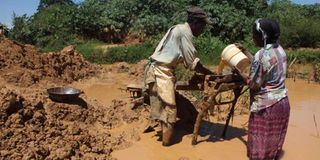
Artisanal miners prospect for gold in Rosterman in Kakamega County.
Photo credit: Tom Otieno | Nation Media Group
An ounce of gold is currently averaging $4,111.39 (Sh530,985), valuing the deposits in Kakamega at Sh683.04 billion or 2.3 times the combined value of the county. Nationally, the gold is valued at 4.1 per cent of the country’s 16.224 trillion Gross Domestic Product.
Shanta projects that it will be paying Kenyan government royalties of between $4.3 million (Sh555.34 million) and $4.7 million (Sh607 million) annually as well as $1.5 million (Sh193.7 million) per annum for the Mineral Development Levy.
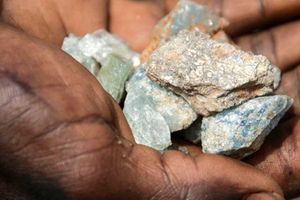
Rosterman residents in Kakamega prospect for gold. The Lirhanda corridor gold is said to be of very high value.
Photo credit: File | Nation Media Group
The host county, Kakamega, will receive 20 per cent of the gold royalty paid to national government, while the community will receive 10 per cent. This amounts to up to Sh11.06 million and Sh5.53 million, respectively every year of mining.
The firm has disclosed that it will also be required to enter into formal agreement with local communities affected by the project and share an additional one per cent of the value of gold produced. This will amount to Sh6.83 billion over the seven-year period, based on current gold prices.
“The project is aimed at obtaining the required authorisation to mine the Isulu-Bushiangala gold resources for economic purposes. This may lead to the enhancement of local economic development through job and business opportunities and significant contributions to the government of Kenya through taxes, royalties and revenue contributions, which are likely to transfer into the local and regional economic growth,” says the firm.
The Shanta project represents a potential turning point for Kenya’s mining sector, which has historically been underdeveloped despite rich mineral potential.
The Mining ministry recently lowered the royalty charges for gold miners, hoping to attract bigger investments into the nascent industry. Revised regulations by the ministry show that miners now pay a three per cent royalty on gross value of extracted gold, down from five per cent previously.
Gold mining has over the years largely featured artisanal and small-scale operations in a mainly informal process that involves risks such as the use of mercury, perilous working conditions, and child labour. This has limited the earnings by miners and the government.
Kenya’s earnings from gold mining have dipped for two consecutive years, hitting Sh3.02 billion in 2024 from Sh3.18 billion in the previous year and the recent peak of Sh3.38 billion in 2023, according to the Economic Survey 2024.
The data shows that 358.8 kilogrammes of gold were realised in 2024, down from 410 in the previous year and 563.6 kilogrammes in 2022.
Acquire 337 acres of land
The Shanta projects could significantly lift Kenya’s earnings from the mining sector and position gold as a key revenue generator for the economy.
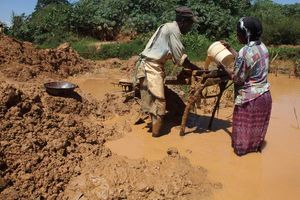
Artisanal miners prospect for gold in Rosterman in Kakamega County.
Photo credit: Tom Otieno | Nation Media Group
The firm projects that it will acquire approximately 337 acres of land, mostly private freehold plots, which will require the relocation of about 800 households. The firm has identified six potential resettlement sites covering up to 1,932 acres, allowing displaced families to either receive cash compensation or resettle within the local area.
Shanta’s Sh26.86 billion investment covers mine construction, plant installation, power systems and surface infrastructure. Once operational, the underground mine will process 600 tonnes of ore per day.
Sustaining capital is projected at between $47 million (Sh6.07 billion) and $55 million (Sh7.1 billion), with an average annual operating expenditure of $19 million (Sh2.45 billion).
The feasibility study outlines detailed plans for waste management, water recycling and post-closure rehabilitation, backed by an estimated $4.5 million (Sh581.3 million) closure budget.
Women prospect for gold in Kimingini village in Ikolomani, Kakamega County.
Photo credit: Isaac Wale | Nation Media Group
The Isulu-Bushiangala mine is part of Shanta Gold’s broader West Kenya Project, which spans the Busia-Kakamega Greenstone Belt—an area long known for artisanal gold deposits. The firm is simultaneously advancing exploration in Ramula (Siaya County) and other satellite prospects within the Liranda Corridor, pointing to more gold.
The projects look set to position Western Kenya as a new frontier for gold mining, promising investment, jobs and infrastructure into a region historically reliant on small-scale extraction.