Hello

Your subscription is almost coming to an end. Don’t miss out on the great content on Nation.Africa

Ready to continue your informative journey with us?

Hello

Your premium access has ended, but the best of Nation.Africa is still within reach. Renew now to unlock exclusive stories and in-depth features.

Reclaim your full access. Click below to renew.

Poultry house
Caption for the landscape image:

How group’s innovations are transforming chicken farming

Scroll down to read the article

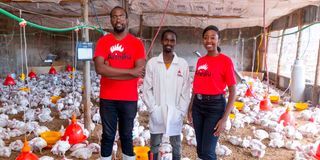
George Chege (left), Peter Lokine, and Eddah Wanjiru in a poultry house that uses Arinifu’s smart technology.

Photo credit: Pool

Demand for poultry meat and eggs is increasing both locally and globally, resulting in steady expansion of the chicken farming industry.

As more people opt for chicken as their preferred source of animal protein, the industry is providing a reliable income for many households.
While most poultry enterprises remain small-scale, the industry is gradually shifting towards commercial production to meet rising demand.

As this transformation gains momentum, technology is becoming an important tool for increasing productivity, promoting sustainability and improving animal welfare. It is now widely regarded as the fifth factor of production in modern agriculture.

George Chege and Eddah Wanjiru, the co-founders of Arinifu — a social enterprise that is transforming chicken farming by providing automated, sustainable and affordable solutions — are at the forefront of this technological revolution.

When asked what inspired them to start Arinifu, Chege explains: “Our products are designed to address the key challenges facing farmers, especially smallholders. We provide them with tools and technology to help them manage their flocks efficiently while ensuring the birds' comfort and welfare.”

The agricultural industry, particularly the poultry sector, is undergoing a significant shift driven by technological advancements.

As the world faces the dual challenges of feeding a growing population and managing diminishing resources, adopting cutting-edge technologies in poultry farming has become crucial.

One of their most notable inventions is Kuku Smart, an integrated farm management system that is transforming the way poultry farmers run their businesses.

The digital platform offers a user-friendly mobile app that allows farmers to oversee their farms remotely, monitor multiple chicken houses, and track key operational indicators.

The app enables farmers to manage daily activities such as feeding, vaccination and health monitoring, while also keeping accurate financial records.

The app provides real-time data and recommendations to help farmers identify areas for improvement, streamline operations and boost productivity.

Kuku Smart also sends timely notifications and alerts to ensure that farmers stay on top of key tasks such as feeding, watering, cleaning, supplement administration, and vaccination schedules.

The system provides a comprehensive overview of a farmer’s operations, enabling them to make data-driven decisions that directly impact the health of their flock and the success of their business.

Poultry house

George Chege (left), Peter Lokine, and Eddah Wanjiru in a poultry house that uses Arinifu’s smart technology.

Photo credit: Pool

Another of Arinifu's key products is the Smart Brooder, a patented system that acts as a digital 'mother hen' to ensure optimal conditions for chicks during their crucial early growth stages.

“It is equipped with a range of sensors that monitor environmental factors such as temperature, humidity, air quality and water levels within the brooding space,” says Chege.

This data is processed through sophisticated algorithms and machine learning models, which automatically adjust the heating, cooling and ventilation systems to create the ideal environment for chick growth.

Whether it’s turning on electric or LPG infrared heaters or activating fans to regulate temperature, the Smart Brooder ensures that chicks are kept in the most comfortable conditions possible.

It automatically adjusts the environment each day as, since chicks grow feathers, their heat requirements gradually decrease.

The Smart Brooder sends alerts remotely via the Kuku Smart app or text message, enabling farmers to monitor and adjust conditions in real time, even when they are not on the farm.

"This remote monitoring feature is particularly valuable for farmers in rural or remote areas, where frequent farm visits can be logistically challenging," he says.

He adds that the ability to control the brooder remotely gives farmers peace of mind, as they know their chicks are receiving the best possible care, even when they are not on site.

Advantage of the Smart Brooder

This feature plays a crucial role in improving productivity while reducing costs.

The system creates ideal conditions for chick growth by regulating temperature, humidity and ventilation, regardless of the weather outside.

According to Chege, farmers using the Smart Brooder have recorded mortality rates as low as three per cent, which is a significant improvement on traditional methods and leads to higher productivity and profitability.

Energy efficiency is another key advantage of the Smart Brooder. Rising energy costs often make it difficult for farmers to balance maintaining optimal conditions for their birds with the financial burden of heating and cooling their farms.

The Smart Brooder addresses this issue by using intelligent controls to minimise energy consumption, saving farmers up to 15 per cent on their heating and cooling costs.

This energy-saving feature is particularly important for smallholder farmers, who typically have limited resources and need to maximise the value of every shilling or dollar spent.

In addition to controlling temperature and humidity, the Smart Brooder also monitors water, which is a crucial component of chick rearing. For every gram of feed a chicken consumes, it requires approximately two millilitres of water.

“The system monitors the water levels in storage tanks and ensures that the birds always have access to clean, fresh water,” he says.

Poultry house

Peter Lokine in a poultry house that uses Arinifu’s smart technology.

Photo credit: Pool

He adds that by tracking water usage and ensuring efficient delivery to the drinkers, the system reduces wastage and guarantees that farmers provide their chickens with the necessary hydration for healthy growth.

This feature is new and has not yet been rolled out; it is currently only available in the premium model.

Arinifu's products are designed to be scalable, making them suitable for a wide range of poultry operations. The Smart Brooder Moja is an entry-level version, designed for smaller farms with a maximum capacity of 300 chicks.

With fewer sensors and the ability to power one supplemental heat source of up to 500 watts, this model is an affordable option for farmers who are just starting out or operating on a smaller scale.

Priced from Sh11,000, the Smart Brooder Moja is accessible to a larger group of farmers who might otherwise struggle to invest in high-tech farming solutions.

For larger-scale farmers, Arinifu offers the Smart Brooder 1000, which can accommodate up to 1,000 chicks.

This model includes additional sensors for monitoring temperature, humidity and air quality, and can power supplemental heat sources of up to 2,000 watts.

Priced from Sh14,000, it offers an affordable solution for medium-scale poultry operations.

For even larger operations, Arinifu offers the Smart Brooder GAS, which can support up to 2,000 chicks and includes features such as air quality sensors and water level monitoring.

This model is designed to meet the needs of commercial poultry farmers, helping them to manage larger flocks efficiently and sustainably.

“Our products are designed to improve productivity and are environmentally friendly, too. We offer solar-powered options for farmers in off-grid areas, enabling them to benefit from the technology without relying on grid electricity,” he explains.

This, he says, is particularly important for farmers in remote areas who may not have reliable access to electricity. By providing eco-friendly, solar-powered solutions, Arinifu is helping farmers to reduce their carbon footprint and lower their energy costs.

Despite the clear benefits, the path to the widespread adoption of these technologies remains challenging.

"The initial cost of integrating advanced systems can be prohibitive for smaller operations, and there is often a learning curve associated with new technologies," he explains.

However, the opportunities that these innovations present are immense. Chege notes that by improving productivity, enhancing animal welfare and reducing environmental impact, technology is paving the way for a more sustainable and profitable poultry industry.