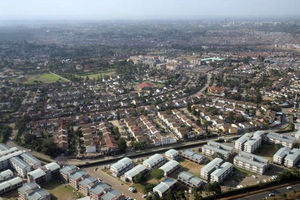
All it took for Samuel Mbugua to lose a lot of money and get stuck in an endless loop of promises was one phone call to SIC Investment Cooperative.
After doing due diligence and identifying one of the land parcels for sale in 2022, Simon knew it would become his home.
His first act was to take his father to the plot in Ruiru, Kiambu County and, crucially, secure his blessings.
Samuel Mbugua, who lost money in SIC Investment Co-operative.
Photo credit: Peter Mburu|Nation Media Group
The Sh3.6 million plot under the Kiambu Marina project by the SIC had convinced Simon that this was where he wanted to build a home for his family and there was no going back.
Fast forward to January 2025 and he had already lost the parcel, having paid an initial Sh1.5 million, after the SIC woke up one day and repossessed it on account of the unpaid balance.
“I was quite mad. I felt it was very unfair because this is a piece of land that I had really looked forward to building. I had taken my father, who has since passed on, and when I told him ‘dad, this is where I want to build’ he prayed over that piece of land. So, you can imagine how emotional it was to me to lose that space,” Simon recalls.
The repossession, which followed a 15-day ultimatum by the SIC to its client of more than two years, would then set off a treacherous journey to pursue the co-operative for a refund of his money.
As we concluded an interview with the SIC's acting CEO, Jared Odhiambo, on Thursday last week, Simon was right at the door. He had come to demand a refund of Sh900,000 the Cooperative promised to clear by February, but has since reneged on the promise.
Simon’s case exposes deep-rooted troubles now facing the Investment Company, exposing about 5,000 members and hundreds of customers to losses to the tune of Sh2 billion.
This follows years of mismanagement of hundreds of millions collected from members and customers, as rogue board members approved the purchase of non-existent parcels and badlands that are just dead assets.
The SIC’s core activities revolve around buying huge chunks of land for resale to make a profit for members and the construction of houses for sale.
View of rocky land purchased by SIC Investment in Mua Hills, Machakos; it's considered unsellable
The cooperative is now left holding land valued at about Sh1.6 billion that cannot be traced since it exists only in its books, other parcels trapped deep in the wild in a mass of rocks and steep gradients, and parcels with a history of family wrangles, all of which can’t find buyers.
A special audit ordered by its 5,000 members last year exposed board members, particularly for approving the purchase of what is now turning out to be dead assets and bypassing technical advice to inflate prices when purchasing land.
The audit established that while the SIC’s land stocks as of the end of 2024 were reported to be Sh2.64 billion, about two-thirds of the assets were either questionable or unsellable.
“A detailed review revealed that land worth Sh1,391,834,840 (representing 53 per cent of the total stock value) was questionable on various accounts. Additionally, land valued at Sh245 million consisted of land parcels that, despite being available, faced challenges that rendered them unsellable,” the audit said.
Nearly half of the questionable land was just air after some officials were revealed to have passed off costs incurred in previous years as new land, adding about Sh627 million to the value of land owned by SIC without any new purchase.
Parcel of land in Mua Hills, Machakos County, which is filled with rocks, taken on April 8, 2026. The SIC has struggled to find buyers for this land due to its inaccessibility and uninhabitable state.
Photo credit: Peter Mburu| Nation Media Group
Auditors last year fingered an external auditor hired in 2024 for inserting the amounts into the Co-operative’s land stocks to create the impression that the land assets were high, when in reality it was transferring costs purported to be from previous years, but which could not be traced to any project.
This raises questions over the legitimacy of profits the cooperative declared in previous years, since its management has now been exposed to have been hiding costs that, if reported, would wipe out the profits.
For the first time in about five years, the company is expected to report losses for the 2025 operations, and an annual general meeting (AGM) scheduled for last month had to be postponed.
Parcel of land in Mua Hills, Machakos County, which is filled with rocks, taken on April 8, 2026. The SIC has struggled to find buyers for this land due to its inaccessibility and uninhabitable state.
Photo credit: Peter Mburu| Nation Media Group
It is now clear that the more than Sh600 million profits reported between 2021 and 2024 were the result of cooking books to hide costs and deceive members that all was well, when in reality, board members and senior officials defrauded them, using their cash to buy dead assets and at inflated prices.
“The total value of stocks of land held for resale, therefore, is deceptive,” auditors said.
The SIC has been deceiving members that it is making profits, but it now appears to have hit the end of the road, with at least two local banks on its neck over Sh700 million loans.
At the SIC, there is a department known as the historical problematic land (HPL). Its main role is dealing with customer and members’ complaints over lands valued at Sh467 million, which relate to parcels where the society was either defrauded into buying air or bought parcels with significant challenges and now can’t find buyers.
These include some Sh245 million land that has “large deposits of rock masses, steep gradients and which face serious accessibility issues” that render them unsellable.
Such land parcels have littered the society’s land assets and have been purchased across the country, from Kisumu, Kajiado and Machakos counties.
We visited one such parcel, the Kito Ridge Mua land project in Machakos County, last Wednesday.
“If you are interested in buying land around this area, I would not advise you to take this, but I’m sure you will see for yourself and make a decision. Since they subdivided it several years ago, we’ve only seen one buyer,” a local woman leading us to its location advised.
The parcel located about 6km from the Makutano-Kitui road is littered with rocks across almost the entire parcel and some buyers would end up getting their entire plots filled with the rocks.
View of rocky land purchased by SIC Investment in Mua Hills, Machakos; it's considered unsellable
The SIC markets the land as “strategically located in a serene area with breathtaking aerial views of the Mua and Lukenya hills” and sells an eighth of an acre for Sh385,000.
Parcel of land in Mua Hills, Machakos County, which is filled with rocks, taken on April 8, 2026. The SIC has struggled to find buyers for this land due to its inaccessibility and uninhabitable state.
Photo credit: Peter Mburu| Nation Media Group
A buyer who had erected a goat pen at one of the plots, though, appears to have given up and relocated, leaving his property unattended.
The society’s board and management have been making attempts to sell the HPL parcels with little success and some of the buyers who had already started making payments “withdrew upon realizing the unsuitability of these land projects”.
“Society’s capital is tied up in non-performing or hard-to-sell land. This reduces the Society’s liquidity and ability to invest in viable, income-generating opportunities,” the audit stated.
Approving land purchase on WhatsApp
The stock of unsellable land is only part of the problem facing SIC Investment Co-operative, as board members and senior officials are also accused of defrauding members by inflating land purchase prices against professional advice.
A case in point is a 36-acre parcel in Katani, Machakos County, acquired in April 2024. The deal allegedly led to an overpayment of Sh83 million. A valuation report had advised the society to spend Sh374 million on three parcels under the Katani Kijani 2 project, but the board and management overruled the recommendation and paid Sh457 million instead.
This translated to Sh12.7 million per acre, including parcels that should have cost as little as Sh9.67 million. An official had warned that the society would not make a profit if it exceeded Sh10 million per acre, but the advice was ignored.
The price inflation was compounded by irregular approvals, with some land purchases reportedly sanctioned via WhatsApp instead of formal meetings with proper documentation.
The overpriced acquisition backfired when the society attempted to sell plots at Sh3.2 million, only to face market rejection, forcing a price reduction to Sh2.9 million.
Members have borne the brunt of the missteps, as the society borrowed Sh300 million from Co-operative Bank to bridge the funding gap and is now under pressure to repay the loan with interest.
In Eldoret, the society proceeded with another questionable deal despite warnings from then CEO Sarah Wahogo that the Sh4.75 million per acre price for a 30-acre parcel was too high. The society still paid a Sh21 million deposit.
Potential buyers have since stayed away, citing the area’s history of the 2007 post-election violence and longstanding family disputes.
A contractor on the run and a stalled housing project
At the Miran Housing Project in Ruaka, Kiambu County, one of SIC’s flagship developments, the society has failed to deliver 200 housing units that buyers expected to occupy two years ago.
Launched in 2022 and initially slated for completion by mid-2024, the project has been plagued by a series of missteps by the board and management, turning it into a loss-making venture reliant on bank financing.
The project’s budget has ballooned from Sh588 million to Sh785 million after the initial contractor failed to supply essential construction materials.
This has resulted in a projected loss of Sh164 million, a sharp reversal from an initial expected profit of Sh135 million.
“By the time we brought in a new contractor, costs had escalated beyond initial projections. The project has now shifted from profit-making to loss-making,” he said.
SIC's acting CEO, Jared Odhiambo.
Photo credit: Peter Mburu| Nation Media Group
A procurement audit further revealed gaps, with key documentation used to award the contract missing.
SIC has since borrowed an additional Sh450 million from another bank to keep the project afloat, further escalating costs.
Auditors flagged weaknesses in procurement, noting that the onboarding of Mc Builders Ltd, which failed to meet expectations, pointed to systemic flaws in the process.
The issues have exposed significant lapses in land acquisition and procurement practices, raising questions about how a co-operative trusted by more than 5,000 members ended up investing heavily in what are increasingly seen as white elephant projects.
Who bears responsibility?
Mr Odhiambo, who took over as acting CEO after the previous officeholder was removed last year, has blamed former board members for acting against the interests of members.
However, he previously served as the co-operative’s internal auditor since 2020, a role responsible for assessing risk, internal controls and governance processes.
The society is also accused of under-reporting costs over several years to create the impression of profitability—an issue that only emerged after members demanded a special audit last year.
Dorothy Chepkoech, a former board member of the Institute of Internal Auditors, said internal auditors are expected to serve as an independent and objective “third line of defence,” providing assurance on governance, risk management and controls.
She warned that internal audit functions should not merely review failures after the fact, but act as strategic advisors who continuously monitor operations to safeguard investor value.
“Management may proceed with land purchases, and auditors later assess whether controls worked. But if management and the board ignore advice, investors remain exposed,” she said.
Mr Odhiambo acknowledged that while management provides technical advice and due diligence reports, the board is responsible for negotiating land prices—and may sometimes lack “goodwill, caution and keenness.”
“Even with the best policies in place, without goodwill and caution, systems can still be bypassed,” he said.
SIC was founded as Safaricom Investment Co-operative in 2009 and rebranded in 2024, by which time many of the challenges had already taken root.
Members have also suffered losses in a fixed deposit product known as Pepea, where about Sh450 million has been sunk. Of this, Sh150 million has matured but remains unpaid due to liquidity constraints.
The funds were used to finance land purchases that have since stalled, as well as the troubled Miran Housing Project.
Some investors had committed retirement savings or funds intended for medical needs, expecting steady returns.
A similar fate has befallen investors in the Interest Earning Deposit product, with over Sh100 million still outstanding.
Despite the mounting challenges, SIC’s leadership maintains that a turnaround is underway. A new board appointed last year is banking on a recovery strategy aimed at stabilising the co-operative.
Among the measures is a shift to an agency model, where SIC will act as a broker between land sellers and buyers for a commission, instead of directly investing in land.
“I wouldn’t say we are in a hole, but we are in a ditch. Our goal is to climb out within a year,” Mr Odhiambo said.
Ms Chepkoech has urged stricter government oversight, calling on regulators to enforce compliance and protect investors.
“There is a governance framework in sectors like banking. The Ministry of Co-operatives must ensure that institutions handling public funds adhere to proper processes,” she said.