The Treasury says the government will retain about 35 percent shareholding Kenya Pipeline Company (KPC) if the proposed privatisation of the State-owned enterprise is sold through an Initial Public Offering (IPO).
Treasury Cabinet Secretary John Mbadi told a joint committee of the National Assembly that is scrutinising a Sessional Paper on the proposed sale of shares of KPC that the government will offload a maximum of 65 percent of its shareholding in the company.
The CS said the Treasury is engaging a transaction advisor but mulls retaining a 35 percent stake in KPC, as is the case with Safaricom Limited.
“We are engaging transaction advisors. The government is to retain 35 percent in line with what we did in Safaricom,” Mr Mbadi said. “We want ownership of KPC to be as wide as possible. Want as many Kenyans as possible to have a stake in KPC.”
Mr Mbadi told the Public Debt and Privatisation Committee and the Committee on Energy that the Treasury is also discussing with Uganda to have some stake in the KPC so that they expand pipeline business environs beyond Kenya
Cabinet Secretary for the National Treasury and Economic Planning John Mbadi .
Photo credit: Dennis Onsongo | Nation Media Group
“Uganda has expressed interest in having some ownership. All the details on shareholder reservations will come out after the transaction advisors give us a report,” he said.
Mr Mbadi said the KPC is valued at Sh120 billion, and the sale of shares will raise Sh100 billion for infrastructure budgetary support.
He said if Kenyans have the opportunity to own shares in the profitable company, they will be creating wealth.
Mr Mbadi warned that the failure of the transaction to privatise KPC through an Initial Public Offering (IPO) will undermine the efforts to stabilise the economy.
He told a joint committee of the National Assembly that is scrutinising a Sessional Paper on the proposed sale of KPC shares that the government is taking an all-government arms approach to deliver the transaction in accordance with the law.
“If the House fails to approve the sale of KPC shares, we will have a budget hole of Sh100 billion. We will go back and cut the budget. That is the only route we will take,” Mr Mbadi said.”
“If we don’t get that money, then we will have to tax Kenyans more, which I don’t think is an option, borrow more, which I think is not desirable, or cut development projects, which are somewhere in Kenya.”
Mr Mbadi said the legal risks include litigations blocking the transaction, hence delaying or stopping the transaction.
“Given the immense benefits that accrue from this market-based transaction, the National Treasury is undertaking this transaction in the utmost strict fidelity to the applicable law and the constitution of Kenya,” Mr Mbadi said.
“You will realise that this transaction has also been highly publicised by the executive to ensure we adhere to the principles of transparency. The key contingent liability is that failure to effect or optimally execute the transaction shall impede the delivery of the 2025/26 budget, hence putting at risk delivery of key social and infrastructure objectives.”
Mr Mbadi said the failure of the transaction will also undermine the efforts to stabilise the economy.
“On this the Government is taking an all-government arms approach to deliver this transaction in accordance with the law,” Mr Mbadi said.
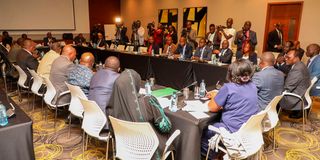
Director General of Public Investments and Portfolio Management, Lawrence Kibet, appears before the joint National Assembly Committee on Energy and the Committee on Public Debt and Privatization at Hilton Garden Inn, Machakos County, on Monday, August 11, 2025, to discuss the proposed sale of the Kenya Pipeline Company Limited (KPC).
Photo credit: Dennis Onsongo |Nation
Mr Mbadi faced tough questions on the KPC privatisation options with MPs demanding to know what stake the government will retain in the firm.
Baringo North MP Joseph Makilap said the KPC has unresolved compensation claims for the Thange Oil spill in Makueni amounting to Sh3 billion, and pending legal claims of Sh5 billion.
“Don’t you see there is a risk in investing in the company when there are pending litigation claims?” Mr Makilap asked.
“How do you appoint transaction advisors? Those who handled Telkom Kenya privatisation claimed more than Sh500 million. How do you protect public money?”
Chepalungu MP Victor Koech demanded to know what would happen if Parliament rejects the proposed sale of KPC.
MPs also demanded to know the ratios for other strategic investors and the public who will be targeted to buy shares in the IPO.
“Why are we selling a company that is the golden goose? KPC gives the government Sh6 billion annually. Are we selling the company at a throw-away price to create oligarchs?” said Mohamed Daudi, the MP for Wajir East.
Mr Mbadi said the advantage of an IPO is that all investors have an equal chance as the shares will be issued based on a prospectus, which shall be public and there is no chance of preferential treatment of investors within a pool.
“We now have a very developed Capital Markets that provides the necessary safeguards and ensures investors are not all treated equally but that due consideration is provided, especially to minority shareholders,” he said.
“The heightened transparency and governance requirements provided by our capital markets regulations will provide the necessary safeguards for all investors.”
He assured KPC staff that they will not be affected by the sale of government shareholding in the company because the company is profitable and will remain a going concern.