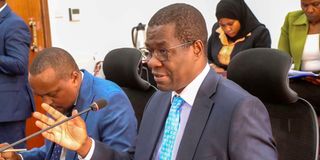
Three international oil companies that have been supplying Kenya with petroleum products under the Government-to-Government (G-to-G) arrangement are free to source products from outside the war-torn Middle East, Energy Cabinet Secretary Opiyo Wandayi has said.
Mr Wandayi told the Senate committee on Energy that nothing stops Saudi Aramco, Abu Dhabi National Oil Company and Emirates National Oil company from sourcing petroleum products outside the Gulf region and delivering them to Kenya as long as the fuel meets the Kenyan standards.
Kenya entered into a G-to-G arrangement with Saudi Aramco, Emirates National Oil Company and Abu Dhabi National Oil Company to supply fuel on credit.
Implemented in March 2023, the G-to-G importation framework was designed to ease pressure on foreign exchange reserves and stabilise fuel supply.
The agreement allows for the importation of petroleum, diesel, and jet fuel under a deferred payment plan of 180 days, coordinated centrally by the ministry.
“There is nothing in the agreement that we signed as a country and the three international oil companies (IOC) from sourcing oil products from any part of the world so long as it meets our standards,” Mr Wandayi told Senators.
“This agreement (G-to-G) has allowed them to obtain petroleum products from across the world and supply as part of meeting their contractual obligations under the G-to-G).”
Mr Wandayi was responding to a question by committee chairperson Oburu Oginga (nominated) who wanted to know whether the country is adequately stocked with petroleum products and Lignified Petroleum Products (LPG).
The Israel-US and Iran war which enters its second month has escalated with Israel air strikes targeting Iranian gas and oil facilities while Iran retaliates with attacks on gas plants in Qatar and other neighbouring US allied countries.
The war has seen Iran blockade the Strait of Hormuz, a critical waterway between the Persian Gulf and the Gulf of Oman that provides passage to 20 percent of the world's liquified natural gas (LNG) and 25 percent of seaborne oil trade annually.
“It is now common knowledge that the unrest in the Gulf region has interfered with free flow of goods and services especially the movement of petroleum products through the Strait of Hormuz which enables movement of 20 percent of world petroleum,” Mr Wandayi said.
“As we speak, there are a number of countries in Africa which have run out of petroleum products. There are those with endless queues in petrol stations but Kenya has not had any incident of stock out since the Middle East crisis began on February 28, 2028.”
Mr Wandayi said there have not been any queues or any waiting by motorists in petrol stations due to the availability of enough petroleum products in the country.
“In short, the G-to-G petroleum products supply framework has proved itself to be robust, watertight, and able to withstand any shock. We have enough stock of all petroleum products such as jet fuel, super petrol and diesel, as well as LPG that will last us many, many days that are coming,” Mr Wandayi said.
Mr Wandayi said the government is expecting more deliveries in the short-term continuing to the end of April.
He said the three international oil-majors and their nominated local oil marketing companies, have confirmed to the government of the lined-up deliveries.
“We are working with international oil companies (IOC) and their robust homegrown nominated local oil marketing companies (OMC)-Galana Energies, Oryx Energies and Gulf Energy-to ensure security and supply of petroleum products given the war in the Middle East,” Mr Wandayi said.
“The IOC and local OMC’s have helped us to have an adequate supply of petroleum products. We have enough oil products otherwise the worst could have happened by now. There should be no cause for alarm”
Mr Wandayi, however, did not rule out the possibility of product shortage in the future noting that nobody knows how the war in Iran and the Middle East will end.
He said pricing of petroleum products will be dealt with by the Energy and Petroleum Regulatory Authority (Epra) “at an appropriate time.”
Separately, President William Ruto has moved to assure the country that the government has put in place mitigations to cushion Kenyans from a fuel shortage crisis, amid the ongoing war between Iran, the United States and Israel, which has raised concerns over supply and pricing of the commodity.
President Ruto says Kenyans will not be left exposed to sudden price shocks because there exists a functional Government -Government deal that has ensured steady supply of the commodity.
In a statement to newsrooms on Monday evening, President Ruto confirmed the significant impact of the ongoing conflict in the Middle East, on the global economy, but revealed that the government has put measures to cushion Kenyans from a fuel crisis.
The conflict in the Gulf region has triggered rising global oil prices, with potential implications for domestic fuel costs.
However, the government says, its existing government-to-government fuel procurement arrangement has helped shield Kenyan consumers from immediate price spikes while ensuring steady supply.