Earnings from the export of cut flowers declined by 32.9 percent in the last five years due to shrinking production volumes, rising logistical costs, and tightening regulations from the European Union (EU).
Newly released Agriculture and Food Authority (AFA) statistics show that cut flowers fetched Sh72.1 billion in 2024, a steep decline compared to Sh107.5 billion in 2020.
This decline was informed by a significant drop in export volumes, which fell to 102,500 tonnes in 2024, down from 146,000 tonnes exported in 2020.
"The export of flowers has been heavily dependent on rose exports, which have seen a shrinking market share over the years due to increased inspection rates at EU entry points. The inspection rate has risen from 10 percent to 25 percent, although roses still accounted for around 70.2 percent of the total value of flower exports in 2024," said AFA.
Cut flowers, primarily grown in Naivasha, remain Kenya’s largest horticultural export, outperforming fresh fruits and vegetables.
In 2024, flowers were Kenya’s leading horticultural export, generating Sh721 billion, accounting for 53 percent of the total horticultural export value. However, this marked a slight decline compared to 2023, when flowers accounted for 47 percent of the total, generating Sh73.5 billion.
The sector's struggles stem not only from production challenges and decreased acreage —down by 12 percent in 2024 to 2,474 hectares, compared to 2,825 hectares in 2023 —but also from tightening regulations in its key European market.
In 2017, the EU classified the false codling moth (FCM) as a regulated quarantine pest, raising concerns about its threat to crops and its potential entry into Europe via imports.
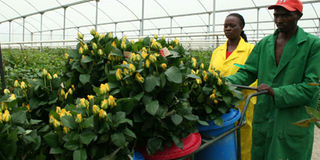
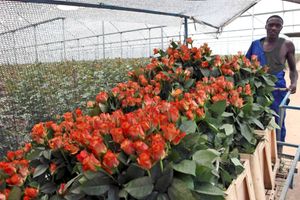
An employee grades cut flowers at the De Ruiter East Africa showhouse in Naivasha.
Since then, inspection levels for Kenyan rose shipments have steadily increased, rising from around five percent in 2020 to as high as 25 percent by May 2024.
In July 2024, the EU introduced Regulation (EU) 2024/2004, a new, stringent measure that requires tighter pest management protocols for fresh-cut rose exports.
For growers, compliance has meant heavy investment in insect-proof netting, additional labour, and farm-level training to meet phytosanitary standards. In 2024 alone, 95 consignments were rejected and 48 intercepted due to FCM, affecting 2.1 million stems valued at €1.1 million.
As a result, the volume of flower exports fell by 12 percent between 2023 and 2024, dropping from 116,273 tonnes to 102,500 tonnes, while the corresponding export value fell by Sh1.4 billion.
These challenges are compounded by global logistics disruptions, such as the Red Sea crisis, which has forced cargo to be rerouted via the Cape of Good Hope. This has driven up freight costs and intensified competition for limited cargo space.
However, the United Kingdom has granted a reprieve by suspending its eight percent duty on cut flower imports until June 2026, providing some relief to exporters.
The Netherlands is the largest buyer of Kenya’s flowers, with the UK and the US also being significant markets.
"One of the major contributing factors was the cargo crisis at Jomo Kenyatta International Airport (JKIA), which was exacerbated by the ongoing security situation in the Red Sea. This forced the diversion of shipping routes from the Suez Canal to the Cape of Good Hope. This disruption has led to increased global demand for airfreight cargo space, particularly for high-value perishables such as fruit. As a result, flower exporters faced increased air freight costs, which squeezed profit margins," stated the AFA.
Earlier in 2017, exports of cut flowers reached 160,000 tonnes, with a value of Sh82.2 billion. The sector experienced a slight expansion the following year, with export volumes rising to 161,200 tonnes and earnings jumping to Sh113.2 billion, reflecting the strength of Kenya’s premium flower prices in international markets.
By 2019, export volumes had climbed further still, reaching 173,700 tonnes, though the value eased slightly to Sh104.1 billion.
The onset of the 2020 Covid-19 pandemic led to a sharp decline in export volumes, which fell to 146,000 tonnes. However, the value surprisingly rose to Sh107.5 billion, buoyed by higher global demand for premium flowers and improved unit prices.
Peak performance was reached in 2021, with exports surging to 210,100 tonnes, valued at Sh110.8 billion—the highest levels in the seven-year review period.
This growth was reversed in 2022, when volumes decreased slightly to 202,900 tonnes and the value dropped to Sh104.3 billion. The industry then faced another downturn in 2023, with volumes crashing to 116,300 tonnes and export earnings tumbling to Sh73.5 billion primarily due to logistical bottlenecks and falling demand in European markets.