Following the death of his parents when he was very young, Philmatt Otieno moved in with his aunt, going on to develop a fascination for briquettes, a sustainable source of energy used frequently in the household.
While equally affordable sources of energy, such as charcoal and firewood produced a lot of smoke while burning, Otieno observed that briquettes could burn for extended periods of time without posing any threat to their health.
“We would light the briquettes at night to cook or warm the house, and come morning, we would use the same briquettes to warm bathing water or make tea,” said Otieno in an interview with Powering SMEs.
Even as he pursued other careers later after finishing school to make a living, Otieno harboured a desire to venture into briquette production, believing that this product could significantly benefit society.
“While working in Kisumu, it reached a point when I realised that I may never be able to save enough money to start the business, because the jobs I was doing did not pay very well and were inconsistent,” says Otieno.
In 2020, with Sh45, 000 in capital, he decided to take a leap of faith and start PGEL Green Energy Hub, a company that would use biomass waste to produce energy sources such as briquettes and pellets.
“I could not afford briquetting machines from China, so I approached an engineer friend of mine, whom I paid Sh15, 000 to fabricate a simple machine. It was not enough, but he believed in my vision,” states Otieno.
Briquettes on display at PGEL Green Energy Hub, Nairobi on August 7, 2025.
Photo credit: Lucy Wanjiru | Nation Media Group
The entrepreneur used the other Sh30, 000 to purchase raw materials, register the business and acquire other essential items. He then set out to start production and marketing as the sole employee at the time.
“I started the business during the Covid-19 period, which was a very difficult phase because even transporting the raw materials was a challenge. Police would often stop us, claiming we were contributing to the spread of the pandemic,” says Otieno.
Reaching customers was also a challenge, not only because of the movement restrictions that were imposed to contain the spread of the virus, but also because not many people knew about briquettes.
“At times, the briquettes would stay at the workshop for months without selling. Since I was only relying on word of mouth, I needed more capital to do proper marketing and training on the usage of briquettes.”
For the business to be sustainable, Otieno knew that he would also require more resources to purchase proper briquetting machines and acquire adequate space for producing more briquettes.
“I needed more capital to expand, but every time I approached a bank for a loan, the answer was no. Either they did not understand our business model or didn’t take the time to,” he explains.
Fortunately, at the time, the Kenya Climate Innovation Centre (KCIC) had just launched the Sustainable Waste Innovation for a Future in Transition (Swift) program, an initiative aimed at supporting SMEs in the waste management sector through funding and formalisation.
“Most of the machines that these companies would need to operate at scale were not locally available. For us, one good briquetting machine from China could cost between Sh7 and Sh8 million,” remarks Otieno.
PGEL Green Energy Hub founder Philmatt Otieno at his firm in Nairobi on August 7, 2025.
Photo credit: Lucy Wanjiru | Nation Media Group
Through the KCIC Swift program, PGEL Green Energy Hub managed to secure Sh5 million, which they used to purchase 11 machines that, though small, enabled them to increase briquette production as well as venture into production of pellets.
“Very few people in Kenya knew about pellets, but we felt there was an opportunity here because not only were they easier to make, they also burned faster than briquettes, almost like gas, and were more affordable.”
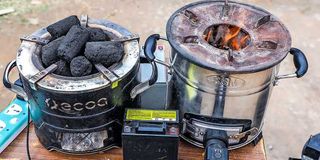
Through a partnership with a Chinese manufacturer, they also began developing a solar-powered gasifier stove that could enable consumers to cook using briquettes or pellets.
“The other reason pellets were not popular is that there were no companies selling pelletiser stoves. Once you put pellets inside our stove, you can light them using a fire gel, then power a fan that circulates oxygen for burning using solar or electricity,” explains Otieno.
At their workshop in Kitengela, the firm, whose workforce has grown to 11 staff, then converts whatever remains of the burnt-out pellets or biomass briquettes into organic fertiliser, which they package for sale.
“Access to individual customers is still a challenge for us, but fortunately, large institutions are now turning to briquettes. One of our clients consumes 14,000 tonnes a month. Combined, all the briquette producers in the country cannot satisfy their demand,” Otieno points out.
To lower the cost of the pellets, briquettes and the stoves further so as to attract individual customers, the firm plans to set up a large factory and import larger machines that will enable them to produce at scale.
“For this to happen, we need government support through policy interventions. Some of the policy changes that have been implemented recently, for example, zero rating of briquettes, are good; however, there is still a long way to go,” said Otieno.
As long as they have a product or service that could positively impact society, Otieno urges budding entrepreneurs not to be afraid to start small, since there is no limit to where a solid vision could take them.