Reviving Kenya's drylands with a mobile solar-powered irrigation system
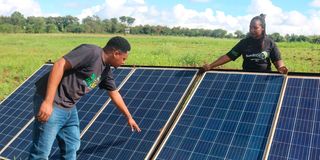
Sow Precise Africa CEO Linda Kamau and Co-founder Pius Wambua checking on their solar panel units on their farm in Mbeere South, Embu County.

What you need to know:
- Previously, most farmers depended entirely on diesel pumps, which were eating their profits.
Eight years after quitting her IT job, Linda Kamau stands in a sun-baked field watching solar panels power water pumps.
Her solar irrigation service company, Sow Precise Africa, has become a beacon of hope for farmers in arid regions, proving that climate-smart agriculture can thrive even in harsh conditions.
In 2016, Linda left a stable NGO career to farm in Mbeere South, an Arid and Semi-Arid Land (Asal) region where erratic rains and expensive diesel pumps made agriculture a gamble.
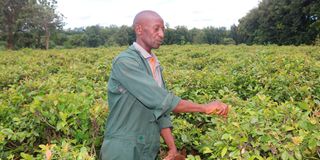
Simon Musyimi, a miraa farmer in Mbeere South, Embu County who is a beneficiary of the mobile solar irrigation services offered by Sow Precise Africa.
"I saw vast idle land and farmers struggling. We had to find a solution," says the 40-year-old CEO.
Mbeere South residents primarily depend on rainfed agriculture to grow food crops such as maize and beans as well as cash crops like muguka (a variety of khat).
Linda primarily grows beans and rotates them with maize.
Yet, even as she focuses on crop production, the state of the area troubles her.
“There’s so much idle land going to waste,” she says.
In Mbeere South, Embu County, many locals fail to utilise their resources fully due to the lack of access to water from old seasonal rivers that run through the region — a challenge worsened by climate shocks.
For those who treat farming as a business, most depend on conventional irrigation systems such as fuel-powered pumps or diesel and petrol generators. However, these systems are costly to purchase and maintain, not to mention the unpredictable and soaring price of fuel.
“Mbeere is arable and highly productive, yet farmers struggle to access affordable irrigation,” Linda laments.
The challenges facing Mbeere mirror those in other parts of Kenya. Over 80 per cent of the country’s land is classified as Asal, much of it at risk of desertification.
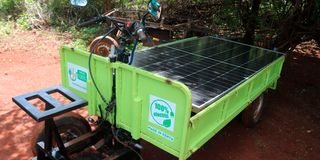
An electric-powered cart (mkokoteni) used by Sow Precise Africa to transport solar panels.
With just two per cent of Kenya’s arable land under irrigation, Linda sees an urgent need for innovative solutions and technologies to close this gap.
“Adopting modern irrigation technologies could help solve Kenya’s persistent food shortages and hunger crisis,” she says.
In 2022, after identifying this critical gap, the agritech entrepreneur developed an innovative solution: a mobile solar-powered irrigation system.
She partnered with Pius Wambua and Julia Kinuthia to co-found Sow Precise Africa, now a thriving agritech enterprise. Today, Linda serves as CEO, Wambua leads operations, and Julia manages finances; combining their expertise to revolutionise small-scale farming.
Yet turning their vision into reality wasn’t easy. “We faced major financial hurdles,” Linda admits. “But after pitching our concept to Allan & Gill Gray Philanthropies (AGGP), we secured a $10,000 grant to kickstart our mission.”
AGGP is a South African-based foundation focused on supporting entrepreneurial development and economic empowerment, particularly for young people in East Africa.
According to Wambua, the funding enabled them to start operations and set them on a path to success. “The biggest challenge startups face is proving that your service can be bought by customers and even attract investors,” he observes. “Coming up with an idea and proving the concept is no walk in the park.”
With the initial funding, they invested in essential equipment— solar panels, pumps, and operational needs like transport and communication systems.
Linda explains their grassroots approach: "We started by implementing the system on our own farm as a demonstration model. When neighbouring farmers saw we could produce consistent yields year-round, two of them immediately approached us for services."
Success story
That marked the beginning of their success story. Today, the company operates five mobile solar-powered irrigation systems called Sun Riders — a significant growth from their humble beginnings with just one prototype. They assemble the systems locally. The irrigation systems comprise solar panels, an inverter, a pump, and pipes for drawing water from nearby rivers.
They are transported using an electric-powered cart — popularly referred to as a mkokoteni, an investment they say allows them to support the transition to clean energy.
“By leveraging solar irrigation systems and an electric mkokoteni, we are keen on helping mitigate greenhouse gas emissions,” Julia observes.
So far, Sow Precise Africa has an outreach of over 50 farmers, both small-scale and large-holder producers.
“Our mission is to empower farmers to cultivate crops year-round; boosting harvests, incomes, and family stability," Linda states with conviction.
Their 20-acre demonstration farm, leased along the banks of River Thiba in Gachuriri village hums with agricultural innovation. Solar panels gleam under the sun, and farmers gather to observe the system in action.
Opportunity
During the interview amid the farm’s lively atmosphere, Linda elaborates: "We specifically target Asal regions, where solar irrigation can transform water scarcity into opportunity." This vision took root when she recognised both the crippling lack of water access in drylands and the untapped potential of solar solutions.
"We're bridging a critical gap," Linda explains, "by making irrigation accessible to small-scale farmers through solar power – an abundant, renewable resource that's already all around us."
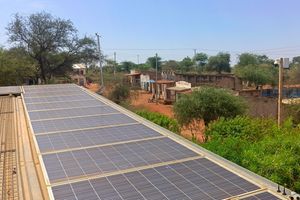
A visit to their demonstration farm reveals this vision in action. Morning sunlight — typically harsh and unrelenting in this arid region — is instead harnessed as an asset. Solar panels glint under the bright skies, powering the very systems that turn this challenging environment into productive farmland.
"This region averages over six hours of daily sunlight; a clean energy goldmine we're tapping to power farmers' success," Linda explains enthusiastically.
Their innovative service model makes solar irrigation accessible at just Sh1,500 per acre weekly, enabling farmers to maintain optimal crop hydration with one thorough irrigation session per week.
Testimonials
Stephen Mutua, one of the pioneering beneficiaries, grows muguka, maize, and beans on his land. "Muguka drives our local economy, but diesel pumps were eating my profits," he reveals. "I used to spend S 4,500 weekly just on 40 litres of diesel for my two-acre plot."
The financial burden was common among farmers. Janet Munguti, who cultivates beans and maize, confirms: "Fuel-based irrigation bleeds money. Solar gives us affordable, reliable watering without the cost shocks."
Sow Precise Africa currently serves farmers within a three-kilometre radius of their operations. Wambua outlines their process: "When a new farmer requests our services, we conduct an on-site assessment to evaluate their land and water access. If suitable, we add them to our irrigation schedule and assign a regular service day."
Their service includes pumps with flow rates of 50,000 litres , 25,000 litres, 19,000 litres and 10,000 litres per hour.
Sow Precise Africa’s innovative approach to restoring drylands through sustainable agriculture earned Heifer International’s endorsement last year. The team secured a Sh750,000 grant in the 2024 AYuTe Competition.
Heifer, a farmer-led NGO, has been leveraging innovation to support youth with scalable solutions by expanding the annual AYuTe drive.
Winners receive grants, capacity-building training, mentorship, and digital tools required to revolutionise food value chains.
“The funds will be used to increase our capacity so that we can serve more farmers by expanding our solar irrigation systems,” Linda explains, noting that the boost will enable them to double their outreach.
Despite the challenges she faced during the concept’s incubation — convincing target clients (farmers) and financiers, she insists that there is no ceiling when it comes to exploring the food value chain.
“What matters is how much value you are giving your customers and how much food you are growing to address food security and hunger.”
Proving that a product fits the market requires commitment, she notes, adding that she has learned that attracting customers and investors demands constant research to improve sustainability and profitability.
Besides serving as a demo farm, the company’s farm also employs 15 to 20 casual workers, proving that sustainability and profitability can go hand-in-hand.