Premium
How business capitalised on gap for local assembly of electronic appliances
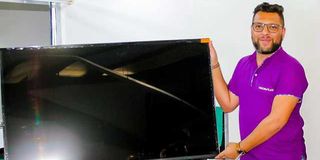
Vision Plus founder Umesh Bhojwani, displays some of the products the company assembles at their workshop in Tatu City special economic zone.

After completing his management and marketing degree in Australia more than 12 years ago, Umesh Bhojwani decided to return to the country to assist his father in running his electronics business.
While working here, Umesh discovered that most of the products sold in the market were owned by foreign multinationals, as few local companies were engaged in the production or assembly of electronics. That affected the pricing of products, as it was more expensive to import fully assembled television sets or audio devices, than it was to import different parts of an electronic device, then assemble them in Kenya.
“It would take the average Kenyan approximately six months to own a TV because of import duty, which was charged at 25 percent for fully built units,” said Bhojwani in an interview with Powering SMEs.


If, however, the different parts of a TV were to be imported separately and then assembled in Kenya, a TV that cost Sh28,000 would cost as little as Sh10,000, because import duty for unassembled parts is lower.
Sensing an opportunity here, in 2016, Umesh decided to start Kryptonite International, a company that would assemble different electronic devices locally and sell them under the trademark Vision Plus. Since he did not have the financial muscle to import the electronic parts in bulk, the entrepreneur contacted different suppliers in China, asking them if they could give him the products on credit.

Vision Plus founder Umesh Bhojwani, displays some of the products the company assembles at their workshop in Tatu City special economic zone.
“This was not easy because we did not even have a credit history to prove to the suppliers that we could pay them, having done no financial transactions through the business,” stated Bhojwani.
The entrepreneur fortunately managed to import the first consignment of parts in November 2016. He then started to design everything from packaging, to the specs and body of 24 to 40 inch television sets, at a small space which he had sublet from his father’s workshop. Satisfied with what he had assembled, Umesh proceeded to market the TVs in various outlets across Nairobi. This is where the real challenge began.
People just did not trust Kenyan brands and so, when Umesh told customers that what he was selling was assembled in Kenya, they believed that it was a substandard product. Initially, the market was right in this assumption because 40 percent of the first consignment of Vision Plus TV sets which Kryptonite International sold had a defect.
“That was a big issue for us because here I am trying to change the narrative that Kenyan brands are trustworthy and not substandard and yet in my first consignment, we get a 40 percent return rate,” stated Bhojwani.
To avoid losing clientele, the company would replace TVs for anyone who came with a complaint, regardless of what that was. At times, Umesh would pick distress calls from clients as late as 1am, to build trust.
Slowly, the market started to embrace their products, and this growth enabled them to venture into the assembly of audio devices such as sound bars and multimedia speakers in 2018.
“We had a very lean team and product mix up until 2020 when we added some more products and expanded our workforce,” said Bhojwani. When Covid-19 struck, resulting in lockdowns and movement restrictions, the company decided to transition from selling to retailers alone to selling directly to customers through ecommerce channels.
“2020 was our best year. The business picked up very quickly because people were spending more on indoor entertainment than on outdoor entertainment. We even ran out of stock due to the high demand,” stated Bhojwani.
In 2022, clients who were pleased with the Vision plus TV sets started asking whether the company also assembled other appliances like dispensers, washing machines, accessories and wearables.
“At that time this space did not have too much competition, so we decided to build on these categories with our partners from scratch. We launched these in 2023,” said Bhojwani.
Unlike the television and audio devices, these product lines did not perform very well. Umesh and his team had to go back to the drawing board and strategise on how to make their products more appealing.
“It was havoc in the office. We put in long hours to get things right. We also had to start the cycle of educating the market about our products all over again because by then, we were known as an entertainment brand,” he explained.
The company also faced a lot of road blocks in getting to the big supermarkets. It took them three years for their products to be listed by one of the large retailers in the market. Over the years, the company has expanded its network to 45 counties in Kenya, through various partners including supermarkets, general retailers and ecommerce dealers. Despite their growth, Umesh says that they still have to prove to the market that their products are good, because there is still that perception that Kenyan brands are not as superior as the imported ones.
“Nothing in tech can ever be 100 percent. One day there is always going to be an issue. It could be a power issue. In our country, power is not very stable, so the board can be struck with excessive voltage and it goes,” said Bhojwani.
“The same applies to longevity, sometimes if you are in the coastal region, the salt water and humidity affects products. What we try to do is to make sure our quality controls are in place to ensure longevity,” he added.
With technology evolving at a very rapid pace, the company stretches the life of products by sending clients frequent software updates, so they can experience the latest technology without having to purchase a new TV.