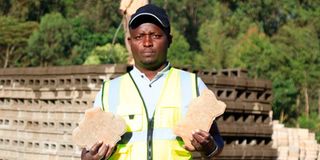
When Newton Wambugu resigned from his job as Health Chief Officer for Nyeri County to revive a business he had grounded four years ago, he was sure he was making the right decision.
There was a rising demand for affordable housing in the region, as well as a gap in provision of affordable construction materials, factors that motivated him to revive his business.
His company, Concrete Precast Works, which he started in 2018, aims to provide Kenyans with materials to put up decent houses at a reasonable cost. Wambugu notes that the rising demand for housing and commercial spaces has led to depletion of quarries, making construction using stones more expensive.
“I value-add by using quarry waste and other products such as quarry dust, chopping sand and cement to produce interlocking hollow blocks, which can save construction cost by up to 40 percent,” he says of what his company does, observing that low-cost housing technologies are offering alternatives to the conventional methods of building.
The interlocking hollow blocks come in different shapes and sizes depending on the customers’ preference.
Newton Wambugu during an interview at his company in Gatitu, Nyeri County.
Photo credit: Joseph Kanyi | Nation Media Group
“While using these products to build, you do not use cement or mortar, which means one can save on sand and cement costs while plastering since only a thin layer of plaster is required,” says Wambugu.
This building technology also saves on labour as one mason can place 500 blocks in a day compared to 100 or 150 laying of stones in a day. And unlike machine cut stones, the blocks gain strength over time and do not degenerate over time due to harsh climatic conditions such as rain or direct sunlight.
With a lot of interlocking companies coming up in every part of the county, Wambugu is concentrating on low-cost housing materials that offer affordable building solutions, a factor he reckons gives his products a cutting edge in the market.
In the next three years, his plan is to purchase land and put up houses that he will sell at affordable prices given there is a demand in housing among the middle class.
“The demand keeps on rising but there is a limited supply of good and affordable houses within the county and region at large. I am trying to seal the gap,” he explains.
Newton Wambugu displays paving blocks that his company produces. The business is based in Gatitu, Nyeri County.
Photo credit: Joseph Kanyi | Nation Media Group
The prices for the interlocking blocks range between Sh750 to Sh1, 200 per square metre. In the recent past, Nyeri County has experienced a surge in the number of businesses investing here, a factor that has led to a demand for low cost decent houses.
“The demand is higher than our supply, therefore we are planning to upscale to meet this need,” he adds.
The biggest challenge he has encountered running his business is the cost of importing the machines he needs to produce the blocks, a factor he pins down on inflation in the country.
Another is access to funding, which he says is difficult, a factor that he feels stifles the ambitions of young people.
“Accessing financing for young people is a nightmare in this country because the financial institutions will always ask for collateral in the form of property, which the youth do not own. It is very discouraging for young people who want to invest.”