His father wanted him to leave their village in Lari, Kiambu County, study and become someone that only higher education could promise.
However, 31-year-old George Muturi had identified a gap in organic poultry farming, and as soon as he completed his final secondary school exams, he convinced his parents to allow him to pursue his dreams and see where they would lead. He set up his poultry and rabbit venture on one corner of his parents’ land using savings from his pocket money.
Soon after, the cost of animal feed threatened to edge him out of business, a problem he had not anticipated.
“I was green in the business and largely relied on luck to succeed, but soon enough, I learned that luck is not a business strategy. One has to be pragmatic and strategic about what they want to achieve. I went online to research and look for answers. I wanted the right kind of feed, something not just to satiate them but to nourish them with the right quantity and quality of nutrients.”
For about three years, Mr Muturi tried everything in the book to remain afloat. He tried worms, but that too didn’t yield much result. Through his research in 2016, he stumbled upon the black soldier fly (BSF). The larvae stage of the insect is high in protein and calcium, which reduced his reliance on commercial feed by 40 percent. He got his first supply of eggs from the International Centre of Insect Physiology and Ecology. He built a 10-square-foot greenhouse and a bed made from locally sourced materials. When he started, Mr Muturi did everything.
“When you start a venture, you are your only employee, the manager, the farmhand...” he says.
Out of the newfound solution to feed his birds came the name of his venture, Comfort Worms and Insects, which would later become a fully registered and operational business. The BSF larvae feed on organic waste, growing rapidly into a nutrient-rich biomass. The adult flies, which don’t bite or transmit disease, live only long enough to reproduce, making them perfect for controlled farming.
“The black soldier fly is nature’s recycler,” says Mr Muturi. “It consumes almost any organic waste, kitchen leftovers, fruit peels, manure, and turns it into valuable feed. Nothing goes to waste here.”
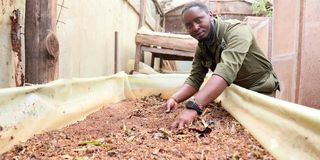
Mr Muturi and his team of five employees coordinate the collection of waste from markets and schools around Kagaa village, where the farm is located. His research had set him on a path of discovery and, like a curated algorithm, it landed him on vermiculture, which is the practice of raising specific types of earthworms to break down organic matter, referred to as vermicompost.
“With vermiculture, my curiosity came from asking the question, what more can I do with the little space I have? Again, the internet was very resourceful, and after learning about the process, we set up another structure almost similar to what we have at the BSF shed. My target was to transition into full organic mixed farming, to get compost or manure, foliar spray, and to reproduce the red earthworms for a sustainable venture.
For this process, we use farm-level waste like cow dung and vegetable cuttings. Here we don’t use anything processed or cooked. We give the worms between six to eight weeks, when everything should have been completely broken down. After that, we collect and sieve the compost.
The finest granulated version is taken as the organic fertiliser, while the not-yet-fully broken-down portion is taken back to the beds to complete the process. For the foliar spray, we ferment the compost extract, a liquid that is used to fight pests and diseases.”
The results, as anyone would see, are that Mr Muturi and his team have very healthy crops on their farm, which they sell to local markets and beyond.
“Currently, we are doing about three tonnes per week, some of which we use here and sell to other parts of Kenya.”
They package their organic fertilisers in bags of 10, 30, and 50 kilogrammes, selling between Sh600, Sh1,500, and Sh2,500 in that order. “If you compare this to the prevailing prices of other commercial fertilisers, you’ll see why our fertiliser is a better option.”
Talking about sustainability, how sustainable is Mr Muturi’s venture as a business? “Remember I said we fully run this as a business, and as such, we look at the books professionally. We are doing well, we could do better, but currently we are profitable, with about a 40 percent return on investment with this arm of the business. This has helped us to expand bit by bit for the last five years. I could put our growth at, say, 10 percent year on year.”
Their target clients are organic farmers, seedling propagators, and export farmers dealing in flowers, vegetables, herbs, and spices. “The reception has been good, even though we haven’t yet stocked in any shops; we sell directly to the farmers. Most farmers come to us for training first to get an understanding of the process.”
This interview happened in between training sessions for a group of farmers. “I have trained people from as far as Embu and Eldoret. They get to hear about us from referrals and our social media as well.” They have incorporated a social media content department to spread the word and market their products. The farm has a local organic certification, and Mr Muturi is in the process of seeking international certification to easily venture into the international market.
In 2017, while still looking for more feeding options for his chicken, he found out about yet another alternative farming venture. “The Azolla is a type of algae. You will find it growing in lakes like Victoria and Naivasha. What you see here is a pond that simulates the conditions in their natural habitats. You introduce it in the pond, and it keeps growing and reproducing,” he says. After the introductory planting, Mr Muturi says that it takes approximately three weeks for the algae to mature, after which it is ready to be harvested. “After this, we harvest every week. You can also harvest daily, depending on the size of the pond. To start, one can do a pond of about 30 centimetres deep, fertilized using cow dung or bioslurry.”
This line of business has opened other opportunities. “We sell the whole technology to other farmers, from training them to setting up ponds for them. The reception for this product is quite high compared to BSF. It is helping farmers across the nation cut costs by up to 70 percent and increase yield from chicken farming, especially for the kienyeji chicken farmers.”
From these ventures, Mr Muturi has learned patience and persistence. “There have been times I questioned the worthiness of the business, but every time I am reminded that success can be a slow process and every milestone counts. So, I remain curious and open to learning. I look for ways to do things better. That is persistence.” Mr Muturi has gone back to school and is currently at Mt. Kenya University taking a degree in Business Management.
“I want to professionalise my management skills, to know more about the commercial aspect of the business, and to explore different ways book knowledge can be used to grow the business.”