Cracking the code on the cost of commercial feeds remains a challenge to many farmers. Smallholders are struggling to remain afloat, with some forced out or discouraged from investing in poultry, pig and fish production. Some have turned to alternative sources of feed.
Mildred Day helps farmers to access affordable sources of protein by transforming organic waste using Black Soldier Fly (BSF) larvae.
She says the larvae contain 35 to 45 percent protein. The product can be used to feed poultry, fish and other livestock.
For years, farmers have relied on expensive protein sources like soybean. The larvae’s excrement, known as frass, is a nutrient-rich organic fertiliser too.
Coming from a background in waste management, Day realised that many project-based solutions were not as sustainable or impactful as she had hoped.
She moved into the social enterprise space, aiming to show farmers innovative waste solutions with income-generating opportunities for long-term success.
“Waste is constant. With a rapidly rising population, so will waste in towns. We provide sustainable solutions to the urban waste problem,” she says, adding that garbage is a resource.
Day says plant-based proteins are increasingly affected by climate shifts while fish face the growing risk of overfishing.
“With a high demand for white meat, farmers are seeking affordable and nutritious food sources for their animals while minimising costs as crop growing deteriorates due to overuse of soil and chemical fertiliser. Transforming waste into useful products is a solution,” she says.
The World Bank says more than two billion tonnes of municipal solid waste is generated globally every year. The figure is expected to double by 2050. Roughly 44 percent of this waste consists of food and greens.
Some 3,000 to 4,000 tonnes of waste is generated in Kenya daily. Nakuru city generates around 250 tonnes of garbage every day.
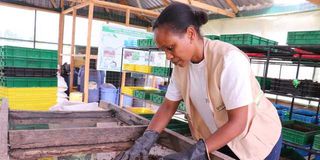
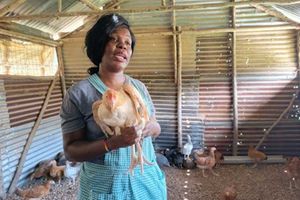
Mildred Day, founder of Griincom Innovate, at her unit in Nakuru on February 14, 2025.
Photo credit: Leleti Jassor | Nation
Day’s Griincom Innovate Ltd collects up to 30 tonnes of the food and organic waste from Nakuru Free Area Market to feed her BSF larvae a month. She also produces foliar.
The BSF unit began with 100 grammes of pupae in the last quarter of 2024. Day bought the pupae for Sh2,500.
Her operation has expanded to six love cages, with one cage holding five crates, each containing three kilos of pupae.
The unit design is unique with parts of its roof having translucent iron sheets to allow enough light in. The remaining is cemented with meshed wire and draped with a paper to control air flow.
Setting up the unit cost Sh1.5 million. It has colourful trays on metal racks. She says a farmer can opt for more affordable alternatives, such as a greenhouse, wooden racks or re-purposing 20-litre square plastic cans of different colours, which can be set up for roughly Sh500,000.
“Nakuru County has always had a linear waste disposal system. In the past, the Free Area Market would generate up to eight skips of waste. Only one skip is produced today as we handle the rest of the waste,” she says.
The waste is sorted and taken to the drying section. After drying, it is sent to the crusher. The fine product is larvae feed.
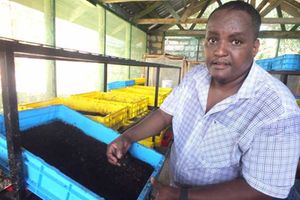
An adult fly lays 500 to 1,000 eggs in her lifetime. Once hatched, some 10g of the first instar BSF larvae are placed in trays, each holding seven to eight kilos of food. The larvae progress through the second to fifth instar stages as the cycle continues for 14 to 18 days.
At this point, some 30 percent of the larvae are reserved for the pre-pupal and pupal stages, where they will eventually be returned to the love box to continue the cycle and sustain the colony.
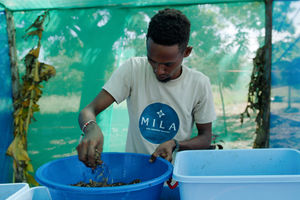
The remaining are used to produce protein feed. This is done by dipping the larvae in hot water to kill and sterilise them, followed by rinsing them with warm water before transferring them to the drying unit for feed production. The cycle lasts eight days.
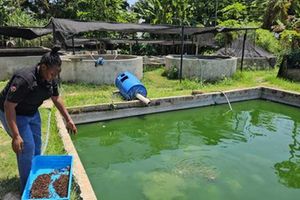
Birds are a challenge to Day’s business. She also at times has difficulties transporting her products to farmers, increasing costs.
“We plan to establish a line of chicken feeds soon,” she says.