Kwale-based business owes the coconut its success
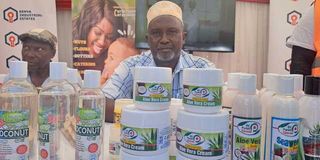
Hamisi Mwakumanya, 60, displays his products during the Kenya Public-Private Sector MSMEs Dialogue at Tononoka Grounds in Mombasa on September 9, 2025.

When the 60s come knocking, most people begin to think about slowing down, maybe tending to their garden or watching their grandchildren grow.
However, in Mwabuga village, Kwale County, Mr Hamisi Mwakumanya has no intention of sitting back. He is busy transforming the coconut into high-demand products such as virgin oil, herbal lotions, shampoos, eco-charcoal, fibre mats, and more.
The Powering SMEs team met him at Tononoka Social Hall during the Kenya Public-Private Sector MSMEs Dialogue, where he was busy attending to customers in his stall. On his stand, bottles and tins of different sizes were neatly displayed. They contained virgin coconut oil, coconut lotions, some infused with aloe vera jelly and seaweed.


"For those with dry skin, I always advise them to use the coconut and aloe vera lotion," he commented, adding, “This is more than a business, it is a way of proving that traditional resources, when used wisely, can be a source of wealth,” he says.
His products are now sold across Kenya and parts of East Africa. He’s won awards, mentored farmers, and is eyeing global markets, capitalising on the fruits and plants that grow freely around him. Mwakumanya didn’t grow up dreaming of becoming a businessman. For most of his life, he worked in both the public and private sectors, but as he approached retirement in the early 2000s, a sense of restlessness crept in.
“I kept asking myself what next after employment? I did not want to sit at home doing nothing,” he recalls.
In 2007, that question led him to join a local farmers’ group involved in environmental conservation and tree planting. A turning point came when the group secured sponsorship for training at Jomo Kenyatta University of Agriculture and Technology (JKUAT), where he was introduced to coconut value addition.
“That training opened my eyes. I realised the coconut is not just a fruit. It is a resource. A business. A livelihood,” he says.
Armed with knowledge from JKUAT and a determination to forge a new path, he began experimenting in his backyard. Starting small, he learned how to extract virgin coconut oil through cold pressing, how to dry and process husks into fibre, and how to burn coconut shells into eco-friendly charcoal. He did not stop at oil. He began infusing it with aloe vera and seaweed, turning the basic product into healing balms, lotions, shampoos, and soaps. He also made doormats and ropes from the coir fibre and produced charcoal briquettes from shells, offering a sustainable alternative to wood-based fuel.
“Coconut oil has many uses. Cooking, managing high blood pressure, diabetes and ulcers and even treating skin and scalp issues. When I add aloe vera or seaweed, it becomes even more powerful,” he explains.
In the early days, his clients were friends and neighbours, but word spread quickly, especially after they experienced the effectiveness of his natural products.
Today, he supplies customers from across Kenya and even parts of Tanzania and Uganda.
To meet growing demand, he sources coconuts primarily from Kwale County, but when supply is low, he turns to Kilifi and other neighbouring areas. His workshop now employs at least 10 people, most of them local youth and women, providing much-needed jobs in a region where unemployment remains high.
A major milestone came about when the businessman’s products were certified by the Kenya Bureau of Standards (KEBS).
“Getting KEBS certification was not easy. It took a lot of documentation, testing, and meeting hygiene standards. But once I had it, my business changed,” he says.
The certification allowed him to participate in trade fairs, supply institutional buyers, and build trust with a wider clientele.
His work has been recognised in several forums. He has received awards for innovation in agribusiness and regularly gets invited to speak at agricultural expos and SME training sessions. He has also travelled across East Africa, not just to market his products but to teach others the value of coconut-based enterprises.
“This knowledge must be shared. Our young people need to see that they do not have to wait for white-collar jobs. Nature has already given us resources to thrive," he coments.
One of the most remarkable aspects of this business is its zero-waste philosophy. Every part of the coconut is turned into a useful product.
“Even the small pieces that seem useless can be ground into powder for soaps,” he adds.
This commitment to sustainability aligns with national and global calls for green business practices, especially in rural industries. However, despite his success, the road to this point has not been without challenges.
A major issue is inconsistent coconut supply, especially during dry seasons. Mwakumanya also points to the high cost of quality packaging, which limits his ability to produce in bulk for high-end markets.
“Many clients want professional packaging bottles, labels, seals and all these cost money. If I had better machinery and capital, I could meet even larger orders,” he explains.
Access to financing has also been difficult. While he has applied for various grants and SME support programmes, he says most are not tailored for rural enterprises. Despite these hurdles, the man is not about to slow down. His next big dream is to export his products to Europe, Asia and the Middle East.
“There is huge demand abroad for organic, chemical-free skincare and wellness products. I know I can compete if I get the right support,” he says.
Long-term, he wants to establish a small-scale processing factory in Kwale, one that will double up as a training centre for youth and women in coastal counties.
Follow our WhatsApp channel for breaking news updates and more stories like this.


