Eco-warriors of Kwale: Youth recycling husks to save forests, clean beaches
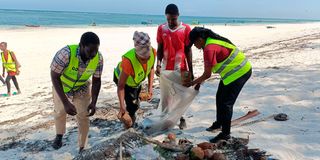
Kwale youth collect coconut husks from Diani Beach during clean-up on August 1, 2025. They use the husks for hosting tree seedlings and preparing charcoal briquettes.

What you need to know:
- Kwale youth are transforming discarded coconut husks into eco-friendly briquettes and seedling hosts, cleaning Diani beaches and conserving forests.
- In Diani, young volunteers are turning madafu waste into climate solutions, from clean-burning briquettes to biodegradable seedling pots.
For years, coconut husks have been a common eyesore on the beaches of Diani. They are scattered not only across the white sandy shores but also along the roads, thanks to the booming coconut water business, popularly known as madafu.
Madafu is a favourite thirst-quencher for both locals and tourists in the hot, humid resort town that has won multiple continental and global awards for its pristine beaches. Yet, a group of young people is now transforming these husks from beach litter into powerful tools for climate resilience and environmental conservation.
In a creative shift from emergency response to environmental action, young volunteers are collecting discarded husks from Diani Beach and converting them into eco-friendly charcoal briquettes and seedling hosts.
Leading the initiative is Ramadhan Sadiq, a 27-year-old youth coordinator at the Kenya Red Cross Society, Kwale County. Inspired by the littered husks he saw along the beach; he began exploring ways to put them to use.
“I was always seeing litter from these husks on the beach and wondered what I could do with them. After my research, I realised they are excellent hosts for seedlings, instead of nylon papers that are commonly used,” Ramadhan explains.
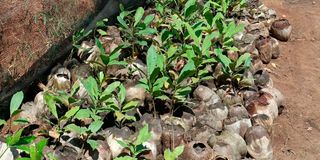
Coconut husks hosting tree seedlings at a nursery in Kwale County on August 1, 2025. Youth in the county are giving the husks a second life to conserve the environment.
His team wanted to grow seedlings without relying on plastic bottles or bags. Other alternatives, such as bamboo stems, proved unsustainable since they would require cutting down trees. So, when not responding to floods, drought, drowning, or fire emergencies, the volunteers dedicate their time to cleaning beaches and using husks to reduce deforestation.
Ramadhan, an electrical and electronic engineering graduate turned humanitarian, says his passion for the environment drives the initiative. “We came up with the idea of picking up litter such as plastics, glass, fabric, and coconut husks. We now do this frequently to collect more husks.”
Once collected, the husks are sorted. Those close to decay are carbonised and used to make briquettes, while larger husks become seedling hosts. Volunteers fill them with soil and plant drought-resistant seedlings, which are arranged under shade nets.
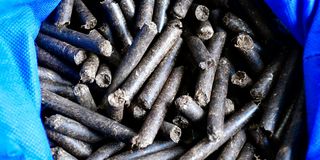
Briquettes made from coconut husks.
“The fibrous material retains moisture, reduces reliance on plastic bags, and breaks down naturally when planted, helping to restore degraded coastal forests,” Ramadhan says.
Manure for kitchen gardens
Overly decomposed husks are mixed with soil to create manure for kitchen gardens. “We aim for zero waste. Many people use plastics as seedling hosts and dispose of them poorly afterwards. We are changing that.”
The briquettes are designed to reduce dependence on charcoal, which is a major driver of deforestation. The production process is meticulous: husks are burned in a kiln for six hours to carbonise them, crushed into fine powder, mixed with cassava flour as a binder, and pressed into cylindrical briquettes. After cutting, they are left for 24 hours before drying in the sun.
“The cassava starch makes the charcoal burn longer and more efficiently. Compared to ordinary charcoal, it lasts longer, with fewer pieces needed for cooking,” he adds.
The briquettes burn without soot, sparks, or scent. The youth use this model to teach communities about eco-friendly cooking alternatives that are less harmful to the environment.
Christine Ndambuki, one of the youth volunteers, says the briquettes are already changing lives. “We provide an affordable alternative fuel source while showing communities that farm waste can be used. Though husks are biodegradable, they take long to decompose, so we are creating other uses.”
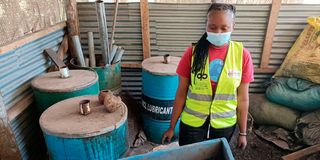
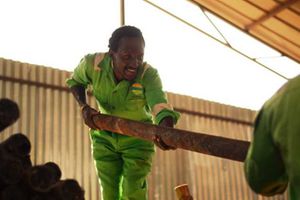
Christine Ndambuki, a youth volunteer at Kwale Red Cross, at the site where they prepare charcoal briquettes.
Since 2022, the team has collected more than 100,000 husks, with seedling hosts distributed to schools and public institutions. Their biggest challenge remains limited resources for collection and large-scale processing.
“If we get organisational support or partnerships, this could have a bigger impact, not only in Kwale but also in other areas,” Ramadhan notes.
Tourism stakeholders have welcomed the initiative, saying it boosts both conservation and business. Kioko Musyoki, General Manager at Leopard Beach Resort and chair of the Kenya Association of Hotel Keepers and Caterers in Kwale, says clean beaches are critical to the region’s competitiveness. “When tourists come to Diani, it is always about the clean beaches and good weather. We compete with destinations such as Zanzibar. Ensuring clean beaches and forest cover is a win for us,” he says.
Kenya is among the countries hardest hit by climate change, facing rising temperatures, prolonged droughts, and erratic rainfall. The warming climate threatens agriculture, water supply, health, and coastal ecosystems. In Kwale, these challenges directly affect food security and water availability, making community-led adaptation efforts like this one more urgent than ever.