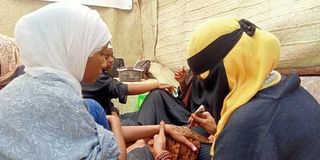
In a quiet corner of her veranda at the Milimani area of Mkomani in Lamu Old Town, Nyebwana Fadhil Mohamed is a picture of serene concentration, her hands moving with practised, fluid motion.
In front of her sits a Swahili lady wearing a vibrant dera dress, a hallmark of East African coastal style, made from lightweight cotton that drapes elegantly around her. The lady has one arm extended and resting on a soft cushion.
Both Ms Fadhil and the lady remain still, a necessary stillness to prevent any smudging of the delicate work in progress. Ms Fadhil’s eyes are fixed on the client’s arm and skin.
In her right hand, she holds a small, thin cone filled with smooth, brownish green paste, stabilising her working wrist with her free hand for control. With gentle pressure, a fine, steady stream of paste is guided onto the client’s skin, creating intricate patterns that seem to bloom under her hand.
Ms Fadhil, 36, is among the renowned henna artists in Lamu who have managed to turn a childhood hobby into a full-time venture.
For Ms Fadhil, however, it is a lucrative business that today enables her to earn as much as Sh70,000 in a good month.
During an interview, Ms Fadhil, a single mother of five, says she did not attend any formal class to acquire the craft but instead learned it from her mother, Fatma Mzee Sheemote, through apprenticeship. She developed an interest in henna painting when she was only five years old.
While in school at Wiyoni Primary, she would sometimes sit in a corner of the classroom and, as the teacher taught, fully engage herself by drawing patterns in books.
“That’s when I realised I was doing a wonderful job, an art that I could make money from,” says Ms Fadhil.
At the time, she offered the service for free. She immersed herself fully in the craft, turning it into a full-time venture in 2011.
She did not struggle to find clients at the beginning since she already had an established clientele.
“It felt great to earn my first coins of between Sh200 and Sh500, just doing something I enjoyed,” she says Ms Fadhil.
Today, the business has prospered, with one client charged between Sh800 and Sh1,500 for simple henna decorations.
Ms Fadhil says that at times she charges between Sh7,000 and Sh10,000, especially when doing henna decorations for brides.
“My business is thriving. Henna art is extremely good during weddings. You can imagine in eight or nine hours’ time, you pocket Sh7,000 or Sh10,000 for decorating a bride. It’s a job that has given me financial independence,” said Ms Fadhil.
She completed high school at Lamu Girls Secondary School in 2014 but could not join college due to family struggles.
“Instead of idling around, I decided to fully nurture my henna craft. I don’t regret it. At times I get Sh5,000 to Sh7,000 just in one day since I’ve made a name and have many clients. In a month, I earn not less than Sh70,000,” she explains.
Apart from the usual body painting, which comes in two distinct colours, black commonly known as ‘Piko’ and red or maroonish, Ms Fadhil also offers part-time henna painting classes to those interested in the art.
She charges Sh2,500 per month, with the course taking about two to five months. Currently, she has five students, which boosts her monthly earnings.
“It depends on your ability and creativity as a student. If you’re sharp or good, it can take only a month or two for you to master the basics. Others take up to five months,” she says.
At the Gadeni area, also within Lamu Old Town, another henna artist, Rasha Abdalla, is all smiles.
What started as a hobby when she was only a four-year-old pupil at Mkomani Mahmoud Bin Fadhil Girls Primary School has matured into a lucrative business that has even enabled her to explore the world.
Today, the 27-year-old is living her dream of becoming an independent entrepreneur.
For Ms Abdalla, henna painting is an inborn talent. During childhood, she was fascinated by watching her aunts practice the craft.
“I remember my primary school days, where during preps or break time my friends and I used to hide at the back of the classroom and draw henna patterns. That’s how I became an expert. I never attended an art school,” says Ms Abdalla.
After completing high school at Lamu’s Wiyoni Secondary School in 2017, she joined Mombasa Airways Institute for a diploma course in Maritime Operations and Clearing and Forwarding.
Her studies were, however, interrupted by the Covid-19 pandemic, forcing her to return to Lamu, where she stayed throughout 2019 and 2020. It was during this period that Ms Abdalla immersed herself fully in nurturing her childhood henna painting hobby.
Her growing and refined artistic skills enabled her to make a name across Lamu. Eventually, she gained enough confidence to paint clients for pay. Her clientele grew rapidly during that time.
This growth gave her an opportunity to fly to Dubai in the United Arab Emirates in April 2021, where she worked as a henna artist for three years.
She returned to Lamu in January 2023, where she stayed for only a month.
“I don’t regret venturing into henna painting. Just a small painting, which is popular with most of my clients, costs between Sh500 and Sh1,000 depending on the size and length of the painting in question,” she says.
During special occasions such as weddings and other cultural and religious festivals, Ms Abdalla says business is always good. She says she charges between Sh5,000 and Sh7,000 for complete body painting for brides, a process that takes about three to six hours.
Due to the privacy required by her clients, mostly Swahili Muslim women who have to remove their buibuis during hand and leg painting, Ms Abdalla works from her own house in Gadeni, Lamu.
“Our culture is very conservative. That’s why you’ll never see me on the streets doing henna painting. My clients know my residence. They’re the same ones who give references for others to visit my place and get services,” says Ms Abdalla.
Hilda Zawadi, a beauty therapist, says that as a henna artist or any other beauty professional, one must always make time to learn new styles and relevant technology to keep up with emerging trends.
“As a henna or any other beauty-related artist, it’s crucial that you always move with new trends in order to attract clients and remain afloat in the industry, especially in this competitive and evolving market. Staying current shows innovation and allows you as an artist to offer unique and personalised designs that appeal to a broader, modern audience, alongside traditional motifs,” says Ms Zawadi.