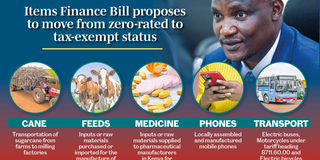
The cost of sugar is expected to increase if the National Assembly approves the Finance Bill 2026, which proposes to remove transportation of sugarcane from farms to milling factories from the category of zero-rated services and goods to that of VAT tax exempt.
The proposed amendment in Clause 31 of the Bill, targets Section A of the First Schedule to the VAT Act, proposing extensive amendments by deleting certain exemptions.
This, while introducing new exemptions and restructuring the VAT treatment of various supplies, including dialysers, worn clothing, scrap metal, pharmaceutical inputs, Public-Private-Partnership (PPP) infrastructure projects and bioethanol stoves.
Sugarcane is loaded on tractor in Lurambi, Kakamega County on April 17, 2024.
Photo credit: File | Nation Media Group
Those targeted to be removed from zero-rated to tax exempt, potentially leading to price hikes, include the locally assembled and manufactured mobile phones, motorcycles under tariff heading 8711.60.00, electric bicycles, electric buses, solar and lithium-ion batteries and animal feeds.
The proposal comes as the Law Society of Kenya (LSK), Institute of Certified Accountants of Kenya (ICPAK) and Deloitte and Touche, an audit firm, warn against the move in the memoranda to the National Assembly.
LSK President, Charles Kanjama, notes that while the proposed amendments reflect National Treasury’s broader policy objective of expanding the VAT base while using exemptions to support strategic sectors, it is the consumer who will bear the brunt.
“LSK notes that exempt status prevents businesses from recovering input VAT and wants deletion of this proposal,” Mr Kanjama says in a memorandum to the House Finance and National Planning Committee, which is considering the Bill.
Law Society of Kenya (LSK) President Charles Kanjama during an interview at his office in Nairobi on February 24, 2026.
Photo credit: Bonface Bogita | Nation Media Group
“The additional costs are passed down to the final consumers through the increase of prices,” adds Mr Kanjama.
Removing transportation of sugarcane from VAT zero-rated category will have a ripple effect on the costs of other products, considering that cane sugar is primarily used as a universal sweetener and functional ingredient in the global food industry.
It also serves vital roles in the pharmaceuticals, cosmetics and industrial applications sectors. Goods, transactions and services that are zero-rated are relatively cheaper compared to those in the tax-exempt category.
Under the zero-rated category, there is no VAT on the final product, and the input tax used in the manufacture of the product is claimed by the manufacturers from the government.
In the tax-exempt category, while there is no VAT on the final product, input tax employed is not claimable and is therefore passed on to the consumer in price hikes, created through hidden and embedded costs across the supply chains.
“LSK proposes that sectors involving essential goods and services, particularly healthcare and agricultural inputs, be considered for zero-rating rather than exemption in order to preserve input VAT recovery and reduce hidden costs,” says LSK, with ICPAK proposing a deletion of this proposal.
“The cost of the raw materials and the inputs would rise given the transition from zero rated to exempt,” says ICPAK.
“Universal Health Coverage is a key deliverable under the Bottom-Up Economic Transformation Agenda and therefore the resultant increase in costs from the enactment of the proposed provision would go contrary to this agenda.”
Photo credit: Nation Media Group
Cane sugar is a staple in commercial food production and family kitchens, fulfilling multiple roles beyond just adding sweetness.
It adds flavour, retains moisture to prevent staleness and acts as a food source for yeast in bread fermentation, sweetens juices, sodas, tea and coffee.
It provides the core structure and texture for candies, chocolates and sugar cubes while acting as a natural preservative in jams, jellies and sauces by drawing out moisture to inhibit bacterial growth.
In pharmaceuticals, sugar is used as a coating for pills, a binder in tablets and a flavour-masking agent in liquid cough syrups while serving as the base carbohydrate to brew alcoholic beverages like rum, as well as industrial ethanol.
Also to be affected in cane sugar price hikes include molasses, the thick syrup left over after sugar crystallisation, which is used directly as animal feed, a baking ingredient, or fermented into alcohol and biofuels.
Currently, the government is focusing on subsidising production and other inputs in a bid to address food insecurity.
As such, making animal feeds tax exempt would imply higher costs of animal and animal products, a clear departure from subsidising production.
There is also bagasse, the fibrous wood-like residue left after crushing the cane stalks.
Platform-based payment services
It is burned in factories to create green electricity and steam power, or used to manufacture paper products and eco-friendly building materials, and the filter cake or mud, the settled impurities filtered out from the raw juice, which are returned to agricultural fields as a nutrient-rich fertiliser.
The Bill also narrows the scope of exempt financial services by excluding certain digital and platform-based payment services from VAT exemption while maintaining exemption for core money transfer and bill payment services.
LSK notes that although the National Treasury seeks to broaden the VAT base and clarify the tax treatment of fintech services, “the amendment may disproportionately affect innovation within Kenya’s digital financial services ecosystem.”
“Subjecting payment gateway, settlement and processing services to VAT may increase transaction costs for consumers and businesses, reduce competitiveness of fintech operators and undermine Kenya’s position as a regional leader in digital finance innovation.”
According to ICPAK, the proposal to change the VAT status from zero-rated to exempt for the supply of electric bicycles, the supply of solar and lithium-ion batteries, and the supply of electric buses may adversely affect the growth of Kenya’s nascent and emerging green economy sectors.
ICPAK notes that “these sectors are still developing and may not yet have attained sufficient market maturity or economies of scale to absorb the additional costs associated with VAT exemption.”
“Retaining the zero-rated status would support continued investment in clean energy and sustainable transport solutions, which are key to the country’s climate change commitments and transition to a low-carbon economy,” says ICPAK.
ICPAK notes that the proposed change could increase the cost of electric mobility and renewable energy products to consumers as it slows down expansion and innovation within the local green manufacturing and assembly sectors.
This, it argues, will negatively affect employment creation opportunities emerging from these industries.
ICPAK proposes that maintaining the zero-rated status would help preserve competitiveness across the value chain, encourage local production and assembly and support Kenya’s broader environmental sustainability objectives.
“Given the capital-intensive nature of these industries, the inability to recover input VAT would significantly increase the cost of production and investment.”
The Bill further introduces VAT exemptions for goods and services directly used in approved PPP infrastructure projects, which is intended to reduce infrastructure development costs and attract private investment into strategic national projects.
However, LSK is proposing that eligibility criteria for PPP-related VAT exemptions be expressly provided within the legislation or accompanying regulations, with transparent application and approval processes subject to defined timelines.
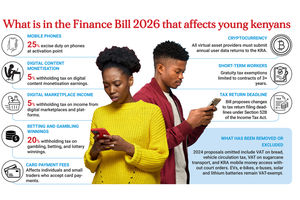
The Bill proposes to remove VAT exemption on digital payment services- payment processing, settlement, gateways and aggregation.
A worker harvests sugarcane at a farm in Koru, Kisumu County on November 7, 2018.
Photo credit: File | Nation Media Group
This, according to Mr Fred Kimotho of Deloitte and Touche, would subject such services to VAT when provided through software or platforms by Payment Service Providers (PSPs).
“The proposal creates an uneven playing-field, disadvantaged PSPs as compared to other financial service providers offering similar services,” says Mr Kimotho adding, “the imposition of VAT on these services may increase the overall cost of financial services, which may duly be passed on to consumers.”
Mr Kimotho warns that if passed as proposed, it risks discouraging innovation and growth in the fintech and digital payments sector.
“Digital payment services form part of core financial infrastructure and taxing them may undermine financial inclusion goals. The proposal also departs from international best practice, where core payment execution services are generally VAT-exempt,” he says.
Deloitte is also opposed to the proposed introduction of VAT on sale of collateral and reposed assets. It notes that the sale of collateral is ancillary to the provision of credit, “which is already VAT-exempt.”
“Treating such sales as taxable would violate the principle of VAT neutrality and mischaracterize banks as traders,” the audit firm says adding, “the sale of collateral is a risk management function, rather than an independent commercial activity geared at revenue generation.”
“Exempting these sales aligns with international VAT principles, where ancillary services follow the treatment of the main supply.”