The government has revealed plans to use cash from the 1.5 per cent Affordable Housing Levy as collateral for a Sh100 billion loan in a process known as securitisation, signalling that the controversial deduction could become a near-permanent feature on workers’ payslips.
Disclosures by a Parliamentary committee show that the State Department for Housing plans to take the loan to partly plug a Sh118 billion funding gap in the affordable housing programme as President William Ruto steps up the rollout of the low-cost home ownership scheme ahead of his re-election bid next year.
The Kenya Kwanza administration has set a target to build one million affordable housing units by the end of 2027, largely using funds raised through the Affordable Housing Levy, under which salaried workers contribute 1.5 per cent of their gross pay, matched by an equal contribution from employers.
Court: Ruto's Housing Levy is constitutional
In its submission on the budget estimates for the 2026/27 financial year, the Housing Committee noted that construction of affordable homes in the financial year starting July would require financing of Sh228.3 billion, but had only been allocated Sh110 billion, leaving a financing gap of Sh118.3 billion.
A significant portion of this financing gap—Sh100 billion—will be bridged through a bond issuance backed by future proceeds from the Affordable Housing Levy, the Housing Committee indicated.
“To address this shortfall, the State Department proposes to mobilise an additional Sh150 billion through securitisation (Sh100 billion) and proceeds from the sale of completed housing units (Sh50 billion),” reads part of the report by the Budget and Appropriations Committee (BAC).
Securitisation ties future Affordable Housing Levy collections to the repayment of the bond, effectively locking in the deduction until investors are paid in full.
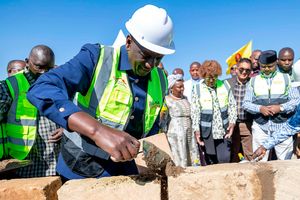
President William Ruto lays the foundation stone for the construction of affordable housing units in Buuri, Meru County, on Thursday, January 25.
Photo credit: Courtesy | PCS
It enables the government to raise large sums of money upfront and roll out multiple projects simultaneously, something that would be difficult to achieve through the gradual accumulation of revenue from levies.
The State Department for Housing in a statement said that “securitisation of receivables is one component” of a capital-raising strategy that will help the government meet its objective of building 250,000 low-cost houses annually.
Others include asset-backed instruments that will use the money they get from selling the complete units as collateral. Rental income and installment payments could also be used as security for getting loans to build more houses.
These capital-raising strategies will sit alongside traditional financing models such as borrowing from the donors, including the World Bank and other development finance institutions.
However, the Principal Secretary for Housing and Urban Development, Mr Charles Hinga, did not respond directly to our questions on how the securitisation would work and whether the levy would remain in force even if a future administration sought to abolish it.
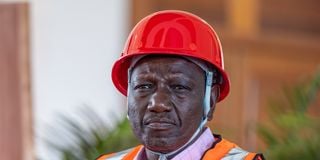
The Principal Secretary, State Department for Housing and Urban Development, Charles Hinga, speaks during the Smart Cities Forum in Nairobi on October 30, 2025.
Photo credit: Wilfred Nyangaresi | Nation Media Group
Although absorption of housing funds has remained relatively low, the government argues that a significant portion of the money already collected has been committed to ongoing projects and will be insufficient to meet the financing needs of projects in the pipeline, hence the need to issue a bond backed by the levy.
That raises the prospect of Kenyan workers continuing to remit the levy well beyond President Ruto’s tenure in office, as abolishing the deduction later on could prove difficult.
The maturity term of many treasury bonds exceed the ten-year maximum presidential tenure under Kenya’s Constitution.
President Ruto has less than two years left of his first term in office, before seeking re-election for another five-year term.
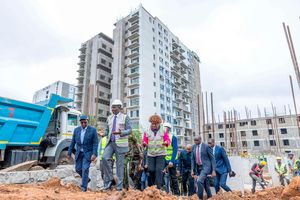
President William Ruto addresses a gathering in Ol Kalau, Nyandarua County during the launch of the affordable housing project on January 11, 2024.
Photo credit: Boniface Mwangi | Nation Media Group
Political commentator Javas Bigambo argues that scrapping the levy after it has been securitised would not be easy, unless the government finds a way to compensate investors.
“Once it has been securitised, it means it cannot be scrapped during the subsistence of the securitisation,” said Mr Bigambo.
He explained that securitisation is undertaken by the State rather than an individual administration, meaning any government that succeeds the current one would be bound by the obligations arising from the transaction.
Faced with huge infrastructure financing needs and limited fiscal space, the Ruto administration has increasingly turned to the securitisation of various levies as an alternative funding model.
One of the most notable examples is the securitisation of the Sports, Arts and Social Development Fund levy, which has been used to support the construction of Talanta Stadium ahead of the 2027 Africa Cup of Nations (AFCON), which will be jointly hosted by Kenya, Uganda and Tanzania.
The government last year raised Sh44.79 billion through a 15-year bond whose returns are paid from betting taxes, which are housed under the Sports Fund.
The Sports Fund is mainly financed by taxes and levies raised from the betting industry, with the fund targeting collections of Sh2.07 billion per month.
The bond carries a 15.04 percent rate of return, which will earn investors Sh57.6 billion in interest over its life.
Other levies that have been securitised include the Tourism Fund, whose proceeds are being used to finance the redevelopment of Bomas of Kenya.
There are also plans to raise funds to pay road contractors and finance new road projects by securitising proceeds from the Road Maintenance Levy Fund.
Part of the funding required to extend the Standard Gauge Railway (SGR) from Naivasha to Malaba is also expected to come from the securitisation of the Railway Development Levy, which is charged on most imported goods.
However, it is the plan to securitise the Affordable Housing Levy that could have the most far-reaching impact, as it may require some workers to continue paying the levy for many years.
Since its launch, the affordable housing programme has continued to absorb the largest share of government development expenditure, overshadowing traditional heavy spenders such as roads, which have historically been the main drivers of capital expenditure.
A recent report by the National Treasury shows that the State Department for Housing and Urban Development recorded the biggest increase in development spending in the third quarter of the financial year ending June 2026, with expenditure surging more than fourfold to Sh90.6 billion from Sh21.1 billion a year earlier as the government doubled down on its pledge to build 250,000 affordable housing units annually.
Before it was rolled out, the levy faced opposition from critics who argued that it was discriminatory because it targeted only salaried workers.
However, the government sought to address this concern by enacting the Affordable Housing Act, which expanded the levy to all income earners. Even so, enforcement among informal sector workers appears to have achieved limited success.