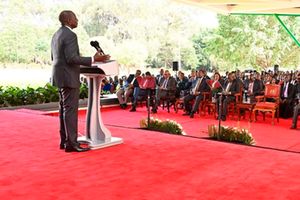
The recently signed Government-Owned Enterprises (GOE) Bill into an Act by President William Ruto is set to change the management of how parastatals are managed in Kenya.
The move will save taxpayers billions of shillings previously used in the management of the parastatals.
According to Section 9 of the Act, the entities will now operate as commercial organisations to make profit. They will also be self-sustaining and self-financing.
“A government-owned enterprise shall operate as a commercial entity and shall operate for profit, be self-sustaining, self-financing and be accountable to the public through the National Treasury,” reads the Act.
The First Schedule to the Act has listed 65 parastatals which are now listed as Government Owned Enterprises and will be required to operate as commercial entities, be self-financing, and self-sustaining.
Some of these parastatals include the Kenya Ports Authority, Kenya Power, Kenya Electricity Generating Company (KenGen), Kenya Railways Corporation, among others.
The Kenya Electricity Generating Company (KenGen) head offices in Nairobi.
Photo credit: Photo | File
During his State of the Nation Address last month, President Ruto said Kenya’s development ambitions—including improvements in roads, energy, water systems, logistics, education, and digital networks—require sustained and innovative financing models.
“We cannot continue funding essential infrastructure through unsustainable borrowing or burdening taxpayers with additional taxes. But neither can we afford to postpone these imperatives without risking our future,” President Ruto said
The Government-Owned Enterprises Act seeks to streamline the operations of state corporations and government-owned enterprises by enhancing accountability, efficiency, and alignment with national development priorities.
It also sets out public service obligations designed to improve transparency and performance standards.
The new Act, if implemented fully, will actualise some of the recommendations of a taskforce appointed by former President Uhuru Kenyatta on parastatals.
The taskforce which was chaired by the then Member for Mandera Central Constituency, Abdikadir Mohammed, came up with a number of proposals, including the need for dissolution and merger of several parastatals and adoption of a business-oriented code of conduct that would uphold efficiency and accountability.
Whereas the Taskforce Report gave impetus for change in governance of parastatals, the implementation of the report has, over the years, experienced resistance to change by the same parastatals that the government sought to make efficient.
In order to cure duplication of duties, wastage of public resources, bloated workforce and corruption that have often characterised operations of the parastatals, section 7 of the Act provides that when determining a request for the establishment of a Government Owned Enterprise, the guiding principles, such as what gap the new enterprise is going to fill in the market.
According to the Act, Government Owned Enterprise shall operate on commercial principles and with a defined commercial income stream that substantially supports the associated commercial activities.
The process of establishing a Government Owned Enterprise has also been tightened in the new Act, a move aimed at curbing the mushrooming of parastatals with no defined roles but gobbling millions of taxpayers ' money in financing their activities.
Kenya Power’s revenues took the biggest hit from industries with sales from this consumer class dropping by 9.5 per cent in the year ended June 2025.
Photo credit: Francis Nderitu | Nation Media Group
According to section 8 of the Act, where the relevant Ministry requires a Government Owned Enterprise to be established, the relevant Cabinet Secretary shall submit to the Cabinet Secretary for National Treasury, a written request for the proposed establishment of the Government Owned Enterprise.
The request, according to the Act, must be accompanied by a written business case, with detailed justification for establishing the Government Owned Enterprise.
According to the new Act, the request to establish a Government Owned Enterprise will be subjected to a feasibility assessment report, which will have to clearly indicate various factors such as the financial and economic viability of establishing the proposed Government Owned Enterprise.
The assessment report will also answer the question of whether the proposed activity can be achieved through an existing Government Owned Enterprise or through the private sector.
Further, the assessment report that will be presented to the relevant CS for consideration will also handle the question of whether there is a need to establish a new Government Owned Enterprise.
The report will also include the proposed functions and objectives of the Government Owned Enterprise, how the activities of the proposed Government Owned Enterprise will fit in the relevant Ministry’s mandate, and the medium-term strategy, among others.
The tight conditions are aimed at guarding against the proliferation of unviable parastatals and eliminating duplication of roles.