Kenya will pursue a new bilateral trade and investment deal with the US to replace the stalled Strategic Trade and Investment Partnership (STIP) even as President Donald Trump promised a one-year extension of the Africa Growth Opportunity Act (Agoa) arrangement, which allows it preferential access to the key market.
Prime Cabinet Secretary Musalia Mudavadi revealed that the US planned for a bilateral agreement with Kenya in place of the Free Trade Agreement (FTA) and STIP, whose discussions failed to materialize over a combined 10-year period of negotiations.
“The US wants the Agoa extended for one year, that is their (Republican) administration. But in the meantime, we are pursuing a bilateral agreement. The FTA and the US-Kenya STIP are no longer in place,” said Mudavadi, who is also the CS Foreign and Diaspora Affairs.
He disclosed that Trump's administration plans to extend the Agoa by one year, crucial to protect thousands of African jobs in textiles, agriculture, and other sectors, while allowing time to negotiate a stronger, long-term trade framework for both nations.
“You recall that the plans to extend Agoa stalled because of a US Congress shutdown. Now that it was resolved, the matter for the Agoa renewal is before the Congress, and we shall have to wait and respect the US’s process for the Agoa renewal,” said Mudavadi.
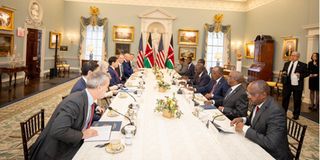
US Secretary of State Marco Rubio and Kenyan Foreign Cabinet Secretary Musalia Mudavadi sign the US-Kenya health pact as President William Ruto looks on.
Photo credit: PCS
This proposed short-term extension, currently awaiting US Congress approval, aims to prevent disruption and build a modern, mutually beneficial trade future beyond the original September 2025 expiry of the Agoa.
“In Washington, D.C. I joined President William Ruto for a meeting with United States Trade Representative Ambassador Jamieson Greer, where he noted that the extension would give the US Government time to design a stronger, more comprehensive programme that advances the interests of both nations,” said Mudavadi.
Mudavadi disclosed that the FTA that was being negotiated between the US and Kenya during President Donald Trump's administration is no longer in place; “Even the STIP that was being negotiated (under Biden) is no longer in place. They have been talking of bilateral trade agreements,” he said in an interview with The East African.
The US-Kenya STIP was launched during the 2022 agreement during President Biden’s administration, aimed at boosting economic growth, supporting African regional integration, and deepening trade cooperation, with a focus on digital trade, agriculture, labor rights, anti-corruption, and trade facilitation.
Launched in July 2022, the STIP is not a traditional free trade agreement (FTA) that Trump had proposed with Kenya during his first term, and does not address tariffs but instead focuses on reducing non-tariff barriers to make US businesses more competitive in Kenya.
The Kenyan delegation, led by President Ruto, discussed the possibility of a US-Kenya bilateral agreement that would also address the 10 percent tariff that the US imposed on Kenya.
President William Ruto shakes hand with US President Donald Trump in Washington DC on December 5, 2025.
Photo credit: PCS
“Our discussions went further, focusing on the development of a new bilateral trade arrangement that will elevate Kenya–US economic cooperation to the next level. We are working on a joint framework that will open new trade opportunities, strengthen predictability for investors, and build a modern partnership that reflects the ambitions of our two countries,” said Mudavadi.
“Kenya is at the lowest band (of tariffs), but we did discuss that even the 10 percent is hurting some of our exporters, so the whole idea of the bilateral trade agreement is to eventually resolve this in totality. But in the meantime, before congressional approval, is the extension of Agoa for one more year.”
Kenya is among the countries across the world hit by Trump’s reciprocal tariffs in what his administration says is a move to correct the country’s trade imbalance, including both the trade deficit and trade barriers.
From April 9th, goods from Kenya now attract a 10 percent tariff in response to trade barriers cited by American firms trading with Kenya and tariffs imposed on goods from the USA.
“We have identified several high-potential sectors for expansion, including apparel and textiles, agriculture, leather and footwear, chemicals and pharmaceuticals, and ICT and digital services,” said Mudavadi.
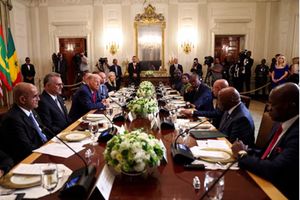
Kenya and US delegations during the signing of the historic Health Cooperation Framework between the two governments.
Photo credit: PCS
“These areas offer substantial opportunities to create jobs, boost export earnings, attract investment, and enhance value chains across Kenya.”
This renewed engagement sets the stage for a more dynamic, mutually beneficial, and future-focused Kenya–US trade relationship.
Republican and Democratic lawmakers describe Agoa as a pillar of U.S. diplomatic relations and a counterweight to Africa's main trade partner, China, which announced in June it would remove all tariffs on 53 out of 54 African states.
Adrian Smith, a Republican on the House Ways and Means Committee that oversees AGOA, says the law countered China's influence and demonstrated "America's commitment to Africa's young, growing population", explaining why it could be extended.
Democratic Senator Chris Coons, who co-sponsored a bipartisan bill in 2024 to extend it by 16 years, said: "If we fail to re-authorize AGOA, China will not hesitate to take our place."
An International Trade Centre (ITC) analysis indicates that without the Agoa, exports from the 32 eligible African countries to the U.S. will be slashed by 8.7 percent by 2029, a figure that includes the impact of other recent US tariff measures, a figure which only decreases to 8 percent with the pact back in place.