The 4th edition of the Kenya Meat Expo 2025 concluded on Friday at the Kenyatta International Convention Centre (KICC), after three days of spirited dialogue, deal-making, and knowledge exchange in the livestock and meat sector.
The expo and conference, organised by the Nation Media Group (NMG) in partnership with the Ministry of Agriculture, drew over 16,000 participants from across the industry.
It underscored the need for collaboration, innovation, and a stronger export-driven strategy to secure Kenya’s place in the global meat market. Participants ranged from livestock farmers, pastoralists to cooperative groups, private sector players, exporters, and policymakers.
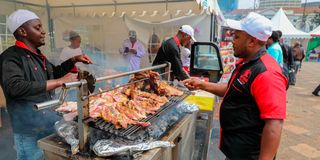
Chef Antony Mwangi of Ribracks grills chicken on day two of the Kenya Meat Expo 2025 at Kenyatta International Convention Centre in Nairobi on August 7, 2025.
Photo credit: Dennis Onsongo | Nation Media Group
The master classes covered diverse topics, including climate-smart livestock systems, which explored ways to adapt farming practices to changing weather patterns; bankability for livestock ventures, offering guidance on attracting financing for agribusiness; silage-based nutrition, focusing on improving livestock diets and productivity; and marketing adaptability, which provided strategies to enhance competitiveness in a dynamic meat industry.
These classes aimed to foster innovation, resilience, and sustainable growth across the livestock value chain.
The need for embracing modern technology took the centre stage underscoring its critical role in safeguarding animal health. Panels examined innovations in cold chain systems, digital livestock tracking, and disease monitoring among other topical issues.
Robust livestock identification system was said to revolutionize the way Kenya tracks animal movement, monitors diseases, and boosts productivity in the sector.
“A reliable livestock identification system is key to safeguarding animal health,” Evans Makokha, Deputy Director of Livestock Production at the State Department for Livestock said. “It will allow us to track movement, monitor diseases, and ultimately boost productivity in the livestock sector.”
Kenya Meat Commission representatives engage participants on the final day of the Kenya Meat Expo 2025 at Kenyatta International Convention Centre in Nairobi on August 8, 2025.
Photo credit: Dennis Onsongo | Nation Media Group
The push for digital livestock management reflects the growing recognition that disease outbreaks and uncoordinated animal movement remain major threats to both domestic supply and export markets.
Such systems, already in use in some parts of the world, could give Kenya’s producers a competitive edge by meeting international traceability standards a key requirement for accessing premium global markets.
“Technology is no longer a luxury in this sector; it is a necessity,” John Owino from the State Department of Livestock said one.
“Before we joined the cooperative, we would struggle to find buyers. Meat would spoil because we don’t have fridges. Now, the cooperative helps us find ready markets,” said Abdi Bulle, vice chairperson of the co-operative, speaking on the sidelines of the Expo.
The pastoralists continue to face harsh weather conditions, from prolonged droughts that kill livestock to floods that wash away key facilities.
“Sometimes the rains destroy the only slaughterhouse we have. We’re forced to walk three to five kilometers into the interior to find somewhere to slaughter,” lamented a local butcher who has been in the livestock trade for over a decade.
A chef demonstrates how to prepare mishkaki on the final day of the Kenya Meat Expo 2025 at Kenyatta International Convention Centre in Nairobi on August 8, 2025.
Photo credit: Dennis Onsongo | Nation Media Group
According to The Garissa Butchers Co-operative slaughters, 35 camels are slaughtered daily, each contributing Sh800 to the county government, and 100 goats daily at Sh200 each. This makes a total contribution of Sh17 million annually into county’s revenue.
“Livestock farming has enabled us to educate our children, build our homes, and live dignified lives,” said co-operative member Mariam Mohammed at the Meat EXPO 2025. “All we ask is that the county supports our efforts by investing in better slaughter facilities and livestock farming initiatives.”
Through pooled resources, members access zero-interest loans and secure steady buyers. Similar models were also said to attract neighboring counties such as Wajir County.
The expo floor buzzed with product showcases ranging from advanced slaughterhouse equipment to premium cuts of Kenyan beef. Exporters promoted the country’s competitive edge in producing organic, grass-fed meat; a growing preference in high-end markets.
Nation Media Group Group Managing Director and CEO, Geoffrey Odundo (left) with Cabinet Secretary for Agriculture and Livestock Development, Mutahi Kagwe during the Kenya Meat Expo 2025 at Kenyatta International Convention Centre, Nairobi on August 6, 2025.
Photo credit: Dennis Onsongo | Nation Media Group
Nation Media Group Managing Director and CEO Geoffrey Odundo reaffirmed the company’s commitment to showcasing the livestock value chain through editorial platforms such as Kilimo and Seeds of Gold.
“Together, we can position Kenya as a true powerhouse in the meat industry,” he told exhibitors and delegates.
The government echoed its vaccination campaign on animals as a critical initiative in driving the success of the livestock sector targeting 21 million cattle and 50 million sheep and goats. The initiative aims to curb outbreaks of foot-and-mouth disease and other livestock ailments that can disrupt trade and threaten livelihoods.
“This vaccination drive is about securing our farmers’ future,” Mr Mutahi Kagwe, the Cabinet Secretary event of the Ministry of Agriculture said. “Healthy livestock is the foundation for a strong meat sector, and we must prioritise animal health as much as we prioritise market access.” He added.
Nyama choma on display on the final day of the Kenya Meat Expo 2025 at Kenyatta International Convention Centre in Nairobi on August 8, 2025.
Photo credit: Dennis Onsongo | Nation Media Group
At the regional level, regulators urged for stricter quality standards across borders to guarantee that consumers throughout East Africa have access to safe, high-quality meat products.
Regional unity emerged as a central message, with Somalia’s Ambassador to Kenya, Jabril Ibrahim Abdulle, emphasizing that East Africa can supply “high-quality meat to the global market” if its countries align their efforts.
Exporters from across the region, including Tanzania’s Union Meat Group, used the platform to explore joint infrastructure and shared market strategies.
“We are keen to understand the areas we share in common with other players, not just in Kenya but across the region,” Mary Mtae, from Union Meat Group said.