Livestock farmers in Garissa County are increasingly turning to financial cooperatives as a survival strategy against the harsh effects of climate change and to gain better access to markets, credit and policy support.
In this semi-arid region—where droughts are frequent and infrastructure remains inadequate—members of the Garissa Butchers Co-operative say the shift to a cooperative model has transformed not only their businesses but their lives.
“Before we joined the cooperative, we struggled to find buyers. Meat would spoil because we don’t have fridges. Now, the cooperative helps us find ready markets,” said Abdi Bulle, the vice chairperson of the cooperative.
He spoke on the second day of the fourth edition of the Kenya Meat Expo, organised by the Nation Media Group (NMG) Plc in Nairobi. The event started on Wednesday, August 6 and will come to a close on Friday, August 8.
From left: Nation Media Group, Group Managing Director and CEO, Geoffrey Odundo, Cabinet Secretary for Agriculture and Livestock Development, Mutahi Kagwe, Kajiado Governor Joseph Ole Lenku, and Principal Secretary, Ministry of Agriculture and Livestock Development Jonathan Mueke, during the Nation Media Group Kenya Meat Expo 2025 held at the KICC, Nairobi, on Wednesday, August 6, 2025.
Photo credit: Dennis Onsongo |Nation
The cooperative model is built on self-reliance and mutual support. Each member contributes a one-time registration fee of Sh500 along with a monthly contribution of Sh1,000, which is used to fund collective services such as marketing, branding, and access to interest-free loans.
“We give loans to butchers and livestock traders to support their operations, especially during drought seasons. No interest is charged,” Mr Bulle explained.
Despite the support from the cooperative, Garissa farmers continue to face extreme climate challenges, from prolonged droughts that kill livestock to floods that destroy the few slaughterhouses available.
“Sometimes the rains destroy the only slaughterhouse we have. We’re forced to walk three to five kilometers into the interior to find somewhere to slaughter,” lamented a local butcher who has been in the trade for over a decade.
The Garissa Butchers Co-operative has become a key player in the county's revenue generation through its daily slaughter operations.
According to Mr Bulle, the co-operative slaughters 35 camels daily, each attracting a Sh800 levy to the county government, amounting to approximately Sh10 million annually.
Additionally, 100 goats are slaughtered daily, generating Sh200 per goat totalling over Sh7.2 million annually. In total, the co-operative injects more than Sh 17 million each year into Garissa County’s revenue.
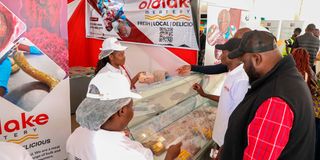
Cowdish Foddex exhibitors engage with clients on Day 2 of the Nation Media Group Kenya Meat Expo, held at the KICC in Nairobi on Thursday, August 7, 2025.
Photo credit: Dennis Onsongo | Nation
“Livestock farming has enabled us to educate our children, build our homes, and live dignified lives. All we ask is that the county supports our efforts by investing in better slaughter facilities and livestock development,” said Mariam Mohammed, a cooperative member attending the Meat Expo 2025.
The rise of such cooperatives across northern Kenya reflects growing calls at the recent Kenya Meat Expo 2025, where stakeholders stressed the need for innovation, climate adaptation and inclusive economic models to support pastoralist communities.
Dryland Learning and Capacity Initiative CEO Jasso Mokku urged urgent support for livestock farmers grappling with climate shocks.
“No animal should die,” he stated, citing the devastating 2022 drought, which wiped out 2.6 million animals valued at $220 billion. Mr Mokku criticised the prevailing notion that pastoralism is outdated.
“The narrative that pastoralism is something of the past must change. It is a smart, climate-resilient initiative,” he said.
Despite supplying 70 percent of the country’s meat, pastoralists continue to operate with minimal investment and policy support—a reality, Mr Mokku says, stemming from outdated and ineffective agricultural models.
“Our agricultural policies are not working. We keep promoting traditional farming methods that continue to fail. Pastoralism is scientific, scalable, and should be fully integrated into our national frameworks,” he argued.
The Kenya Export Promotion and Branding Agency echoed these sentiments, saying the livestock and meat sector’s crucial role in driving Kenya’s export-led economy.
“This sector is vital in growing our exports,” said David Yamina of the agency, noting that Kenya’s total export value has reached USD 100 billion, with a 22.8 percent growth rate between 2020 and 2024. He also pointed to emerging markets in the Middle East, including UAE, Saudi Arabia, Iran and Kuwait, as well as expanding opportunities within Africa.
Mr Yamina highlighted branding and media engagement as critical components in enhancing market access.
“We have received more than one million potential buyers showing interest in our products,” he revealed. “However, we are yet to build the capacity to meet this growing demand.”