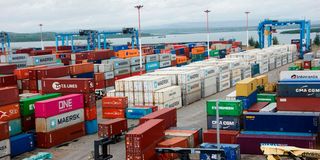
Clearing and forwarding agents at the Port of Mombasa have suspended cargo handling services for goods destined for South Sudan.
The move follows the introduction of a new charge of $3,580 (Sh461,820) per container, which the agents say was imposed without consultation with key stakeholders.
Speaking in Mombasa, Mr Roy Mwanthi, representing the agents, said the government of South Sudan issued the notice on the new levy without following international diplomatic procedures and without engaging those directly involved in cargo transportation.
"We were shocked to get the communication from South Sudan Revenue Authority (SSRA) commissioner general William Kuol even without consulting us," said Mr Mwanthi.
In a notice dated November 17, 2025, Juba introduced the new charges, which will be applied to shippers, clearing and forwarding agents, and transporters handling South Sudan cargo.
In the same notice, SSRA also abolished the container deposit fee of $5,000 (Sh645,000) for cargo destined for Juba from the Port of Mombasa. The fee acts as security to assure transporters that the container will be returned, and its removal is disadvantageous to traders.
The abolishment of the container deposit fee has been opposed by shippers and clearing and forwarding agents, who say many containers destined for Juba do not return and the amount is used as compensation for the loss.
"The removal of the fees is advantageous to South Sudan traders but puts shippers and clearing and forwarding agents at risk of losses since container return or in good condition is not assured," said Mr John Mwangi, a Mombasa-based clearing and forwarding agent.
By abolishing the fee, the South Sudan government intended to increase the 1.5 million tonnes of cargo handled through the port of Mombasa by reducing the cost of doing business.
But cargo handlers in Mombasa have already warned that the policy will force them to abandon the cargo since the government has not put in place safeguards to protect containers, most of which are never returned to Kenya once they land in South Sudan.
They complain that the fee is excessively high and will negatively affect regional trade between the two countries. The agents warned that the move is likely to cause major cargo delays and financial losses for traders.
The agents have now called on the Kenyan government and relevant authorities to intervene to prevent serious disruption to the transport and logistics sector. On Friday, clearing and forwarding agents said cargo services to South Sudan will remain suspended until the new charge is withdrawn and formal consultations are held.
In the notice, the commissioner general urged cargo handlers to secure OTPs exclusively through the official government e-government portal to ensure that the OTP is properly generated, verified and preserved prior to the release or onward movement of any cargo bound for South Sudan.
The commissioner general said the policy is a cornerstone of the government's unwavering commitment to streamlining cargo management, eliminating container loss, and strengthening coordination among regional ports, shipping lines and South Sudan's logistics authorities.
"The decisive action undertaken jointly by the governments of Kenya and South Sudan to provide substantial relief to South Sudanese traders and signals a new era of regional cooperation," said Mr Kuol.
The South Sudan business community in Mombasa chairman Emmanuel Kachuol said its members have been at the forefront for the last 10 years advocating for the abolition of the empty container deposit fees. Mr Kachuol said that with the right tracking, shipping lines will be assured of the return of their containers.
"Finally, the exorbitant empty container deposit fee has been abolished. This prohibitive fee has been so high and negatively affected the entire business chain in South Sudan," said Mr Kachuol.
He added, "With the abolishment of the fees, South Sudan traders will be motivated to do business with Kenya due to low operation cost".
But shippers have warned that the lack of container deposit fees will lead to huge losses, saying maritime containers are high-value assets and protecting them is essential for stable and sustainable logistics.