As South Sudan grapples with a deepening economic collapse driven by years of civil war and plummeting oil revenues, a shadow economy is thriving—one that is enriching its neighbours while draining the country’s natural resources.
A new report presented to the United Nations Security Council reveals how illicit trade in gold and charcoal, facilitated by military actors and informal networks, is funnelling millions into Kenya and Uganda.
These trades, largely unregulated and often illegal, have become lifelines for South Sudanese citizens and soldiers alike, but at a devastating cost to the nation’s forests, institutions, and future.
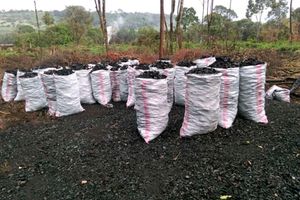
The report by a panel of experts tabled before the United Nations Security Council in July this year, but publicised this week, says South Sudanese security forces and in particular the South Sudan People’s Defence Forces (SSPDF) are among key participants in the country’s charcoal trade where they engage in charcoal production and transportation often using military vehicles to Juba where it fetches a higher price.
According to the report, several military and police vehicles are transporting charcoal, which is sold along the roads outside of the city and some is exported to Kenya and Uganda.
“Charcoal is also exported to Kenya and Uganda, where prices can be higher. Documents dated January 2025 viewed by the Panel contain details of charcoal being exported to Uganda by trucks via Kaya border crossing, with each truck loaded with 300 bags,” the report says.
In February 2025 a large sack of charcoal would cost around SSP50,000 to SSP 60,000 ($384 – $461) in Juba and SSP25,000 ($192) a little outside the capital and as little as SSP 10,000 to SSP 12,000 ($77 – $92) in more rural areas.
“As charcoal can be produced at little cost, these revenues are mostly profit for the producer,” the report says.
Charcoal remains the dominant source of household fuel in South Sudan, including Juba, but illegal charcoal production is a major threat to the country’s forests.
Soldiers of the South Sudan People's Defence Forces at the SSPDF Headquarters in Juba on December 28, 2022.
Photo credit: File
According to the report, the gold deposits of South Sudan have also attracted attention in the wake of oil export disruptions, with the exploitation of the country’s gold remaining almost entirely unregulated.
The report notes that the huge majority of the gold that is mined is smuggled across to Kenya and Uganda, where many traders sell it for dollars with which they purchase goods to resell back to South Sudan.
“The vast majority of the gold that is mined and traded in this way is then smuggled across to Kenya and Uganda, where many traders sell it for dollars with which they purchase goods to resell back to South Sudan,” the report says.
“Gold thus also works as an alternative form of foreign currency in a context where the South Sudanese Pound is not widely accepted in the region and foreign currency is scarce.”
The report notes that on several occasions, local authorities and the Central Bank of South Sudan have sought to purchase gold from miners but their efforts have been undermined by foreign traders who offer better prices often on the basis of the parallel rather than the official exchange rate.
While South Sudan does not record or publish any formal trade data, the United Arab Emirates reported gold imports from South Sudan worth $20 million in 2022 and $27 million in 2023 “It is likely that significant quantities of South Sudanese gold are reclassified as being from Uganda or Kenya,” says the report.
South Sudan is experiencing a real economic crisis, with the country’s oil production, a key source of revenue, plunging significantly. During the country’s first year of independence, South Sudan produced almost 350,000 barrels of oil per day, netting the Government more than $3 billion in revenues.
However, by 2018, following years of conflict, production had more than halved while the Government’s share of revenues dipped below $1 billion.
The economic crisis in South Sudan has forced many of its citizens, including members of the armed forces, into the illicit and informal economy, hastening the depletion of natural resources and encouraging illegal checkpoints and other forms of predation.
A number of the South Sudanese told the Panel of experts about the ways in which their daily lives are increasingly shaped by smaller acts of misappropriation and abuses of power, noting the corrosive impact this has had on their relationship with the State and its institutions.
Several described acts of petty extortion as completely ‘normalised’ and just a part of life in South Sudan.
Traffic police routinely stop motorists to demand payment, public hospitals ask you for money before you are treated, and police demand payment before they investigate crimes.
In February last year (2024), damage to one of the pipelines that transports the country’s oil further reduced oil exports by around 70 per cent, limiting production to around 45,000 barrels per day.
South Sudanese security forces are among key participants in the country’s charcoal trade.
Photo credit: File I Nation Media Group
Without restoring oil exports to their previous levels, the Government estimated that it would only be able to fund around half of its planned expenditure during the current 2024/2025 financial year, and it has struggled to meet basic spending commitments.
The Government is not, however, without resources.
It has continued to export one cargo of Nile blend crude oil per month during the current 2024/2025 financial year, each worth around $45 million.
Oil revenues have also likely been boosted by the fact that in-kind transfers to the Sudan of around 28,000 barrels per day appear to have been suspended, or substantially reduced only to around 2,500 barrels per day.
In addition, the Government has also collected around 50 to 60 billion South Sudan pounds ($11-13 million) per month in non-oil revenues.
The entire monthly salary budget of South Sudan for both organised forces and civil servants total just SSP 53 billion ($11.8 million) for the 2024/2025 financial year and could therefore, in principle, be accommodated by these limited resources.
Similarly, the failure to adequately finance electoral institutions and security arrangements largely preceded oil export disruptions.
The Government exceeded its revenue target for the 2023/2024 financial year, but nevertheless accrued months of salary arrears.
According to the report, the humanitarian situation in South Sudan has continued to deteriorate amid ongoing insecurity, the conflict in Sudan, flooding and an economic crisis.
As of December 2024, around 6.3 million people, or around half the population, are facing crisis (phase 3) levels of food insecurity or above.
In total 76 of the 79 counties in South Sudan face crisis or worse levels of food insecurity, while malnutrition data, often considered a more reliable measure of the ground conditions, indicate a ‘full-blown’ public health emergency.
In total, 1.71 million South Sudanese face ‘emergency’ (level 4) levels of food insecurity, while around 41,000 people face ‘catastrophe/famine’ (level 5).