Have you ever gone shoe shopping, and asked the salesperson for a certain size, only to find that there is not much to choose from?
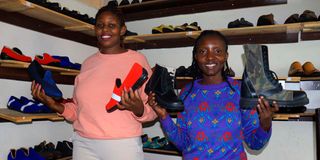
This scenario is what motivated Njeri Mbote, 30, and Daisy Rono, 28, to invest in a business specifically selling footwear targeting the African market. At the time of setting up their business, they did not have lots of money to invest, starting with a capital of Sh3, 000.
They started VaaKenya in 2017, starting off as an informal enterprise, selling shoes from artisans based at the Kariokor Market. To ensure that they reached a wider market, they would market the shoes online.
After a short while, they began getting numerous customisation requests, which proved them right – that there was a shortage of standard African shoe sizes. The requests overwhelmed them, there was a need, but they found it difficult to meet this need because the artisans they relied on lacked the skill and capacity to deliver.
“This opened up the shortcomings we had in this industry - lack of standard African shoe sizes and lack of financial and talent capacity,” says Njeri.
The two realised that to solve these problems, they needed to understand how the industry works from the inside. This led them to open their first workshop in Donholm Estate, Nairobi, where they started manufacturing shoes. Their biggest challenge was the artisans, since they were few, and retaining them was very hard.
“Most of them were entrenched in the informal sector with minimal skills. It was always quantity over quality. To scale, we needed to be able to retain artisans and also increase our production capacity by buying more machines and equipment.”
Njeri Mbote co-founder VaaKenya shoe company during an interview at His workplace at Donholm on July 27, 2021.
Photo credit: Sila Kiplagat | Nation Media Group
The duo set out to look for an investor, getting their first angel investor who invested Sh1.3 million into the business. With the funding, they were able to expand, afford good talent and retain it, retrain and acquire the space for more research and developing their products.
In March 2019, they registered the company as a limited liability company.
“We immersed ourselves deep into the industry to learn all its aspects, from suppliers, manufacturers, distributors, and consumers. At the same time, our sales were increasing, such that we started taking bulk orders, which brought us back to our capacity deficit.”
They got another boost when they were awarded a Sh2 million grant from the US African Development Foundation, funding that enabled them to launch an apprenticeship program, training 10 young people with no prior experience in the art of shoemaking, and their intention was to increase their talent capacity.
“Our company name, VaaKenya means ‘wear Kenya’ in English, and was inspired by the fact that ‘made in Kenya’ is best for Kenyans as it is made for us and with us in mind,” says Njeri, adding,
“We source leather from local tanneries in bulk and supply them to our manufacturers. Everything else is bought from informal distributors in Kariokor and Gikomba Markets.”
They do marketing via their website and through WhatsApp, where their orders are processed. If the shoe is not in stock, it is placed in the production schedule and delivered within 72 hours - they offer countrywide deliveries via parcel services.”
For those that may like to look, touch and appreciate the workmanship of the product before buying it, they have a workshop in Donholm to cater for this buyer. The cost of their products ranges between Sh300 to Sh20, 000.
“We work with local tanneries to get good quality leather at affordable rates. Our soles are soured here too. Initially, the first soles we used for our safety boots were imported, but they were expensive, and the shipping times did not work for us. We, therefore, collaborated with a local sole manufacturer, World Boot, and designed our own version.”
“We are a team of seven who form the core operations team but also work with many outsourced independent contractors. We are not only supporting those who make our shoes, but also various subsectors that supply us with raw material.”
VaaKenya’s main challenge when starting was the lack of goodwill in made-in-Kenya products. Most Kenyans relate products produced in Kenya with low quality, but the government, in partnership with local manufacturers, has been running campaigns to change this mindset. “Today, our biggest selling point is the fact that our products are made in Kenya,” Njeri points out.
“Our aggregated capacity is heavily underutilised as a result of inadequate capital. We are sometimes unable to meet huge production financial demands. We are a growing start-up, and the current size of our asset base has not been sufficient enough to attract commercial investment, particularly where such is required as collateral.”
“Formal linkages between these two sectors do not exist, a factor that has led to the informal sector being excluded from the market and financial access. The informal sector also exists in a fragmented nature, thus aggregating them is a new concept to them, however, their reception has been very optimistic.”
In the next 10 years, the company is looking to build jua kali manufacturers’ capacity and be the go-to-market partner of choice for informal sector manufacturers, and become the trusted brand for made-in-Kenya products.
With 90 per cent of Kenyan manufacturing happening in the informal sector, this business model has the potential to boost employment of youth, drive manufacturing and bring consumers and companies a brand they can interact with, hold accountable and be proud that it was truly made in Kenya by people who own their labour.
“Once we figure out the Kenyan market, our business model can be easily replicated across the African market with the goal of availing made in Africa products to the world. The market is ripe for Africans to finally produce and consume their products amongst themselves,” concludes Njeri.