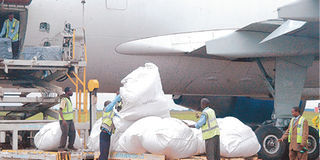
The Kenya Revenue Authority (KRA) will install advanced three-dimensional (3D) and artificial intelligence (AI) scanners at Eldoret Airport to cut clearance time for cargo.
Mr Abdi Malik Hussein, Chief Manager for Customs and Border Control in the Rift Valley, said the upgrade is part of KRA’s ninth corporate plan, which runs from July 2024 to June 2029.
“With AI, 3D technology and the installation of a bigger scanner, we should expect minimal interference when it comes to the arrival of cargo,” Mr Hussein said.
“If we have proper declarations from merchants and improved scanning, cargo should flow fast. We foresee an average of three hours within which cargo is cleared and loaded to its destination.”
According to the airport management, it takes four to five hours to offload, scan, verify and clear consignment – largely imported goods by small-scale traders in one large container.
The goods mostly include mobile phones, laptops, TV sets and related accessories, as well as furniture and automotive spare parts.
Times Tower, the Kenya Revenue Authority's head office in Nairobi.
Photo credit: File | Nation Media Group
Unlike Jomo Kenyatta and Mombasa airports, which get scheduled flights, Eldoret mainly handles chartered aircraft.
“What this means is that any plane that arrives is given priority in terms of cargo clearance – the time of loading, scanning, verification and release,” Mr Hussein said.
To facilitate faster clearance, customs officers encourage traders to adopt “wheels-up declarations” by filing manifests as soon as the plane departs from its origin.
“Wheels-up means that as the aircraft is leaving Dubai, for instance, the manifest has already been lodged with the consolidator,” Mr Hussein said.
“Cargo clearance is anchored on self-assessment in the Integrated Customs Management System. What this means is that the merchants, consolidator or the clearing agent can put up the declaration – ‘this is what I have imported via this manifest’. On arrival, government agencies just go through the documentation.”
Three to five consolidators operate at the airport, which gets five cargo flights every week on average. They include Ethiopian Airlines, which operates on Wednesdays and Fridays, Kenya Airways on Thursdays and Fridays, while private chartered flights also ferry consolidated goods.
Cargo flights at the airport resumed in March 2024 after being temporarily suspended for at least eight months following the KRA’s shift from a weight-based to a unit-based taxation system for consolidated cargo in March 2023. The change was initially resisted by traders, resulting in a drastic drop in cargo volumes.