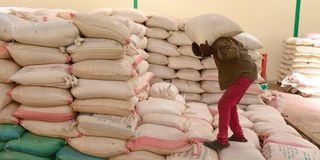
It is an early Christmas for maize farmers as the cost of the commodity skyrockets amid a price rivalry between the National Cereals and Produce Board (NCPB) and millers, driven by increased demand for the staple.
Maize prices have risen from Sh2,800 to Sh3,200 per 90kg bag in the past month, even as food security experts warn of an impending hunger crisis linked to climate change and economic pressures.
While the NCPB is targeting to purchase up to two million bags at Sh3,500 per 90kg—amounting to Sh7 billion for the National Strategic Food Reserve—millers and traders have raised their buying price to as high as Sh3,600 in a cut-throat competition to bolster their stocks.
NCPB management has admitted that deliveries to its buying centres remain slow, having purchased about 80,000 bags of 50kg maize in the past two months.
“The delivery of produce to our buying centers is slow but steady and we urge farmers to take advantage of our attractive prices,” said Titus Maiyo, NCPB Corporate Communications Manager.
Agriculture Cabinet Secretary Mutahi Kagwe said the government distributed 21.3 million bags of fertiliser worth Sh53.25 billion. Of these, 6.9 million bags were issued for the long-rains season, with plans to scale up to 12.5 million bags next planting season.
Agriculture and Livestock Development Cabinet Secretary Mutahi Kagwe address journalists during the opening of the UN food system summit (UNFSS+4) Africa region preparatory meeting held in Gigiri, Nairobi on May 5, 2025.
Photo credit: Lucy Wanjiru | Nation Media Group
Millers have, however, warned of further price increases due to high demand, citing the Early Warning on Acute Food Insecurity Outlook, which indicates Kenya has re-emerged as a hunger hotspot.
The report attributes the looming crisis to poor rainfall forecasts, high food prices and intensifying conflict over scarce resources.
According to the Kenya National Bureau of Statistics (KNBS), Kenya has imported an average of 295,092 tonnes of maize annually over the past five years.
Imports from Uganda rose sharply—from 2,629 tonnes to 34,590 tonnes—in the 2022/2023 marketing year.
Zambia’s exports to Kenya rose from 10,728 tonnes to 88,050 tonnes during the same period, while imports from South Africa increased from 2,782 to 64,512 tonnes.
Imports from Tanzania, however, declined from 708,978 tonnes to 412,755 tonnes due to export constraints.
Millers are urging the government to harmonise cess and levies across counties to facilitate a steady flow of maize.
“Maize prices are expected to rise as millers and traders camp in the North Rift region offering above Sh3,000 per 90kg bag at farm gate level,” said Joshua Kosgei from Eldoret.
Maize farmers in the North Rift region have taken the government to task over the deteriorating buying prices for the crop.
Photo credit: John Njoroge | Nation Media Group
At the same time, the country is staring at an impending wheat shortage as more farmers abandon the crop—one of Kenya’s key staples—due to volatile market prices, disease outbreaks, climate change, and a shift toward more profitable ventures.
Agriculture experts warn that rising production costs—including fertiliser, seeds and herbicides—have contributed to reduced acreage under wheat cultivation. KNBS data shows that wheat acreage fell from 119.6 thousand hectares in 2022 to 104.4 thousand hectares in 2023.
“It is increasingly risky to invest heavily in wheat production due to unpredictable weather patterns, disease outbreaks, and unstable market prices,” said David Sang from Sergoit, Uasin Gishu County.
Wheat production dropped from 368.7 thousand tonnes in 2022 to 309.5 thousand tonnes in 2023, with the value of the crop falling from Sh14.7 billion to Sh12.3 billion.
Kenya produces an average of 365,600 tonnes of wheat annually against a consumption of 8.4 million 90kg bags, forcing the country to import the deficit.
The Rift Valley produced an average of 4.5 million bags of wheat from 127,825 hectares last season.
Acreage in Uasin Gishu County fell from 40,000 hectares to 18,000 hectares as farmers shifted to maize, horticulture, and dairy farming.
County records show wheat acreage declined from 19,140 hectares in 2019 to 13,791 hectares in 2020, with production dropping from 57,420 thousand 90kg bags to 42,369 thousand bags over the same period.
The highest acreage recorded was in 2021 at 32,271 hectares, producing 117,151 thousand 90kg bags. By 2023, this had fallen to 21,304 hectares and 72,252 thousand bags.
KNBS data indicates the country produced 310,973 metric tonnes of wheat from 102,560 hectares in 2024. Agriculture experts warn yields may be lower this season as more farmers switched to maize following last year’s attractive prices of Sh6,400 per 90kg bag.
Most millers are currently buying wheat at Sh4,800 per 90kg bag—a price farmers say is too low given rising production costs. Bakers have increased prices of wheat products by 16 percent, citing high raw material costs.
The price of a 400-gram loaf of bread has risen by Sh10 to Sh70, while the 800-gram loaf has increased from Sh130 to Sh140.
Agriculture experts note that rising wheat demand and changing diets pressure global grain markets, often pushing up prices and disrupting trade when droughts or floods hit major wheat-producing regions.
“By 2050, the world population will exceed 9.6 billion, and demand for wheat, maize, and rice is expected to increase by at least 60 percent.
Wheat is a key source of calories and protein for 4.5 billion people across more than 100 countries,” states the annual global wheat production report.
Local farmers have expressed concern over stagnating yields due to recurrent stem rust and the Ug99 wheat disease strain. They are calling for new technologies to help increase production and improve earnings.
“Apart from adopting new technologies, wheat farmers need access to superior, climate-adapted, disease-resistant seeds to boost production,” said Jackson Kosgei from Sergoit, Uasin Gishu County.
Wheat was Kenya’s second most important cereal after maize five years ago, but production and consumption have since declined as farmers diversify to more profitable ventures.