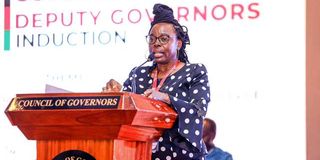
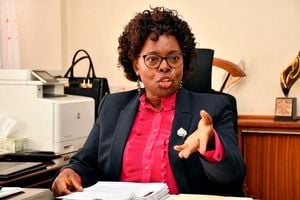
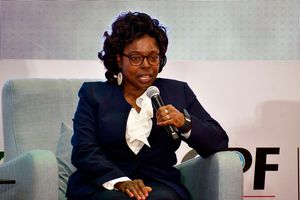
The Controller of Budget (CoB) Margaret Nyakang’o wants the government to limit borrowing for development projects, as it emerged that Sh507.98 billion was incurred in debt repayments during the first three months of the current financial year.
In a review of the national budget implementation for the first three months of the 2025/26 financial year, the CoB notes that increased borrowing to finance the Sh4.69 trillion budget on projects that have no economic or social returns exposes the country’s fiscal space.
This, even as Dr Nyakang’o noted that the debt repayment during the period under review represents 27 percent of the revised estimates, compared to the Sh325.52 billion or about 17 percent, recorded in a similar period of the last financial year, 2024/25.
The CoB mainly attributes the increase spending to the settlement of principal payments for both external and domestic debts, which stood at Sh251.80 billion compared to Sh95.54 billion paid in a similar period in the 2024/25 fiscal period.
“To enhance fiscal impact and ensure debt sustainability, borrowing should be strictly aligned with development projects that have measurable economic and social returns,” says Dr Nyakang’o.
The allocation towards public debt service in the current financial year is Sh1.90 trillion, representing 89 percent of the Consolidated Fund Services (CFS) budgetary allocation, compared to revised estimates of Sh1.74 trillion allocated in the financial year 2024/25.
This comprised Sh803.70 billion for principal redemption and Sh1.10 trillion for interest payments during the period.
The government’s debt repayment within the first three months of the 2025/26 fiscal period includes Sh213.09 billion in external debt service, broken down as Sh141.10 billion on principal payments, Sh71.68 billion on interest payments, Sh255.37 million on commitment fees, and Sh50.28 million on other charges.
Domestic debt drinks up nearly half of all the tax revenue collected in the country.
Photo credit: Shutterstock
The domestic debt payment during the first three months stood at Sh294.89 billion, consisting of Sh110.70 billion in principal payments and Sh184.20 billion for interest payments.
A burgeoning public debt has seen a huge chunk of the revenues collected locally allocated to its repayment, crowding out recurrent and development expenditures.
This has left the government with the easiest alternative of accumulating commercial loans to pay salaries for public sector workers, development, and even debt servicing.
“Recurrent expenditure should be contained through expenditure rationalization, efficiency gains, and stronger public financial management controls,” says Dr Nyakang’o.
The CoB document shows that the public debt stock increased by 2 percent from Sh11.80 trillion as of June 30, 2025, to Sh12.04 trillion as of September 30, 2025.
This was, however, marked with external debt declining by 2 percent due to repayments, while domestic debt recorded 5 percent growth attributable to increased borrowing in the domestic market.
The public debt stock comprises Sh5.39 trillion owed to the external lenders, or about 45 percent, and Sh6.65 trillion due to lenders from the domestic market, which is 55 percent.
The composition of external debt as of September 30, 2025, includes multilateral debts of Sh3.057 trillion, commercial bank loans of Sh1.26 trillion, bilateral loans of Sh1.065 trillion, and suppliers’ credit of Sh14.51 billion.
Kenya's domestic debt stock has jumped to Sh5.4trn as of the end of June 2024 from Sh4.832trn.
Photo credit: Shutterstock
The domestic debt is largely dominated by Treasury bills and bonds to the tune of Sh6.65 trillion, overdraft of Sh55.02 billion, and IMF Special Drawing Rights(SDR) funds on-lent to the government of Sh78.93 billion. The SDR is an international reserve asset created by the IMF to supplement the official reserves of its member countries..
To finance the 2025/26 financial year budget, the government, through the National Treasury, targeted to raise funds from various revenue sources.
The sources include tax revenue of Sh2.63 trillion, non-tax revenue Sh127.65 billion, domestic borrowing of Sh1.10 trillion - comprising net domestic borrowing of Sh634.75 billion and internal debt redemption or roll-over of Sh463.51 billion.
Other sources of revenue to finance the budget include external loans and grants of Sh561.81 billion and other domestic financing of Sh10.80 billion.
The government also targeted to raise Sh672 billion in Appropriations-in-Aid (A-I-A), comprising Sh334.26 billion recurrent A-I-A and Sh337.74 billion development A-I-A.