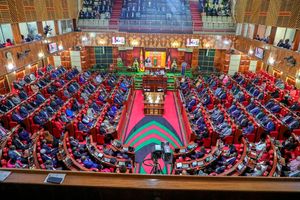
Five counties contribute almost half to the country’s Gross Domestic Product (GDP) as 16 others account for less than one per cent each, the latest devolution watch report shows.
The report, released by the Parliamentary Budget Office, reveals the unequal development in the growth of counties.
The five that contribute 49 per cent of the country’s GDP – which indicates the health and size of a country’s economy – are Nairobi, Kiambu, Nakuru, Mombasa and Machakos.
According to the report, Nairobi has the largest contribution share at 29.5 per cent, followed by Kiambu at 5.6 per cent, Nakuru (5.2 per cent), Mombasa (5.2 per cent) and Machakos at 3.4 per cent.
The report attributes the high performance of the counties to their being peri-urban centres with diverse economic activities.
It also highlights the next tier of counties whose economies have a significant contribution to Kenya’s GDP at more than one per cent.
These include Meru (three per cent), Kisumu 2.5 (per cent), Uasin Gishu (2.4 per cent), Kilifi (2.1 per cent), Kakamega (2.1 per cent), Murang’a (1.9 per cent), Bungoma (1.9 per cent) and Nyeri 1.9 per cent.
The category also has Kisii at 1.8 per cent, Narok (1.6 per cent), Kericho (1.6 per cent), Kajiado (1.6 per cent), Nandi (1.5 per cent), Bomet (1.5 per cent), Trans Nzoia (1.5 per cent) and Embu at 1.4 per cent
Others are Kwale (1.2 per cent), Migori (1.2 per cent), Kirinyaga (1.2 per cent), Kitui (1.2 per cent), Homa Bay (1.2 per cent), Nyandarua (1.2 per cent), Makueni (1.1 per cent), Nyamira (one per cent), Turkana (one per cent) and Siaya (one per cent).
While some counties have an optimistic economic outlook in terms of their contribution to the country’s GDP, sixteen others collectively contributed only 7.5 per cent.
“Many of these regions are marginalised, facing challenges such as drought, poor infrastructure and limited economic investment,” the report says.
These regions are Isiolo at 0.3 per cent, Samburu (0.3 per cent), Tana River (0.3 per cent), Lamu (0.3 per cent) Wajir (0.5 per cent), Mandera (0.5 per cent), Garissa 0.6 (per cent) and Tharaka Nithi (0.6 per cent)
Others are Marsabit (0.6 per cent), Taita Taveta (0.6 per cent), West Pokot (0.7 per cent), Baringo (0.7 per cent), Vihiga (0.7 per cent), Busia 0.8 per cent), Laikipia (0.9 per cent) and Elgeyo Marakwet (0.9 per cent)
According to the report, five counties stand out as the fastest growing in manufacturing.
These are Bomet at 24.6 per cent, Vihiga (25.7 per cent), Nandi (15.2 per cent), Machakos (15 per cent) and West Pokot (14.8 per cent).
Workers make useable items from bamboos in Lwandoni village, Vihiga County.
Photo credit: Isaac Wale | Nation Media Group
“Their strong performance was largely driven by the expansion of small-scale agro-processing and the continued revival of cottage industries supporting local value chains,” the report continues.
Counties like Busia, Laikipia, Meru and Tana River sustained stable growth averaging eight to 12 per cent, supported by improved infrastructure, better access to markets and rising private-sector investment.
According to the report, Nairobi, Kisumu, Nakuru and Mombasa continue to anchor national manufacturing output, even as competition from emerging regional industries intensifies.
For instance, Nairobi recorded an 8.2 per cent growth in 2023, while Mombasa posted 14.8 per cent, both reflecting renewed investor confidence and capacity expansion.
“However, counties such as Migori, Kericho, Narok and Kisii experienced high fluctuations in growth due to seasonal agricultural dependence and limited industrial diversification,” it says.
The report notes that other counties like Mandera, Marsabit and Garissa are coming up steadily in manufacturing, registering an increase of 10.6 per cent, 9.2 per cent and 2.8 per cent respectively.
The growth of these regions is particularly noticed in livestock-based manufacturing and the production of construction materials.
“With continued investment in energy, transport and trade infrastructure, these counties are poised to become Kenya’s next frontiers of industrial development,” the report continues.
Homa Bay Governor Gladys Wanga (second left) showcases the Homa Bay envisioned city to Deputy President Kithure Kindiki during the official closing of the Devolution Conference 2025 at Homa Bay High School on August 15, 2025.
Photo credit: Alex Odhiambo | Nation Media Group
The Devolution Budget Watch 2025 presents an in-depth assessment of county budget implementation for the Financial Year 2025/26, focusing on the evolving fiscal environment, sectoral investments and the performance of devolved services.
The report underscores the growing importance of devolved governments in national growth, with sub-national economic activity recognised as the main contributor to Kenya’s GDP.
While coming up with the report, the Parliamentary Budget Office, a think-tank that advices Parliament, assesses a series of important issues in the implementation of approved county government budgets, with the objective of providing strategic oversight tools for the Senate, County Assemblies and the citizens to enhance the prudent management of public resources.
The team assesses the implementation of budgets within a constrained fiscal environment by devolved governments.
Governors during the Biennial Devolution Conference at Eldoret Sports Club in Uasin Gishu County on August 17, 2023.
Photo credit: Jared Nyataya I Nation Media Group
It also highlights the growing role of counties in driving Kenya’s economic performance, underscoring the need for equitable resource allocation and strengthened fiscal accountability.
The report has been released at a time county governments face mounting operational challenges, from delayed Exchequer releases and slow uptake of electronic procurement to legal uncertainties surrounding bursary administration and wage pressure in the health sector.
The report is designed to support the Senate, County Assemblies, policy-makers and the public in strengthening devolution by shedding light on budget implementation realities, sectoral trends and emerging risks.