Only 4 per cent of Kenyans have the income to afford a mortgage of Sh10 million amid the rise in home prices.
A new survey by pension firm Zamara, the Centre for Affordable Housing Finance in Africa and Financial Sector Deepening Kenya show that only 6,146 of 145,205 pension scheme members can afford a house loan of more than Sh10 million, representing 4.23 per cent of the respondents.
This is in line with Central Bank of Kenya (CBK) data that shows that the average home loan has increased to Sh9 million from Sh6.9 million in 2013 and Sh7.5million in 2014, a jump blamed on expensive homes and upfront fees.
Besides rising home prices, the survey reckons that stagnant pay and costly mortgage have locked out a majority of Kenyans from bank-financed housing.
CBK data shows the average size of a mortgage is Sh9 million with a repayment period of 11 years at an interest of 14.9 per cent.
This type of loan will attract a monthly instalment of at least Sh140,000 and one would require a gross monthly salary in excess of Sh420, 000, given that banks demand that borrowers retain a third of the pay after all deductions.
Over 85 per cent of Kenyans earn less than Sh100,000 per month, official data shows.
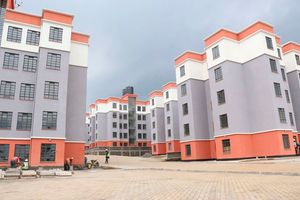
High mortgage rates slow down mortgage uptake.
Photo credit: Shutterstock
“High interest rates, strict eligibility criteria, and low income levels push most households to rely on short-term, high-interest personal loans or informal financing, which are not ideal for long-term housing projects,” the report read in part.
Banks have pointed at low level of income against high cost of property purchase, as a major impediment to the growth of Kenya’s mortgage market. The banking sector had issued 30,016 mortgage loans against a formal employment of 3.4 million Kenyans.
According to the Zamara survey, 22.7 percent of respondents can afford a Sh3 million house with a favourable 25-year repayment period and at 9.5 percent.
“Under the subsidised Kenya Mortgage Refinance Company rate of 9.5 percent, a household earning Sh100,000 per month can qualify for a mortgage of Sh3.4 million, enough to purchase a typical Affordable Housing Programme unit.”
Zamara highlighted the profile of the pension scheme members, with about half or 47 percent, earning below Sh50,000, 42 percent taking home between Sh50,000 and Sh150,000 and 11 percent getting over Sh150,000.
The report has pointed out that the AHP’s attempt to “solve the price equation, fails the ‘livability test.’”
This is because the affordable housing stock comprises primarily studio, one-bedroom, and two-bedroom units, designed to meet affordability targets rather than family requirements.
“Our survey indicates that most members predominantly in their 30s and 40s aspire to own three- or four-bedroom homes suitable for families with children... This points to a fundamental disconnect between policy intent and market demand,” the report added on family size mismatch.
Three-bedroom houses under the affordable housing project are targeted to be sold at Sh3 million a unit.
About one in ten (12.2 percent or 17,725) respondents can afford a five-million-dollar house comfortably without much financial strain.
The number of non-performing mortgages in the banking sector in 2022 rose by the sharpest margin in five years, the latest data by the Central Bank of Kenya (CBK) shows, pointing to the deep struggles of borrowers in a deteriorating economic environment.
Photo credit: Shutterstock
“[This] represents mid- to upper-income earners capable of servicing larger loans, though at higher financial commitment levels,” the survey read in part.
Only four percent or 6,146 of the sampled Kenyans said they can afford a house loan of more than Sh10 million.
Most of the properties on the market are targeted at the middle class with a recent report noting that there is a shortage of low-cost housing.
The Kenya Bankers Association has previously said that this shortage was because developers are inclined.