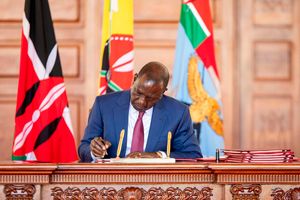
A civil rights organisation has sued, seeking to block the implementation of the newly enacted Government Owned Enterprises Act, arguing that the sweeping restructuring of State corporations violates constitutional safeguards, lacks public participation, and risks undermining Parliamentary oversight of strategic national assets.
The Centre for Litigation Trust (CLiT) filed the case in the Constitutional and Human Rights Division, targeting the law signed by President William Ruto on November 21, 2025, which designates 65 State-owned enterprises for privatisation.
Among the affected entities are the Kenya Literature Bureau, National Oil Corporation, Kenya Seed Company, Rivatex East Africa, Kenyatta International Convention Centre (KICC), and New Kenya Cooperative Creameries (New KCC) .
While the government maintains that the reforms aim to enhance efficiency, reduce public wage burden, and align State corporations with commercial principles, CLiT contends that the law unlawfully consolidates control under the National Treasury, bypassing Constitutional checks.
A signpost at a petrol station branded by the National Oil Corporation.
Photo credit: File | Nation Media Group
The petition names the Treasury Cabinet Secretary and Attorney-General as respondents, accusing them of sidelining Parliament and the public in managing critical national assets.
"The Act represents a radical shift from the State Corporations Act to a company-law model without transparency, meaningful public input, or adherence to constitutional safeguards," CLiT asserts.
Under the new framework, the Treasury CS gains exclusive authority to hold shares, appoint boards and executives, set strategic direction, and oversee finances—powers the petitioner argues erode parliamentary oversight mandated under Articles 95 and 96 of the Constitution.
The petition highlights that the law repeals or amends statutes governing entities like the Kenya Ports Authority, Kenya Airports Authority, and Kenya Pipeline Company, granting the Treasury unilateral decision-making powers over restructuring, concessions, or sales.
"This centralisation enables Executive overreach, diminishing scrutiny over strategic assets," CLiT warns, adding that Parliament’s role in examining public debt, summoning officials, and representing citizens’ interests is effectively undermined.
The legislative process itself faces sharp criticism for alleged haste and opacity. CLiT describes the bill’s passage as a "blueprint sprint through Parliament," facilitated by a supplementary order that accelerated debate while limiting stakeholder engagement.
The suspension of Deputy Minority Leader Robert Mbui during opposition protests in the House underscores the contentious nature of the proceedings.
The organization argues this hurried process violated constitutional requirements for meaningful public participation under Articles 10 and 118, characterizing the limited consultations that did occur as "cosmetic exercises undertaken merely to tick constitutional boxes" rather than genuine attempts to incorporate citizen input.
According to the petition, affected stakeholders – particularly workers from the corporations facing restructuring – were given insufficient notice and opportunity to engage with the complex legislation.
It cites sparse communication, compressed timelines, and minimal engagement with workers from affected corporations.
"The reforms’ complexity was concealed, and debate truncated," CLiT states, arguing that the process violated constitutional standards and eroded governance credibility.
Most significantly, the petition challenges the transfer of comprehensive authority over state corporations to the Treasury Cabinet Secretary, who, under the new law, gains powers to hold shares on behalf of the national government, appoint board members and top executives, set strategic direction, monitor performance, and exercise financial oversight – all functions previously distributed across different government institutions.
"This unprecedented concentration of power fundamentally undermines the constitutional principle of separation of powers," argues CLiT's legal team in court documents.
"It effectively sidelines Parliament from its constitutionally mandated oversight role regarding national assets and public finances as outlined in Articles 95 and 96 of the Constitution."
The organization highlights particular concern about provisions allowing the Treasury CS to make unilateral decisions regarding the restructuring or potential sale of strategic national assets – including critical infrastructure operators like the Kenya Ports Authority, Kenya Airports Authority, and Kenya Pipeline Company – with only cabinet approval required rather than full parliamentary scrutiny.
The Kenyatta International Convention Centre in Nairobi.
Photo credit: File | Nation Media Group
Beyond domestic concerns, the petition alleges that the Act contravenes international best practices, including OECD guidelines on state-owned enterprises and the UN Convention Against Corruption, which emphasize transparency, separation of ownership from regulation, and fair competition.
"The Act creates precisely the kind of blurred accountability and regulatory capture these international instruments seek to prevent," the petition states.
CLiT warns that converting state firms into Treasury-controlled companies risks market distortions, as implicit government guarantees could disadvantage private investors.
The petitioner argues the legislation fails to resolve what it terms the "dual mandate dilemma" – the inherent tension when state-owned enterprises attempt to simultaneously pursue commercial profitability while fulfilling public service obligations.
The petition contends the law provides no clear legal mechanisms to reconcile these competing priorities, creating potential conflicts that could disadvantage both taxpayers and consumers.
The petitioner seeks a court declaration nullifying the law and suspending its implementation, contending it threatens public ownership and oversight of national assets. The case awaits hearing directions, with respondents yet to file replies.