A few minutes past midday, we arrive at the residence of Mr Samuel Karuma in Kirwara Farm, Elburgon, Nakuru County, barely a five-minute drive (1.5 km) from the Elburgon–Molo road.
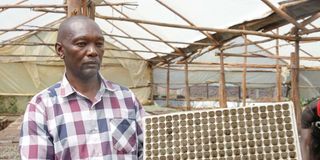
Mr Karuma and his son, Kelvin Gitau, are working inside the unfinished greenhouse, where Mr Karuma grows imported cabbage seedlings using modern technology to sell on.
“The idea to grow cabbage seeds in plug trays came from farmers who had attended seminars in Naivasha.
Since most of them were my customers for my previous ground-grown cabbage seedlings, they told me that this new method was doing well in the market and that the seedlings grew faster than those grown using other methods,” says Mr Karuma, who is watering his seedlings with his son on a quarter-sized plot of land.
Samuel Karuma (right) and his son, Kelvin Gitau, display some of the cabbage seedlings that they have grown on plug trays inside a greenhouse at Kirwara Farm in Elburgon, Nakuru County.
Photo credit: John Njoroge | Nation
I bought 200,000 seedlings from certified and recommended dealers at a cost of Sh200,000,” said Mr Karuma, adding that the greenhouse holds 1,000 trays, with 200 seedlings in each.
Once completed, he said, the greenhouse will be able to hold over 400,000 cabbage seedlings.
He said that he had initially started the project using locally available wooden materials and polythene due to the high cost of metal bars.
However, he plans to build a modern metal structure in the future. He revealed that he had used 180kg of imported coco-peat soil, free from diseases, which he had mixed with a 90kg bag of manure, before applying it to the cabbage trays.
“The seeds take four days to germinate if you water them daily, morning and evening. The seeds are ready for sale within one and a half months of planting,” said Kelvin, the manager. He added that the warmth in the greenhouse allows the seedlings to germinate and grow rapidly.
However, he said that aphids attack the seedlings one month before they are ready for sale, at which point they spray the plants with pesticides to kill the aphids.
Mr Karuma noted that with this technology, there are no weeds or diseases, and the seedlings are not disturbed during transplanting, unlike with ground farming. He said that the germination rate is 98 per cent, compared to around 65 per cent for ground-grown seedlings.
Samuel Karuma displays some of the plug trays used for growing cabbage seedlings inside the greenhouse at Kirwara Farm in Elburgon, Nakuru County.
Photo credit: John Njoroge | Nation
His first seedlings did not germinate as well as those in subsequent months, due to logistical challenges as he was unfamiliar with the new technology.
He added that the new project is easier to manage since only water is required, and the number of casual workers needed is also minimised compared to ground farming.
“I did not experience any challenges in the market during my first sale of the new project, since all my former customers came in large numbers after being a cabbage dealer for many years and embraced my new technology. I sold my seedlings for Sh2 each and received over 300,000 shillings,” he says, adding that sales and production were exemplary during the planting season, especially between March and September.
During peak season, the farmer earns over Sh600,000 every month, as each seedling retails at between Sh3 and Sh5.
The farmer attributed his excellent production to quality, certified seeds, sufficient water, and better management. He has a 10,000-litre raised tank, sourced from the local water department, which is located just a few metres from the greenhouse.
He also has two water pans, each holding 50,000 litres, which help him to collect rainwater for use in the greenhouse during heavy rainfall. He says this water is enough to sustain his seedlings, even during dry seasons.
Samuel Karuma (right) and his son, Kelvin Gitau, display some of the cabbage seedlings that were grown in plug trays inside a greenhouse at Kirwara Farm in Elburgon, Nakuru County.
Photo credit: John Njoroge | Nation
Mr Karuma said that he used to grow maize before switching to cabbage seedling farming. However, he has another farm some distance away where he grows Hass avocados for sale.
“I have no regrets about investing in this farming method because, once all the seedlings have been sold, farmers can simply replant more seeds in the same trays without having to prepare the land as they would with traditional ground farming,” Karuma affirms, adding that only a mixture of soil and manure needs to be applied for fresh planting.
He cited water shortages and overgrowth of seedlings caused by a lack of customers as some of the main challenges that farmers face. “When farmers plant the commodity in large numbers, the market price falls, and this affects our businesses,” he said, adding that he sells his seedlings to the local market.
He called on the county government to find better markets, build mini dams and install water tanks to help small-scale farmers, such as those who grow produce in kitchen gardens. “My plan for the future is to expand the greenhouse to more than two acres to meet the increasing demand,” said Mr Karuma.
Samuel Karuma (right) and his son Kelvin Gitau are pictured inside a greenhouse where cabbage seedlings are grown on plug trays at Kirwara Farm in Elburgon, Nakuru County.
Photo credit: John Njoroge | Nation
According to Patrick Manyasa, manager of the organic section at Baraka Agriculture College in Molo, Nakuru County, farmers should prepare their farms in good time and plan the season more effectively to increase production.
“The seedlings can thrive in the dry season because, when transplanted, their roots are not disturbed as they are grown in trays, unlike those planted on the ground. Since they are grown in a greenhouse, farmers should harden off the seedlings before transplanting them so that they can adapt to the outside environment,” he said, adding that crops should not be planted in the same area where similar crops were previously grown.
He urged farmers to ensure they have enough water nearby and to check for pests before planting the seedlings, in order to minimise the risk of attack. He said that well-composed manure is paramount during transplant.