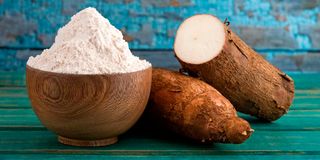
While nearly unknown in temperate climates, cassava is a key source of nutrition throughout the tropics . It was domesticated 10,000 years ago , on the southern margin of the Amazon basin in Brazil, and spread from there throughout the region. With a scraggly stem a few meters tall, a handful of slim branches and modest, hand-shaped leaves, it doesn’t look like anything special . Cassava’s humble appearance, however, belies an impressive combination of productivity, toughness and diversity.
While nearly unknown in temperate climates, cassava is a key source of nutrition throughout the tropics . It was domesticated 10,000 years ago , on the southern margin of the Amazon basin in Brazil, and spread from there throughout the region. With a scraggly stem a few meters tall, a handful of slim branches and modest, hand-shaped leaves, it doesn’t look like anything special . Cassava’s humble appearance, however, belies an impressive combination of productivity, toughness and diversity.
It begins with grinding cassava’s starchy roots on shredding boards studded with fish teeth, chips of rock or, most often today, a rough sheet of tin. Shredding mimics the chewing of pests, causing the release of the root’s cyanide and cyanohydrins. But they drift away into the air, not into the lungs and stomach like when they are eaten.
Cassava is naturally loaded with cyanide, making it deadly if eaten raw.
Photo credit: Shutterstock
Next, the shredded cassava is placed in rinsing baskets where it is rinsed, squeezed by hand and drained repeatedly. The action of the water releases more cyanide, nitriles and cyanohydrins, and squeezing rinses them away.
Finally, the resulting pulp can be dried, which detoxifies it even further, or cooked, which finishes the process using heat. These steps are so effective that they are still used throughout the Amazon today, thousands of years since they were first devised .
A powerhouse crop poised to spread
Amazonians’ traditional methods of grinding, rinsing and cooking are a sophisticated and effective means of converting a poisonous plant into a meal. Yet, the Amazonians pushed their efforts even further, taming it into a true domesticated crop. In addition to inventing new methods for processing cassava, they began keeping track and selectively growing varieties with desirable characteristics, gradually producing a constellation of types used for different purposes.
In our travels, we have found more than 70 distinct cassava varieties that are highly diverse, physically and nutritionally. They include types ranging in toxicity, some of which need laborious shredding and rinsing and others that can be cooked as is, though none can be eaten raw. There are also types with different tuber sizes, growth rates, starch production and drought tolerance.
Their diversity is prized, and they are often given fanciful names . Just as American supermarkets stock apples called Fuji, Golden Delicious and Granny Smith, Amazonian gardens stock cassavas called bufeo (dolphin), arpón (harpoon), motelo (tortoise) and countless others. This creative breeding cemented cassava’s place in Amazonian cultures and diets, ensuring its manageability and usefulness, just as the domestication of corn , rice and wheat cemented their places in cultures elsewhere.
While cassava has been ensconced in South and Central America for millennia, its story is far from over. In the age of climate change and mounting efforts toward sustainability, cassava is emerging as a possible world crop . Its durability and resilience make it easy to grow in variable environments, even when soils are poor, and its natural pest resistance reduces the need to protect it with industrial pesticides. In addition, while traditional Amazonian methods for detoxifying cassava can be slow, they are easy to replicate and speed up with modern machinery.
Furthermore, the preference of Amazonian growers to maintain diverse types of cassava makes the Amazon a natural repository for genetic diversity. In modern hands, they can be bred to produce new types, fitting purposes beyond those in Amazonia itself. These advantages spurred the first export of cassava beyond South America in the 1500s , and its range quickly spanned tropical Africa and Asia. Today, production in nations such as Nigeria and Thailand far outpaces production in South America’s biggest producer , Brazil. These successes are raising optimism that cassava can become an eco-friendly source of nutrition for populations globally.
While cassava isn’t a familiar name in the U.S. just yet, it’s well on its way. It has long flown under the radar in the form of tapioca, a cassava starch used in pudding and boba tea. It’s also hitting the shelves in the snack aisle in the form of cassava chips and the baking aisle in naturally gluten-free flour. Raw cassava is an emerging presence, too, showing up under the names “yuca” and “manioc” in stores catering to Latin American, African and Asian populations.
Wriiten by Stephen Wooding, Assistant Professor of Anthropology and Heritage Studies, University of California, Merced.