One man’s efforts to manage termites and preserve the ecosystem
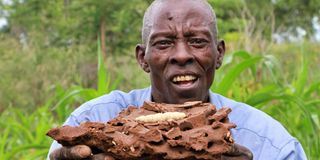
Ikovu Nyamasyo poses with a termite queen after dismantling a termite mound at Mavindini region in Makueni County. PHOTO|POOL

What you need to know:
- Prof Nyamasyo has grown assorted vegetables and pulses, bananas, cassava and sweet potatoes around the mound. He delights in regular harvesting of the insects to feed his fish and chicken and the flourishing fodder grass which he uses to feed his Alpine and other hybrid goats.
- Mr Ikovu is among a handful of old sinewy men scattered across the arid region who have built a reputation as experts in dismantling termite mounds for a fee
Armed with a pick axe, spade and determination, Nyamasyo Ikovu descends on a termite mound at Mavindini Village in Makueni County. The 65-year-old makes a living from a trade he has mastered over the years; digging up termite mounds to eliminate the tiny crawling insects.
“The demand for termites mound dismantling services has been increasing for as long as I can remember. I have lost count on the number of termite mounds I have dismantled so far. They are uncountable,” he tells Healthy Nation in between breaks as he works on a troublesome mound at Martin Musyoka’s farm on the fridges of Mavindini township in Makueni County.
Mr Ikovu is among a handful of old sinewy men scattered across the arid region who have built a reputation as experts in dismantling termite mounds for a fee. They go for a method of managing termites which is embraced by farmers but disapproved by ecologists as it threatens to wipe out the insects which ecologists hail for ecosystem restoration.
There are more than 2,500 species of terminates in the world and more than 1,000 of these are found in African grasslands, according to Arnold Van Huis, a tropical entomologist at Wageningen University at the Netherlands in his article ‘Cultural Significance of termites in sub-Saharan Africa’ which is published in the Journal of Ethnobiology and Ethnomedicine. In Mr Ikovu’s neighbourhood and the larger Makueni County, termites are associated with destroying crops, wooden structures and furniture.
Mr Ikovu charges at least Sh500 for the labour-intensive work which entails mapping the possible location of the termite queen, digging up and scooping kilos of earth and thousands of termites of different dimensions while going for the ultimate prize-the queen termite. Although it is hailed for its effectiveness in eliminating termites, this method has placed Mr Ikovu and others on a collision path with ecologists who see termite mounds as effective buffers against ecosystem degradation.
Winged termites which are a delicacy in most Kenyan communities are future kings and queens which depart from the colony at the start of the rainy season. They mate, drop their wings and start new colonies. The workers forage for dry wooden material which they convert to fungus; their food. Most termite species use earth to build mounds, the home of the colony. Ecologists see a termite mound as a factory that comes with a complex weather proof system. The queen, who is highly guarded by soldiers in a specially reinforced compartment inside the mound, is charged with procreation. It takes killing the queen to nip the entire colony of termites at the bud.
Today, termites are at the centre of a global campaign on food diversification. They are a source of high value chicken, fish and pig feed. They are also a high value human food. The Food and Agriculture Organization promotes the consumption of termites among hundreds of edible insects which are highly nutritious. As the government steps up efforts towards exploiting the lucrative edible insects value chain, Kenya Bureau of Standards (KEBS) has approved guidelines for the production of edible insects such as termites. The low hanging fruits notwithstanding, conservation of termites is fraught with misgivings as the insects are highly destructive.
Take Professor Gideon Nyamasyo, for instance, a dyed in the wool ecologist who taught ecology at the University of Nairobi for decades until he retired recently. He sits on the other end of termites’ conservation spectrum. He believes that destroying a termite mound and poisoning the insects is like setting a bundle of notes on fire. "Termites are a keystone species for the grasslands. They help to enhance the fertility and productivity of soil by decomposing vegetation,” he told Healthy Nation at a termite conservation garden he has set up at his ranch located at Ngaamba Village in Makueni County.
The unique garden entails protection of termite mounds through fencing them off, installing shade nets over them, growing assorted pulses, vegetables and tubers around them, and covering the garden with a sheet of mulch which is watered periodically.
Prof Nyamasyo is among ecologists who strongly believe that the government and other stakeholders can get the country’s food security needs right by properly managing dry lands since more than 70 per cent of the country is dry. Towards this end, he builds a strong case for the conservation of termites as a panacea to ecosystem degradation and a way of spurring sustainable livelihoods.
“Termites should be considered as livestock. They are an important source of food and feed. Their mound-building behaviour aerates soils and enriches them by reversing the process of nutrients and mineral leaching into the soil when it rains. The mounds are made up of soils brought out from great depths. The soils are not only fertile but also contain different chemical composition from the neighborhood. As a result, the vegetation that grows on and around the mounds is often of different dimensions from that growing in the immediate neighborhood. The vegetation on and around termite mounds is considered highly nutritious and therefore forms good fodder for livestock,” he said.
The passion for termite conservation is understandable as Prof Nyamasyo specialised on the tiny insects for his doctorate studies. Over the years, the mounds dotting his sprawling ranch have honed the scientist’s experiential knowledge on the insects known scientifically as isoptera. To debunk the notion that termites are harmful to farmers, Prof Nyamasyo has grown assorted vegetables and pulses, bananas, cassava and sweet potatoes around the mound. He delights in regular harvesting of the insects to feed his fish and chicken and the flourishing fodder grass which he uses to feed his Alpine and other hybrid goats.


