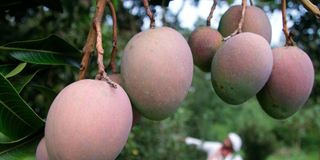
At just 23 years, Mr Musyoki Ndasya hopes that the 22-acre mango plantation left to him by his grandfather will make him and his family billionaires.
He had to abandon his education at Form Four five years ago to organise the estate’s accounts as he could not afford to pursue a course in civil engineering.
He says the allure of mango profits has captivated him, causing him to postpone his academic ambitions, as he makes money every season.
However, he is praying hard to escape the allure of mango farming in order to pursue further education by 2035, as well as to contest the Ndithini ward seat in the Masinga constituency, where his village of Kwa Muthike is located.
“With about 2,000 mango trees, I am sure that each one can produce about 300 top-quality mangoes. The problem is the market,” he said.
Mr Ndasya was made custodian of the estate by his grandfather, Mr Patrick Ndasya, who passed away last year.
“This is an occupation that can make us very wealthy. The problem we have is accessing a stable, rewarding and sustainable market. We need the Machakos County government to seriously consider ways of helping us add value,” he says.
“In a season, I can harvest about 600,000 pieces. The nature of the prevailing market is erratic.”
He says that, unless the county government came up with creative ways of supporting mango farmers, he might consider cutting down the trees and making charcoal out of them.
“My grandfather boosted our family greatly when he handed me the productive mango trees. To start with, you would need to buy 2,000 seedlings for Sh200,000 and then wait about four years for the first harvest,” he said.
He adds that it is also a blessing that he comes from a family with a large piece of land. With the right support programme, he is confident that he can make a significant contribution to the personal, family, national and county economies.
The farm grows the Ngowe, Apple, Dodo, Boribo, Batawi, Peach, Tommy Atkins, Kent, Haden, Keitt and Vandyke varieties, enabling him to access a broader market.
Mr Ndasya says the Ngowe variety is sweet and fibre-free, while the apple variety is sweet, aromatic and popular for export, making it a top performer.
“The Tommy Atkins variety is mildly sweet, fibrous and high-yielding. Kent mangoes are sweet with a tangy twist and are juicy. If you are interested in this sector, I would advise prioritising these varieties, but remember that all mangoes are in high demand,” he said.
“Traders come to the farm gate, where they pick grade one unripe mangoes at a cost of 5 to 10 shillings per piece. This accounts for about a quarter of the total produce. The second phase of harvesting yields Sh2 or Sh3 per piece. The final phase is a market estimation,” he said.
He said that the general mathematics of the production cycle sees his plantation make a gross gain of Sh3 million per season.
“Minus husbandry costs of around Sh600,000, the family is left with approximately Sh2.4 million,” he said.
“If our county government were to introduce value-addition programmes like those in Makueni County, our estate could post a net income of at least Sh15 million per season,” Mr Musyoka said.
He added that the erratic nature of the market results in huge losses for small-scale traders who visit our farms randomly.
Mr Musyoka added that when the market is flooded with mangoes, we suffer immense losses, either lowering farm gate prices to attract buyers or helplessly watching post-harvest losses eat into our profits.
“If the county government were to take this sector seriously and empower us to join producer groups, giving us access to standardised agrochemicals to control pests and diseases, as well as helping us access a structured bulk market, this would be an economy that could improve the quality of life in this area,” he says.
He says that, owing to a lack of knowledge about disease and pest control, he and his neighbours sometimes use banned chemicals, which aggravates fruit damage and leads to a market boycott.
“We hear that in neighbouring Makueni County, the mango support programme ensures that farmers gain about 93 per cent of the market. Here in Machakos, we are operating at only 20 per cent of the gross market gain,” he said.
He said working in the mango plantation in his village is risky due to the presence of hippos from the nearby River Tana.
“Those animals have ensured that every household has trumpets, drums and fireworks to serve as hippo repellents.”
According to a Machakos County government document: Wealth Creation Through Fruit Trees (2021), mango farming is key to uplifting the area’s economy.
“Through the Department of Environment and Natural Resources, we seek to boost incomes, food security and nutrition, while promoting environmental conservation by issuing fruit tree seedlings, including mango trees,” the report states.
However, the report does not mention cooperatives in the mango subsector, research, added value or marketing.
While Governor Wavinya Ndeti has launched the campaign “Chakula Mezani, Pesa Mfukoni”, which aims to ensure that families have food on the table while improving household incomes through sustainable agriculture, she has been accused by mango farmers of paying lip service to optimising economic gains.
The report states that, as of 2021, mango farming occupied over 49,000 hectares and generated Sh11.9 billion, making the county the second-largest producer of mangoes in Kenya.