On Monday evening, with the sun rays receding, Reuben Korir, submerged in a pond, holds a fishing rod in one hand while his his grandchildren curiously jostle to see if their grandfather would catch the day’s dinner in record time.
Mr Korir, a retired banker, suddenly pulls on the fishing rod, and wrestles a big tilapia fish from the water.
The grandfather, dressed in a pair of brown khaki trousers, a checkered shirt and open shoes, unhooks the fish, attaches bait and swings the fishing line back into the pond. Three sizeable fish harvests later, he carries the catch, with his grandchildren in tow, and hands it over to his wife, to cook dinner.
“My grandchildren and other family members prefer eating fish over red meat, a preference they developed in the last four years. It is a very interesting development and I wish I had started fish farming a bit earlier,” Mr Korir says.
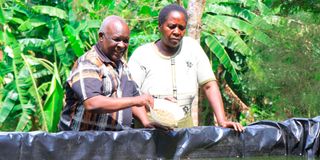
Mr Rueben Korir (left) and his wife Agnes Korir (right) displaying fish they harvested from their fish pond at Kapinderem village, Yaganek location, Sotik constituency, Bomet County on May 23, 2025.
Photo credit: Vitalis Kimutai | Nation Media Group
A push to have the local community adopt fish farming (pisciculture) and the eating of fish is gaining momentum in Bomet County, demystifying age-old cultural practices and beliefs.
Members of the Kipsigis community, a sub tribe of the Kalenjin community, are known for keeping livestock and eating beef and mutton.
For decades, the local community frowned on cooking and eating fish, but the narrative has changed over time with sensitization on the health benefits it has on human beings.
A campaign to raise fish production by constructing fish ponds, providing groups with fingerlings, feeds and technical support is being implemented by the Bomet county government with the support of the World Bank under the Financing Locally Led Climate Action (FLLoCA).
A total of 25 community fish ponds have been constructed, equipped and stocked in the five constituencies – Bomet East, Bomet Central, Konoin, Sotik and Chepalungu – to raise fish production and satisfy local demand through the FLLoCA programme.
The project runs under the Fish Production for Improved Food Security and Livelihoods initiative that is one of the climate smart projects.
In local markets and hotels, the demand for fish has been rising, but the cost is high, locking out the would be consumers.
“I ventured into fish farming in 2020 with 300 fingerlings supplied by the fisheries department. But most of the stock died as there was a leakage in the pond and a breakage of the concrete wall” Mr Korir revealed.
Mr Rueben Korir and his family members at their fish pond in Kapinderem village, Yaganek location, Sotik Constituency, Bomet County.
Photo credit: Vitalis Kimutai | Nation Media Group
He said, “The business I had worked hard for and nurtured for nine months, all went down the drain and I had to start all over again. I did not give up as I had personal motivation to succeed”
Mr Korir said the pond broke four times, but every time there were hitches, he used them as a learning curve and went on to improve, He and sought professional help from the fisheries department in the county.
He spent Sh30,000 to construct the pond which is nine metres long, five metres wide and one metre deep. But the cost of setting up and stocking a simple pond is much cheaper.
Initially, it was expensive to repair the pond due to collapse and leakages, but the maintenance was drastically reduced after he laid a polythene lining.
He keeps male tilapia fish in the pond as he says, it is nutritious and has enough meat that is enough to feed the family.
The female tilapia fish is small in size as it retains eggs in the mouth until it hatches, and as such is not a heavy feeder.
“One time, I ordered 300 fingerlings only to realize there were a lot of female species which hatched and overcrowded the pond leading to shortage of oxygen and deaths” Mr Korir stated.
Mr Korir, who practices mixed farming, also keeps dairy cattle, grows bananas, pineapples, avocado, maize and beans. He says fish farming is profitable and is not labour intensive.
Freshly harvested from a pond in Bomet Central constituency, Bomet County in this picture taken on May 22, 2025.
Photo credit: Vitalis Kimutai | Nation Media Group
Mr Korir is not alone. He is among other farmers in Bomet who are establishing fish ponds to supplement their incomes amidst a growing demand for fish in the region.
Ms Brenda Chebet Keter, a member of the Ngainet Community Fish project in Ndarawetta, Bomet Central, which has 18 members, says locals have changed their initial negative perception towards keeping and feeding on fish.
“As it is now, we source fish from urban centres which is expensive. The decision to go into fish farming was informed by the fact that we have a lot to learn before transferring the knowledge to our own projects in the end.” Ms Keter said.
The construction of the pond and fencing has been completed. It will hold the initial 2,000 fingerlings which have been ordered and will be stocked in the next few days.
“There is a need for the county government to set up a fingerlings centre so as to make it easy for the residents to access stock for their fish ponds as the demand rises”
Mr Paul Towett, a resident of Raia village on the outskirts of Bomet town, has also engaged in fish farming at subsistence level, having turned a water pan into a fish pond.
He says the challenge facing fish farmers in Bomet county is the lack of commercial feed, forcing them to source it in other counties, raising the cost of production, thus making it not economically viable for subsistence farming.
A fish pond belonging to at Ngainet Visionary Youth Self Help Group in Ndarawetta wWrd, Bomet Central Constituency.
Photo credit: Vitalis Kimutai | Nation Media Group
“I bought 700 fingerlings and stocked them in the pond which I sold to neighbours for Sh200 each and consumed others. I did not keep stock of the ones sold and the ones consumed by my family,” Mr Towett said.
He sources feeds from Oyugis in South Nyanza region, through officers from the fisheries department with a 25 kilograms bag retailing for Sh3,000.
Mr Towett said his family members have had an insatiable appetite for fish since they were introduced as it is sweet and easy to cook.
“My neighbours have started to keep fish in small quantities after realizing it is commercially viable, ” Mr Towett said.
The farmers currently source fingerlings from Kisii and Homa Bay counties, which makes the business expensive as a result of transport costs.
Fish farming and consumption
Bomet County falls under the Lake Region Economic Bloc (LREB) that has 14 counties that are reaping from the Blue Economy model rolled out by the national government and development partners.
Mr Solomon Kimeto, the Chief Officer for Water, Sanitation, Environment and Natural Resources, which is implementing the World Bank-funded project, said there was a high interest from the locals on fish farming and consumption.
“The ponds constructed under the FLLoCA programme measures 300 metres square, with a liner installed, fence erected, laying of predator nest, stocking with 1,000 fingerlings and supply of fish feeds” Mr Kimeto said.
Mr Kimeto said: “There is a huge business potential for farmers and investors in the fish sector with an estimated annual demand of 400 tons of fish in Bomet, which is expected to steadily rise over the years.”
Fish farmers are being sensitised to adopt cages and aquaponics farming to spur production and make the enterprise economically viable in a small area.
“Market for fish produced is locally available and it does not take a lot of marketing or transport efforts to offload. Apart from hotels that require them in large quantities, a demand we can not meet, the locals have developed a liking for it in the past few years,” Mr Kimeto said.
Dr Kibet Sitienei, the Chief Officer for Agriculture, Livestock and Fisheries, said the production and consumption of fish has been rising in the county in the past few years.
“In the last financial year, the production of fish by farmers in Bomet county stood at 95 tons valued at Sh 24 million. The production is from rivers, dams and ponds,” Dr Sitienei said.
Dr Sitienei said new fish farming technology was were being introduced to the farmers involved in pisciculture to boost production for commercial and domestic consumption.
Bomet Governor Professor Hillary Barchok says the county government has started sensitizing locals on the commercial viability of fish farming, adoption of value addition to fish and fish products.
“Much as we are not in the Coastal and Lake regions in the country, we are rolling out economic and food security projects including fish farming by harnessing available resources,” Professor Barchok said.
As a result, the county government has been urged to set up a fish hatchery facility, commercial feed production under a subsidy program to spur production.
“The fish farming in both small and large scale is aimed at not only enhancing sources of livelihoods, mitigating the effects of climate change, and addressing food security and nutrition components in the society,” Prof Barchok said.
Despite the high demand for fish, the farmers said they have not experienced cases of theft of the stock, which does not require any enhanced security other than curbing cases of children drowning and livestock destroying the ponds.