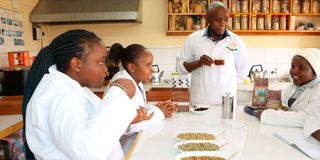
For 12 years, Chuaga Kinuthia has been working as a coffee taster at the Dedan Kimathi University of Technology (Dekut) in Nyeri, a career he wishes many young people would embrace.
Kinuthia is certified by the Coffee Directorate of Kenya and the Coffee Quality Institute of America as a “Q grader”, meaning he is skilled in sensory evaluation of green coffee.
He trains students at the university on how to roast, grind and cup coffee. Kinuthia spoke to Seeds of Goldon careers one can pursue along the value chain.
With training as a cupper, one can work in coffee shops, mills and marketing organisations, dealerships and coffee roasting plants.
They will be tasked with blending and assessing the quality of coffee brought to the laboratory, which is a requirement in selling coffee.
“Blending is important for two main aspects, the cost and quality purpose. It helps as a guide on what to roast and what not to,” says Kinuthia.
Tasting of coffee requires one to be sober as drawing the characteristics of the product relies on the memory of the cupper. Kinuthia says that to be a good cupper, one requires all the five sensory organs to be functioning well, but most importantly the tongue.
As a coffee taster, one spends a lot of time in the laboratory sampling different types of coffee.
Through tasting, one understands basic tastes of coffee and quality control, which leads to grading. Coffee is tasted based on individual merits that range from the basic form to the finer points.
After harvesting, coffee berries are classified into seven grades, starting from premium AA, AB and PB followed by C, T, E and then Mbuni.
Kinuthia says the university offers both certificates and diploma courses in coffee technology for six months and one year respectively. For certificate courses, one needs a mean grade of D+ in KCSE, while Diploma C-. Students learn agronomy, processing, management and coffee trading and marketing as well as cupping.
A barista's work is to brew coffee for consumption. They can work in coffee shops that have installed espresso machines to make over five different types of coffee drinks namely mochasino, cappuccino, expresso, americano and latte.
They roast green coffee for sale at coffee shops. They also formulate the profile of coffee, which means roasting coffee to a degree or level that allows development of flavour. “Different coffee profiles produce different flavours, which are based on the region the coffee is produced,” says Kinuthia.
According to him, coffee roasting is an art and skill that one needs to keep harnessing. There are three types of roasting coffee, namely light-medium, medium or dark roast, all done at particular temperatures depending on the purpose. The light-medium roast is used for coffee tasting and is roasted between five to eight minutes, medium roast is used for those who enjoy drinking black coffee. The roast is done between eight to 10 minutes.
The dark roast is used to make espressos thus roasting should be above 10 minutes but not exceeding 15. Dark roasting is also perfect for white coffees.
“Roasting starts at 200 degrees Celsius and as a roaster, one stops depending on the type of roast they are doing. To be a roaster you must have the skill. There are opportunities that need to be explored both locally and internationally,” he added.