About 12 kilometres from Katito town in Kisumu County is Zamil Farms Ltd.
The four-acre farm belongs to 29-year-old Mildred Adhiambo. One enjoys the spectacular view of Nyabondo hills from the farm.
The Seeds of Gold
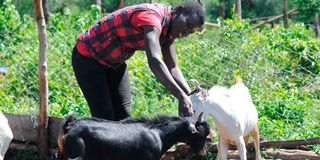
“After getting the salt lick, the animals are released to the hill to browse on the shrubs. They have known that we provide the salt lick around 3 pm,” Adhiambo says.
From her savings and business proceeds, Adhiambo bought an acre in 2020. Her intention was to set up a goat breeding farm.
A year later, she went to Kitui and Kajiado counties to buy 50 Galla goats. One was going for Sh5,000.
“The Galla breed has a large body and fetches more money compared to local goats,” Adhiambo says.
Unfortunately, Adhiambo lost 35 goats to diseases just months later.
She admits not having been keen on spraying, deworming, pest control and other routines.
Mildred Adhiambo gives salt lick to some of her goats.
Photo credit: Elizabeth Ojina | Nation Media Group
“Many died of anaemia and other metabolic illnesses,” Adhiambo recalls.
With time, she mastered good husbandry skills after attending a one-month course at the Dairy Training Institute in Naivasha.
The goats are fed on shrubs, rice straw, and maize stalk mixed with molasses with a supplement of salt lick.
“I realised that rearing goats have better returns compared to poultry. Chicken feed is very expensive. A goat eats about 1.5 kilos of feed a day,” she says.
She adds that only kids with desirable characteristics are sold.
“Many farmers are looking for a place to get quality breeds. We do synchronised breeding of 30 goats every five months.”
Zamil Farms Ltd sells a young doe for Sh5,000, a mature one for breeding for Sh7,000 while a pregnant goat goes for Sh9,500.
“Those ready to slaughter are sold per live weight. A kilo goes for Sh300. Many of our customers come from Kisumu, Busia and Migori counties. Farmers are looking for reliable breeders and suppliers.”
Since some families desire to rear goats but have no space, Adhiambo lets the animals remain at her farm but at a fee.
Those interested “hire” a billy goat. When the farmer’s female goats conceive, she links the owner to potential buyers.
“We do all we can to vaccinate the goats and control pests and diseases. Foot and mouth diseases usually originate from Kericho County,” she says.
Adhiambo’s five-year plan? To expand Zamil Farms Ltd and supply more goats for breeding around the country.