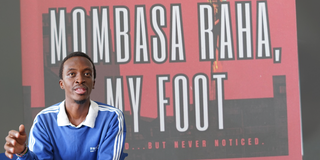
In 2014, Haroun Risa Kimani began walking eight kilometres to a public university he had never enrolled in. He had no student admission letter, no tuition fees and no guarantee that he would be allowed through the gates. What he had was a plan: to find opportunities to learn about acting and film.
Inspired by the Indian film Three Idiots, in which a young boy sneaks into schools to acquire knowledge, Kimani wondered whether he could pull off something similar in Kenya. He had been accepted into a two-year film and television production diploma programme at a university in South Africa, but his mother refused to support the move. Coming from a military family, he was expected to follow the family tradition and join the defence forces, like his elder brother. He had other ambitions.
“I am pretty much the one who broke the ‘generational curse’ of signing up for the defence forces,” he says.
His father had served in the Air Force and studied aviation at the US Army Aviation Centre. His parents met while both serving in the military. Instead, Haroun was drawn to storytelling.
Haroun Kimani has self-published eight books, including Mombasa Raha, My Foot, and is seeking funding to adapt it into a feature film.
Photo credit: Thomas Rajula | Nation
His interest in journalism began in primary school, when he regularly watched Al Jazeera documentaries, including Witness, 101 East and Al Jazeera World. He was equally fascinated by acting, watching films and television dramas such as 24, starring Kiefer Sutherland. He imagined himself working in both fields, although his family struggled to understand why he would turn away from a conventional career.
His creative instincts surfaced in Class Seven, in 2007, when he wrote a composition imagining the events that might have led to the crash of Kenya Airways Flight 507 in Douala, Cameroon. His English teacher called his mother to school, asking what television programmes her son watched.
The composition received 38½ out of 40. His mother, however, was not pleased. She had warned him about the kind of shows he was watching. She slapped him. The teacher, meanwhile, encouraged him not to abandon his talent.
By the time he began sneaking into the university, Kimani had already been looking for ways to develop his acting skills. In 2013, international casting directors had planned an event in Kenya for actors, models, singers and dancers, but the Westgate terror attack disrupted those plans. Among the people involved was South African talent manager Elsubie Verlinden, who had seen Kimani perform and was impressed.
The following year, he began making regular visits to the university. He would leave his identification card at the gate and explain that he “had lost my student ID”. Once inside, he headed to the Department of Theatre and Film to look for audition notices and use its computer lab. The technicians would log him in, also assuming he was a student there.
He befriended students studying theatre and film, who advised him on how to prepare for auditions. They encouraged him to watch films with strong dramatic performances and monologues, then practise those scenes. Some cast him in student films, giving him experience and introducing him to student directors and directors of photography.
He also auditioned at venues such as the Kenya National Theatre. His appearance sometimes led people to assume he was not Kenyan. When he explained that his father was Maasai and his mother Kikuyu, they were often surprised.
The university gradually became his informal training ground. He learnt from students, observed how productions were put together and sought out opportunities to perform. He says that, after about five years, security personnel had become familiar with him and sometimes assumed he was a student.
His acting journey eventually took him into professional productions. He secured a speaking role in the international series Sense8, portraying Guy #2 in the episode “Fear Never Fixed Anything” (Season 2, Episode 5). The experience gave him a closer look at how major productions operate.
He was particularly struck by the attention paid to timekeeping. If a call time was 11am, he says, the expectation was that everyone would be ready at exactly 11am. He also noticed that contracts were more detailed and payments followed clearly established rates, including those agreed through industry unions.
He realised that professionalism and discipline were just as important as acting ability. He also appeared in the Kenyan feature film 18 Hours (2017) and an episode of Varshita, which he particularly enjoyed.
While pursuing acting, Kimani continued taking up odd jobs to support himself. He worked as a waiter, at car washes and in sand harvesting in Kajiado County. He left the car wash job after contracting typhoid. His mother eventually recognised that he was determined to find his own way.
Mombasa Raha, My Foot is a 424-page thriller inspired by human trafficking reporting .
Photo credit: Thomas Rajula | Nation
In 2016, he had begun writing his first novel, Mombasa Raha, My Foot, inspired by a KTN news feature on human trafficking in Kenya. He wanted to explore the subject through fiction, particularly its links to sex tourism and the exploitation of vulnerable people.
The subject became more personal when a former high school classmate told him that their sister's body had been found outside the family home, more than two years after she had been kidnapped. Kimani attended the memorial service and was struck by the tragedy.
He remembered a writing masterclass by television producer Shonda Rhimes, who encouraged writers to follow news channels and use real events as inspiration for believable fiction. He researched the subject further, including through organisations such as Awareness Against Human Trafficking (HAART Kenya).
The novel follows Ruth Adhiambo-Khan, an investigative journalist whose younger sister, Catherine, is found dead. When the police discover evidence suggesting Catherine may have been involved in human trafficking, Ruth sets out to investigate her murder. Alongside this storyline is a group of students who win an all-expenses-paid trip to the Coast Culture Festival, unaware that the competition is being used to lure people into trafficking.
Haroun Kimani has self-published eight books, including Mombasa Raha, My Foot, and is seeking funding to adapt it into a feature film.
Photo credit: Thomas Rajula | Nation
Kimani's writing was interrupted by serious health problems. In 2017, a relative paid for him to study a certificate in film and television production at the Africa Digital Media Institute (ADMI). Around this period, he collapsed at home, sustaining a deep cut above his left eyebrow. He later collapsed again at school and was taken to hospital.
An electroencephalogram test ruled out epilepsy, but doctors diagnosed severe anaemia. His blood level was reportedly at four, which he describes as dangerously low. He was told that malnutrition was responsible and spent 2018 on medication and a carefully managed diet.
He had paused writing Mombasa Raha, My Foot after completing about 80 pages, but was determined not to abandon it. He resumed outlining the story and eventually completed a 424-page manuscript. Friends helped him identify errors, and the editing process also taught him proofreading skills, which he now uses to help other writers.
He approached publishers around Kijabe Street, but they were uncomfortable with the title and suggested changing it. Kimani chose to retain it, believing its unusual phrasing would make readers curious. He instead turned to self-publishing through Amazon Kindle Direct Publishing. The book came out in 2018.
For local readers, he began working with Publish4All Kenya in 2019, using its print-on-demand services to produce copies according to orders. He says he pays Sh1,000 for two copies rather than investing in a large print run. The book sells for Sh2,500 locally and $28.99 on Amazon.
Kimani says he has personally sold 600 copies, while more than 400 others have been sold through Amazon. The proceeds help him support himself and reinvest in his career. He has also worked with bookstores such as Nuria to make the book available to readers.
By the time he graduated from ADMI in 2018, he had written a second novel, Kenyan Timing Ate My Boob, which raises awareness about breast cancer. He has since written six more, bringing his total to eight. Among the titles are Bangla Pendo, Navy Blue Stiletto, Choohanesburg: Con Man Paradise and The Pirates of Zanzibar.
The novels are connected through a shared timeline, with the events in the later books leading towards the story in Mombasa Raha, My Foot. He says he borrowed from Dan Brown's approach to recurring characters in the Robert Langdon series, keeping the cast relatively small so readers can follow the unfolding story.
His writing also earned international recognition. After the Covid-19 pandemic, he revisited the composition he had written about the Kenya Airways Flight 507 crash as a primary school pupil. He reworked it into a short story titled The 44th Question, incorporating Kenyan Indian themes, and submitted it to Engaging Borders Africa, a competition founded by Nigerian writer and lawyer Richard Ali.
The story was selected for the 2022 anthology, earning him Sh25,000. He was one of two Kenyan writers included, alongside contributors from Namibia, South Africa, Ghana and Nigeria.
The university continued to serve as his informal classroom. In 2023, a student introduced him to Alison, an online learning platform offering free courses. Kimani enrolled for a diploma in journalism, completing the course in 2025. The coursework and examinations were free; he only had to pay for the certificate.
Haroun Kimani has self-published eight books, including Mombasa Raha, My Foot, and is seeking funding to adapt it into a feature film.
Photo credit: Thomas Rajula | Nation
He continued using the university's computer labs, watching videos by journalists such as John-Allan Namu and Mohammed Ali, taking notes and studying further at home. He also practises his reporting skills and shares some of the exercises on TikTok. His voiceover work has attracted comments that his voice is particularly suited to documentary narration, including wildlife and travel programmes.
But the university has also been a place where he learnt how to make a living from skills beyond his original ambitions. He taught himself to design book covers using free online tools and began creating covers for other writers. He has also taken on freelance writing and editing assignments to support himself. On one occasion, a master's student at the university offered him work after discovering that Kimani was the son of a former colleague.
The experience taught him to learn quickly, identify opportunities and turn new knowledge into practical skills. It has also required financial discipline, especially when he has had to prioritise his career over spending on temporary pleasures.
“It is you and you alone,” he says. “You get out there and fight your own battles and find your own way and carve your own way.”
His health challenges have also shaped his approach to daily life. Kimani says it took seven years to learn to manage his anaemia, a condition he continues to live with. He had to pay close attention to his diet, including avoiding black tea and coffee. He also explored meditation through the Brahma Kumaris organisation in Westlands, after being introduced to it by a Kenyan Indian acquaintance. The practice helped him feel more positive and manage the pressures he was facing.
At 32, Kimani still visits the university to use the computer lab, although not every day. He has spent 12 years making use of its resources, learning from its students and finding opportunities that were not otherwise available to him.
His ambitions now extend to the big screen. Inspired in part by the documentary Bangladesh's Biggest Brothel, he is working to adapt Mombasa Raha, My Foot into a feature film. He developed the screenplay with Kenyan multidisciplinary artist, actor, scriptwriter and filmmaker Sanchez Ombasa. The script runs to 134 minutes.
The production team, which includes four producers, is seeking about Sh30 million in funding. Margaret Wairimu is the director, while Samuel Luchemo is among the producers. Kimani says they want to make a film that meets international production standards and can reach audiences across Africa and beyond, including through platforms such as Netflix or Hulu.
He has not lost sight of the wider challenges facing Kenya's creative industry. Having worked on both local and international productions, he believes the industry needs greater support and stronger discipline among cast members, crews and production managers. He also wants filmmakers to take more creative risks.
“The audience is always smarter than you think,” he says. “Whatever story you've created, it has to be believable enough for readers or audiences to follow.”
He believes Kenyan filmmakers should move beyond repeatedly exploring relationship themes and find fresh stories that can captivate audiences without necessarily relying on controversy or whatever happens to be trending.
For Kimani, the next chapter is another opportunity to learn and create. The young man who once walked eight kilometres to access a university's resources is still building his career, one skill and one opportunity at a time.