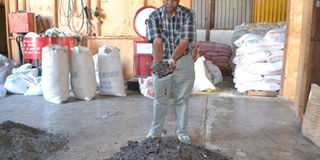
Dr James Gakuo, a veterinary doctor, displays ingredients for making animal feed in his farm in Nyeri. For the approximately 450 cattle in his farm, Dr Gakuo requires at least 40 metric tonnes of oil crop products per month, which include soy beans, sunflower and cotton cakes, all which are by-products of oil manufacturing companies. PHOTO | ISAIAH ESIPISU | NATION MEDIA GROUP
The number of feedlot beef farmers is on steady rise but there is short supply of feed ingredients as Dr James Gakuo attests.
Soy beans are the best source of plant protein, can be used as by-product or whole grain.
Soy beans and sunflower grow well in western Kenya, according to Prof Ruth Oniang’o.
A recent study by the International Development Research Centre (IDRC) and the UK Department for International Development, said the number of cattle in Kenya’s drought prone areas has reduced by 26 per cent in the past 39 years, meaning that county governments must come up with innovative ways of mitigating the problem.
A few years ago, Dr James Gakuo, a veterinary doctor, started the business of fattening emaciated cattle from pastoralist communities using intensive feeding programme before selling them for slaughter.
The farmer’s move to establish the feedlot that enables him save cattle from arid and semi arid regions from dying due to drought has presented a huge opportunity for farmers in arable regions, who grow soy beans, lucerne grass (and other types of grasses) for hay production, sunflower and cotton.