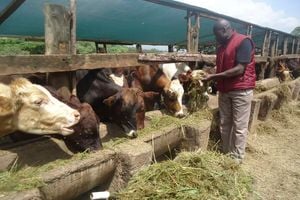
In 2021, Johnstone Sang attended a one-day training course in Nyeri County sponsored by ECLOF-Kenya Limited, a microfinance institution that supports dairy farmers by providing them with loans. During the course, Sang and the other attendees visited a dairy farmer in the area who reared over 30 cows and owned three biogas digesters. Through ECLOF, the farmer had been able to construct a zero-grazing unit and a biogas system.
"I learnt that farmers can use cow dung to generate biogas for cooking and heating water for milking the cows. The biogas waste can be channelled to livestock feed crops such as lucerne, napier grass, and potato vines, which benefits the farmer by reducing the cost of buying fertiliser from farm supply shops," said Mr Sang. He added that, in 2022, a team from ECLOF, in partnership with Sistema Biogas, installed a biogas digester on his farm after he received a Sh120,000 loan, to be repaid over six months.
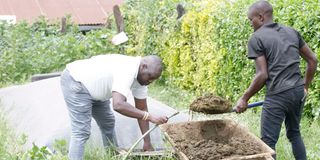
He said that the cost of installing a biogas digester depended on how many cows a farmer had. In his case, this fitted the six cows he reared on the farm. Mr Sang added that his 10-foot by 4-foot biogas digester was ideal for producing sufficient gas for domestic use. During a recent visit to his Tegat Farm in Elburgon, Nakuru County, Mr Sang noted that, after installation, fresh dung is collected from the cowshed every morning, heaped in one area near the shelter, and later collected in a wheelbarrow. This is then taken to a metal container near the Sistema tube where foreign matter is removed by hand.
Johnstone Sang mixes cow dung with water to remove foreign materials on August 31, 2026.
Photo credit: John Njoroge | Nation Media Group
“At the beginning, I collected 21 20-litre containers filled with cow dung. For each container, I mixed the dung with 20 litres of water in a jerry can and stirred to ensure the sieved mixture passed through the waste pipe to the system tube. I repeated this process for 21 days until the gas was ready for use,” said Mr Sang, adding that he currently adds cow dung to his metal container every two to three days, depending on how much biogas is needed at his residence. To maintain his biogas technology, the farmer practises zero-grazing.
He said that since installing his biogas system four years ago, he has never needed to refill his gas cylinders because his current energy source has been very effective, providing a continuous supply depending on usage. Sang added that his family no longer buys LPG cylinders because the biogas has reduced their need to buy LPG for domestic use, the price of which has increased in recent months.
Mr Sang said that his farm has become a place of attraction for other farmers, who visit him to learn how to build their own biogas digesters. He plans to install another digester of the same size by the end of this year, as this will enable him to extend his zero-grazing unit from eight to 15 lactating cows. He also intends to buy a milk-processing machine to reduce labour costs for his workers.
Sang adds more cow dung, assisted by his farmhand, to the sistema tube when it deflates according to how the gas is used, so as to make the process run. “If the tube is well maintained, it can last over 20 years. Instead of using a machete, which could easily damage the tube when clearing the bushes around it.
, I normally spray to kill weeds that grow near the biogas tube,” said Mr Sang. He added that his farm has become more productive since he started using the biogas digestate as organic manure, leading him to increase his plot of land from three to seven acres, where he now grows maize for silage and lucerne, as well as other feed crops. He also said that the manure eliminated the need for chemical fertiliser on the farm, cutting the cost of buying inputs such as fertiliser from Agrovet shops.
Johnstone Sang mixes cow dung with water to remove foreign materials on August 31, 2026.
Photo credit: John Njoroge | Nation Media Group
To improve his skills, Mr Sang visits Githunguri Dairy in Nyeri County and attends agricultural shows and seminars. He also reads newspapers and learns online. He encourages other farmers to embrace biogas technology for domestic and commercial use because it is effective, and any farmer can set it up on their farm. He added that even a small-scale farmer with as few as three cows can set up a biogas digester and begin using it within 21 days of installation, provided there is enough cow dung, which can be a particular challenge for beginners.
Apart from reducing the cost of buying and refilling gas cylinders, Mr Sang noted that no capital is required to start using this technology because the installation team provides a free service and supplies the complete biogas kit package. Mr Sang says that on his farm, he has no problem getting cow dung to process the biogas.
Mr Edwin Kimtai, a former trainer at Baraka Agricultural College in Molo, says that farmers should invest in biogas digesters as they are a sustainable way of managing organic waste and generating energy. He explains that animal droppings, crop residue and other organic materials can be used in aerobic digesters to produce biogas for heating, cooking and lighting purposes.
Johnstone Sang (right) and his farmhand, Leonard Tonui, mix cow dung with water to remove foreign materials before channelling the sieved mixture through a waste pipe into the Sistema tube on August 31, 2026.
Photo credit: John Njoroge | Nation Media Group
"This process reduces greenhouse gas emissions and creates nutrient-rich materials that can be used as fertiliser. It improves soil health and crop yields,” he says, adding that investing in biogas can enhance energy independence, reduce waste disposal costs, and contribute to sustainable agriculture.
Mr Obedi Kimani and his son David made the well-thought-out decision to start the biogas project a few years ago because they now use the gas for cooking, reducing their use of charcoal and LPG cylinders for domestic purposes. The family practises zero-grazing, which makes it easy for them to collect cow dung from the cowsheds every morning.
“When we collect cow dung every morning, we follow the correct biogas processing method that we learnt from the team that installed the biogas system on my farm in Turi, Elburgon. I have no regrets about starting this project, as it has benefited my family,” says Mr Kimani, a retired teacher.