For years, buying fertiliser, pesticides and other farming supplies was an expensive undertaking for Veronicah Mwende Wambua, a smallholder farmer in Kaviani, Machakos County.
She had to travel about 10 kilometres to Kathiani, spending Sh500 on return transport alone, sometimes carrying the supplies on her back. Today, however, she can walk for about 10 minutes to a nearby digital agro-shop, order farm supplies and seek agricultural advice, all without making the costly journey.
Ms Mwende attributes this change to the agricultural and livestock sector’s adoption of digital platforms and tools. At the heart of this change are digital agro-vets, who now serve farmers online.
One such model is DigiShop, a digital tool that enables Ms Mwende and other farmers to order farm supplies online for home delivery.
“The platform has brought us many benefits. It makes it easier to access farm supplies, reduces the need to travel long distances, and helps us to obtain products even when we don’t have the full amount of money required to pay for them all at once,” she says.
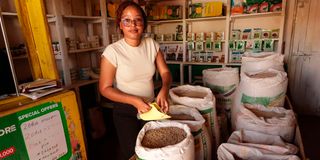
Lydia Nzali, an agro dealer, displays a Digishop App at her shop in Kiviani, Machakos county on October 23,2026.
Photo credit: Evans Habil | Nation Media Group
Ms Mwende grows spinach, carrots, cabbages, avocados and tomatoes in Kiteng’ei, Kaviani. She has been farming for around five years and says that the arrival of DigiShop in her neighbourhood almost two years ago has reduced the cost and inconvenience of obtaining agricultural supplies.
When she does not have enough money to pay immediately, the agro-dealer allows her to pay in instalments, enabling her to obtain products as and when needed. She can also seek advice when her crops encounter problems.
The service is provided by ShambaPride, a Kenyan agritech company that uses digital technology to connect smallholder farmers with agro-dealers, agricultural supplies and advisory services. Its DigiShop model provides existing village agro-vet businesses with digital tools for ordering stock, managing inventory, maintaining farmer records, and delivering agricultural information.
ShambaPride’s founder, Samuel Munguti, says the idea grew from his upbringing in a farming community and his experience of managing supply chains.
His parents were farmers, which inspired his interest in solving challenges affecting agricultural producers. Although he studied agriculture at university, his first job took him in a different direction.
“I worked in a company that made cold beverages,” he says.
This experience exposed him to organised supply chains, which he then compared with the distribution of agricultural inputs.
“I saw an opportunity to improve distribution and supply chains, create a positive impact in farming communities, and build a sustainable business,” he says.
While taking a break from employment to complete his Master of Business Administration in 2017, he began developing the idea that would lead to ShambaPride.
Smallholder farmer Veronicah Mwende waters her crops on her farm in Kiviani, Machakos County, on October 23, 2026.
Photo credit: Evans Habil | Nation Media Group
The company’s platform connects farmers, agro-dealers, and suppliers via digital services. Farmers can order products via a mobile app, while those without smartphones can access the services via an Unstructured Supplementary Service Data (USSD) platform. They can select their preferred agro-dealer and send orders or enquiries directly to the shop, reducing unnecessary journeys and making it easier to obtain supplies.
Digital technology also supports extension services. According to Mr Munguti, ShambaPride uses geographical mapping and artificial intelligence (AI) to group farmers into digital communities according to their locations and agricultural value chains. This enables the company to provide information relevant to their crops and production needs. This approach addresses the shortage of conventional extension services.
Munguti estimates that some counties have one extension officer for every 6,000 farmers, while in others, this ratio can be as high as one to 8,000.
“Compared with the physical delivery of training and extension services, digital delivery costs approximately three per cent as much,” he says.
Digital services can extend the reach of agricultural advice, complementing physical farm visits and helping farmers access guidance on crop management, livestock production, and the use of agricultural inputs.
ShambaPride has established a network of 4,500 agro-vet businesses across 24 counties, including Machakos, Makueni, Kitui, Siaya, Kakamega, Trans Nzoia, Busia, Uasin Gishu, Bomet and Kericho. Around 15 per cent have attained DigiShop status, which is reserved for businesses that meet the company’s higher standards for technology adoption, product quality, and service delivery, according to Munguti.
The platform serves approximately 78,000 farmers across the counties in which it operates.
Munguti says that some farmers in the network have reported productivity improvements of up to 2.5 times, which they attribute to better access to quality inputs, training and digital tools.
In eastern Kenya, for example, some farmers who previously relied on rain-fed production have adopted more climate-smart crops after receiving relevant agricultural information. The company also reports that agro-dealers in its network have recorded increases in shop profitability of up to tenfold within the first 18 months of working with ShambaPride.
Lydia Nzali, an agro-dealer in Kaviani, says that the digital model has transformed her small business into a growing enterprise. She started her shop in 2019 with Sh150,000 borrowed from her father, selling agricultural supplies without any formal training or support services. After meeting the ShambaPride champions, she adopted the DigiShop model in 2021, using digital tools to manage stock, communicate with farmers, and order products.
Smallholder farmer Veronicah Mwende waters her crops on her farm in Kiviani, Machakos County, on October 23, 2026.
Photo credit: Evans Habil | Nation Media Group
“Before, I had to travel to Machakos town to buy supplies, which meant incurring transport costs and spending time away from my customers. ShambaPride now delivers stock to my doorstep every Tuesday,” Ms Nzali shares.
These include animal feed, agrochemicals, and biological agricultural products. Through the platform’s dashboard, she can track inventory, purchase orders and stock value, helping her to identify which products need replenishing.
Access to credit has also enabled her business to grow. She can now receive supplies and pay for them within two weeks instead of having to raise the full amount upfront.
“When I started, my stock was worth Sh150,000. Today, it is worth more than Sh1 million,” she reveals.
Initially ranging between 1,000 and 2,000 Kenyan shillings, her daily sales can now reach 10,000, 15,000 or even 20,000 Kenyan shillings on a good day.
She has expanded from one outlet to three, located in Kaviani, Zaikoni and Kidunguini, and now employs three people. Across her shops, she now serves over 550 farmers, compared to just five to ten when she started out. Farmers can place orders digitally or call to order and arrange for deliveries to their farms, saving time and transport costs, especially during the rainy season. The USSD service enables those without smartphones to access the network.