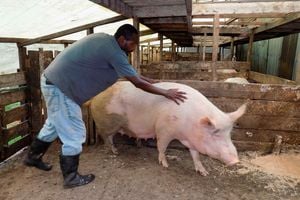
Mwangaza is a household name among pork lovers in Homa Bay. This is the nickname of a pig farmer in the town who has dominated the pork business for over 40 years.
His pig farming business has enabled him to create wealth and become the region’s pork king, and he is looking for more opportunities in farming.
Mwangaza, whose real name is Mark Mosengere, has grown progressively over the years, managing to avoid the challenges faced by other pig farmers. He started the business 40 years ago after his timber venture failed.
"I started selling timber used in construction. Sometimes my suppliers would fail to deliver timber when the Kenya Forest Service restricted tree felling. I thought of a new venture that would provide a constant income. That's when I had the idea of keeping pigs,” says the farmer.
He had a friend who kept pigs, so he decided to try his luck with a similar farming activity. Mosegere says he first bought two pigs. Within months, he had several piglets, which multiplied to more than 100 several months later.
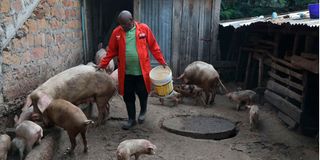
Mark Mosengere at his pig farm in Homa Bay Town on April 14, 2026.
Photo credit: George Odiwuor| Nation Media Group
"I came up with a new business plan. I started selling pigs to other farmers and to people interested in starting their own pig farm. My main market was Nairobi,” the farmer recalls. For several years, he supplied pigs to people in the capital city.
However, he decided to stop when the market became saturated, which lowered demand for pork as the supply of pigs increased.
When Mosegere realised that he was not making enough profit, he decided to stay put and continue doing business in Homa Bay. Nevertheless, he prospered and is now one of the region's leading pig farmers.
“As well as selling pork to individuals for consumption within their households, I also supply hotels with pork when their guests request it. Hotel managers request the quantity of meat they want before a pig is slaughtered and sent to them,” says the farmer.
The farm currently has 50 pigs of various sizes, ranging from dominant males to females used for breeding. When the Seeds of Gold team visited, the number of animals was at its lowest.
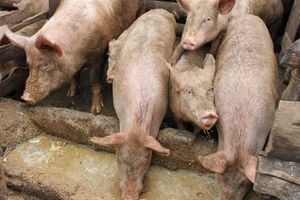
Mark Mosengere at his pig farm in Homa Bay Town on April 14, 2026.
Photo credit: George Odiwuor| Nation Media Group
The farm can sometimes accommodate more than 200 animals, which, once grown, are slaughtered. Mosegere attributes the success of his business to zero grazing. He restricts the movement of his animals.
In other regions, pig farmers allow their animals to roam freely through residential areas in search of food. This is a cost-effective way of keeping animals as there is no need to purchase feed.
However, this practice is dangerous as it can lead to the spread of diseases when the animals come into contact with others, including unhealthy livestock, which can make healthy pigs ill. Dr Charles Oduor, the head of veterinary services in Homa Bay, notes that humans can contract some illnesses from sick animals (zoonotic diseases).
He says the spread of illnesses hinders animal development. Diseases that can be passed to humans from pigs include swine influenza, Streptococcus suis and hepatitis E. Bacteria such as salmonella and erysipelas can also cause serious respiratory, neurological or gastrointestinal illness.
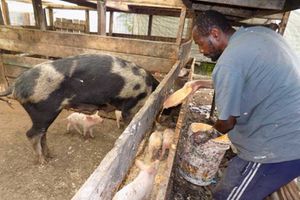
Mark Mosengere at his pig farm in Homa Bay Town on April 14, 2026.
Photo credit: George Odiwuor| Nation Media Group
"Animals that are not confined do not gain weight quickly. Time is an issue in farming. Besides, markets like Farmer's Choice do not engage pig farmers whose animals roam around," explains the animal health expert. Livestock that walk freely in search of food also risk injury from human attacks.
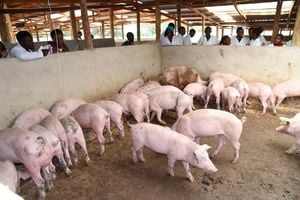
To reduce all risks, Mosegere decided to build a pigsty to keep the animals in a safe environment. He also restricts access to the pen, allowing only his workers in, and they must sterilise their shoes to prevent the spread of disease. Daily animal care includes feeding them and cleaning the pen.
The animals are given two types of meal at the farm. Mosegere ensures that he has an adequate supply of processed pig feed, which is balanced, high-energy and high in protein, and formulated to support rapid growth and lean meat production.
“The pigs are given the meal twice a day, morning and afternoon. Each pig eats one kilogramme of feed, while the piglets are given half a kilogramme,” he says.
Based on the current population, the animals consume 12bags of feed every month. Each bag costs Sh 2,500. The animals also consume food left over from hotels. Mosegere helps some hotels in Homa Bay Town dispose of their leftovers.
“Rather than throwing the food away, the hoteliers give it to me and I give it to the pigs. I don't pay for anything as it's a symbiotic relationship. The animals can access the food at any time, as there is no set schedule for giving it to them,” he says.
Mark Mosengere at his pig farm in Homa Bay Town on April 14, 2026.
Photo credit: George Odiwuor| Nation Media Group
Two employees carry out all these activities. To keep the pigs safe, the farmer has hired a veterinary officer who checks on the pigs at least once every three months. If one of the pigs shows signs of illness, animal health experts can be engaged. To prevent the spread of disease, the animal is isolated and given the necessary medicine to ensure it stays healthy.
The animals are occasionally given deworming drugs to control internal parasites such as roundworms, nodular worms and lungworms.
The pigs also receive regular multivitamin supplements to improve their health. Vitamins A, D3, E and B complex are essential for boosting immunity, enhancing growth rates, improving appetite and managing stress during weaning or illness. Mosegere has a licence to slaughter pigs on his farm.
Homa Bay Town has an abattoir where cows, sheep and goats are slaughtered. Pigs can also be slaughtered there, but this would conflict with the customs and beliefs of Muslims.