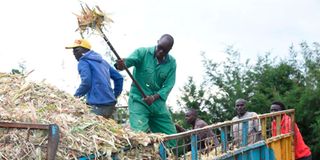
For many small-scale farmers, agricultural crop residues constitute a crucial part of cattle, sheep and goats diet, particularly during the dry season.
Maize stover is one of the most abundant crop residues in Kenya.
However, the nutritive value of this important feed resource is limited due the presence of lignin.
Further, stover has variable dry matter content, yield and chemical composition depending on harvest time, harvesting technique, maize variety, climatic conditions and pre-feeding treatment methods.
To optimise on the nutritive value of stover, the farmer can apply a variety of technologies, one of them being the use of agricultural urea.
These are stalks (40-60 per cent), leaves (20-30 per cent), cobs (15-20 per cent) and husks (10-15 per cent).
These include physical actions like chopping and grinding; chemical methods such as the use of ammonia, sulphuric acid and sodium hydroxide and biological procedures like the use of fungi, bacteria and other micro-organisms. However, almost all these practices have shortcomings.
Its protein content stands at six to nine per cent compared to four per cent of rice, wheat and barley straw.
However, the crude protein level is low compared to dried cassava leaves, lucerne hay or commercial supplements like cotton seed cake.
Stover is also low in calcium and Vitamin A. The latter is found in green plants which should also be added to a stover meal.
Maize stover diet should not exceed 25 per cent in young animals as their stomachs are not fully developed to handle the high fibre content.
These stages are affected by the amount of urea, moisture of the stover/urea mixture, treatment time and temperature of the mixture.
Urea content of three to four per cent concentration has optimal results while the moisture content should be around 30 per cent at temperatures of 30-60 degrees Celsius.
Beside the chemical breakdown of the fibrous material, urea increases the protein content of stover in form of non-protein-nitrogen (NPN) to as much as 23 per cent.
NPN is used by micro-organisms in the rumen of animals like cattle, sheep and goats to make protein.
For better results, the stover should be reaped within 24 hours after grain harvesting to reduce quality losses through maturation, pest attack, tramping, erosion and degradation by weather conditions.
The materials should then be chopped to about five centimetres to enhance its ability to mix with the re-agent and make it easier to mix the final product with other supplementary feeds like molasses, greens and protein sources that further improve quality and palatability.
Small amounts should be added each time and compacting done to reduce air spaces. Seal the bag or cover the pit to avoid loss of ammonia.
This is to facilitate the two-step reaction necessary for conversion of the fibrous materials to quality feed.