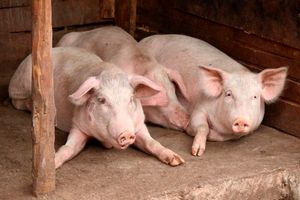
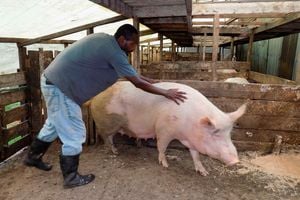
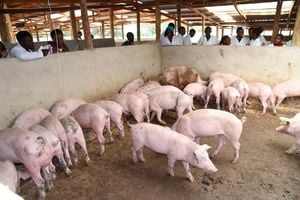
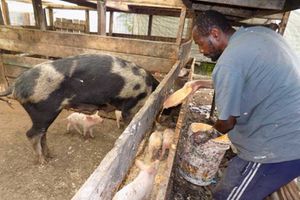
The squealing of the piglets and their mothers rends the air as Oscar Juma, 33, holds a piglet in his pigsty in Ngei Estate, Huruma, Mathare Sub-county.
The young pig farmer has mastered the art of pig farming, and the appearance of his animals attests to this – they are big, neat, and the skin texture is smooth.
Juma has been rearing pigs for two years - a venture that he says has been viable for him, and he is not quitting the venture any time soon.
“I do pig farming and keep a few chickens,” says Juma, who pays Sh2,500 per month for the space that he uses to rear the animals.
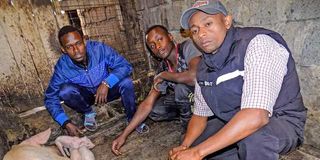
Oscar Juma (left), Regan Mwangi and Stanley Gichuki with their pigs in Ngei, Huruma, Nairobi.
Photo credit: Peter Changtoek | Nation
The farmer reveals that he started with two pregnant pigs, which he bought at Sh20,000 each, plus some additional cost, which he spent in constructing the pig structures and buying the feeds.
“We started with two pregnant sows, which we bought from a farmer in Mathare,” says the young farmer. After around two to three months, one of them gave birth to two, and the other gave birth to ten. Unfortunately, three (among the ten born by one sow) were stillbirths,” he reveals.
A few days before Seeds of Gold team visited the pig farm, three other pigs had given birth. One of them had given birth to nine, another one had given birth to 11, and the other one had given birth to eight.
He says that after some time, together with some of his colleagues, they borrowed a male pig to serve the first female ones again, and served their offspring, which had matured, and that is how the number increased from two.
Juma says that they use different feeds to feed the pigs. They source them locally and also buy commercial feeds that have enabled the animals to grow faster. “We use vegetable remains, which we collect from vegetable vendors. We also boil potato peels and mix them with other feeds,” says the farmer, adding that they collect potato peels from French fry sellers and wash them well before boiling them for the pigs.
The farmer says that a well-fed pig becomes ready to be sold for slaughter in a period of six months. This, however, depends on other conditions that include gender and good health, among other factors.
He adds that a pig farmer should have extra cash in hand, if possible, in order to enable them to run the venture smoothly before it picks, especially for purchasing feeds and for medication incase the pigs fall sick, to curb losses.
But for him, he has not come across major challenges like diseases. He inoculates the animals to prevent potential diseases. He says some diseases can be prevented through hygiene.
The structures that he uses are built in such a way that the droppings and the urine of the pigs can fall without making the floor dirty, because there is space between the timber used to make the floor, hence easy cleaning.
The structures are also raised some feet high. “One advantage of using timber to make floor is that, timber floor is warm compared to concrete floor,” says Juma.
He says that initially he had many chicken, but experienced some challenges that compelled him to rear a few, but comparing pig farming with poultry farming, pig farming is more profitable to him.
However, there are some challenges that he has experienced in this venture, which include a shortage of water and a high cost of electricity. Also, the high cost of feeds is another challenge, especially for commercial feeds. “You cannot rely on local feeds only,” adds Juma.
According to the farmer, pig farming, like any other venture, requires patience. “Patience is a great virtue that farmers should learn to have, because you can rear pigs for some time and they all die,” he says, adding that pig farming is tedious.
The farmer sells the animals to various customers, which include a slaughterhouse in Kabete and Kabati in Murang’a, among others. “We sell to the highest bidder; we just compare the prices,” he says.
The farmer reveals that a mature pig is sold for around Sh28,000 or more, depending on different factors that include weight, among others.
The farmer reveals that his future plan is to increase the number of pigs in his farm, in order to reap more from the venture.