Kenya’s livestock revolution: Why every animal must have a digital identity
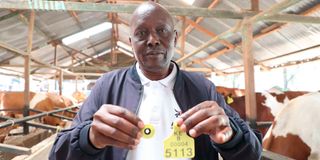
Dr Kyalo Michael, Senior Deputy Director of Veterinary Services at the State Department for Livestock, displays an AniTrack system at Jamhuri Park Showground, Nairobi, during the Nairobi International Trade Fair on October 1, 2026.

Imagine a Kenya where every cow, goat, sheep, camel, or pig carries a digital identity that follows it from birth to the dinner table. A simple tag that records who owns the animal, where it has grazed, what vaccinations it has received, when it has moved from one county to another, and finally, when it is slaughtered or processed.
This is not science fiction. This is ANITRAC, the Animal Identification and Traceability System, and it is already transforming the way we manage our livestock sector.
ANITRAC is Kenya’s digital livestock traceability system, anchored in the State Department for Livestock Development. Each animal is fitted with a unique electronic ear tag, linked to a secure, centralized database. That database can be accessed through a web portal or a mobile application that works even in remote areas with no internet connectivity, ensuring that our pastoralists and field officers are never disconnected.


In simple terms, we are replacing the outdated and painful livestock iron branding with a digital identification and traceability global standard. This will empower farmers, county governments, and national policymakers alike with real‑time, trusted data on Kenya’s livestock resources.
Why is this so critical? Because traceability is no longer a luxury or a nice‑to‑have. It is the passport that allows Kenyan livestock and livestock products to enter the world’s most lucrative markets. Consumers in Europe, the United Arab Emirates, the United States, China, and Saudi Arabia now demand to know exactly where their meat, milk, and leather come from.
They want proof of food safety, animal health, and ethical production. Without a system like ANITRAC, our livestock products face barriers at every border. With ANITRAC, we can provide the farm‑to‑fork proof that global buyers insist upon, opening doors that have long been closed to our pastoralists and traders.
Export markets
The benefits of ANITRAC go far beyond export markets. Disease control is one of our greatest challenges. When an outbreak of Foot‑and‑Mouth Disease or Rift Valley Fever occurs, every hour counts. With ANITRAC, we can trace an outbreak back to its source within hours, allowing us to impose quarantines, target vaccinations, and stop the spread before it devastates entire herds. This protects not only livestock but also human health, given that roughly sixty per cent of human infectious diseases originate from animals. ANITRAC is a cornerstone of our national One Health strategy and our preparedness for future pandemics.
Livestock theft and illegal movement have long plagued our pastoral communities. Without proper records, stolen animals are impossible to trace, and conflicts over ownership often escalate into violence. ANITRAC solves this by requiring digital ownership transfer and electronic movement permits.
Every animal’s journey is recorded, making it far easier to recover stolen livestock and hold criminals accountable. This brings peace and security to our rural areas.
For the pastoralist household, ANITRAC is a tool of empowerment. Tagged animals can be used as collateral for loans from financial institutions, unlocking credit that was previously unavailable.
Insurance companies can verify animal ownership and health records, making premiums cheaper as well as making payouts faster and more reliable when drought or disease strike. On the trade front, traced animals command premium prices in formal markets. Our message to every livestock keeper is simple: tag your animal, increase your value.
So where are we today? As of July 2026, we had registered cattle across seven pilot counties and government farms. We are operational in Narok, Kitui, Garissa, Taita Taveta, Siaya, Kiambu, and Tana River, and we are working with county governments to expand rapidly. The ANITRAC Bill has been validated at the national level, and regulations are being developed to give the system a strong legal foundation. Our target is ambitious but achievable: to register all our livestock and to operationalise the system in all our counties.
Data security
We are also building the infrastructure to support this vision. The secure core system is installed and operational ensuring data security, with a disaster recovery site to ensure business continuity.
The global trends are clear. Botswana’s traceability system opened European markets for its beef, and Namibia’s system has become a benchmark. Kenya has every opportunity to do the same — and to go further. With ANITRAC, we are not just meeting global standards; we are setting a new standard for Africa.
The time for paper records and guesswork is over. The time for digital, transparent, and reliable livestock management is now.
I call on every livestock keeper to embrace ANITRAC. Bring your animals for tagging. Register your details. Join us in building a livestock sector that is resilient, profitable, and globally competitive.
Together, we can transform our herds into wealth, our pastoralists into exporters, and our nation into a livestock powerhouse. The revolution has begun. Let us all be part of it.
Follow our WhatsApp channel for breaking news updates and more stories like this.
Jonathan Mueke is the Principal Secretary, State Department for Livestock Development, Ministry of Agriculture and Livestock Development.