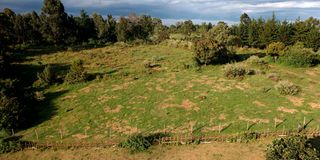
Of late, overgrazing has emerged as one of the most dangerous human practices in the Mau Forest Complex.
The Mau complex, Kenya’s largest water tower and one of East Africa’s most critical ecological assets, faces a crisis that has been building for years.
Herders driving livestock deep into the forest in search of pasture have trampled seedlings, compacted soils, and prevented natural regeneration.
The forest floor, stripped of its natural cover, has become vulnerable to erosion, sending sediments downstream into rivers and dams.
Speaking at the launch of the Mau Forest Complex Integrated Conservation and Livelihood Improvement Programme (MFC-ICLP) on September 17, 2025, leaders acknowledged that livestock rearing has been one of the major drivers of Mau’s degradation.
Instead of sidelining farmers, the government is seeking to make the livestock sector part of the solution.
The State Department of Livestock, in collaboration with the State Department for Environment and Climate Change, unveiled measures aimed at reducing pressure on the forest while improving livelihoods.
Principal Secretary for Livestock, Jonathan Mueke explained that the department is working to strengthen the dairy sector as an alternative to unsustainable grazing in Mau.
Principal Secretary State Department for Livestock Development Jonathan Mueke speaks at the Mau Forest Complex Integrated Conservation and Livelihood Improvement Programme event in Nairobi on September 17, 2025.
Photo credit: Bonface Bogita | Nation Media Group
“One of the key areas we are focusing on is the dairy value chain,” Mueke said. “By strengthening the dairy industry, we can provide communities with sustainable income without relying on forest resources.
Farmers in the Mau region often face challenges with milk preservation. Without cooling facilities, milk spoils quickly, forcing farmers to sell at low prices or suffer post-harvest losses.
As part of efforts to reduce pressure on the Mau Forest, the State Department of Livestock plans to install two milk coolers within the Mau ecosystem.
"To begin with, we have pledged to provide two milk coolers within the Mau ecosystem. These will help farmers preserve their milk, avoid post-harvest losses, and access broader markets. Alongside this, we are supporting water supply systems to ensure that livestock keepers can maintain good nutrition for their animals and improve production,” Mueke said.
The PS further outlined plans to promote complementary activities that connect agriculture and forestry. Among them is a programme, developed in partnership with the State Department of Forestry, that will see the distribution of thousands of beehives to communities around Mau.
“Through this programme, we are placing beehives in forest areas,” Mueke said. “Bees are critical for pollination, and they thrive in these environments while also producing honey. This will diversify community income and at the same time enhance biodiversity,” he explained.
Addressing the challenge of livestock diseases, vaccination campaigns are set to be rolled out in the Mau ecosystem to ensure healthier herds and safer products.
“We will be doing a vaccination exercise to ensure disease control for all livestock keepers around the ecosystem,” Mr Mueke said. “This will make sure that products like milk and meat are widely acceptable by the market, which in turn secures livelihoods and protects consumers.”