Hello

Your subscription is almost coming to an end. Don’t miss out on the great content on Nation.Africa

Ready to continue your informative journey with us?

Hello

Your premium access has ended, but the best of Nation.Africa is still within reach. Renew now to unlock exclusive stories and in-depth features.

Reclaim your full access. Click below to renew.

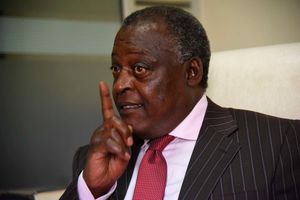
President William Ruto
Caption for the landscape image:

'Sasa pesa imefika': Stories of Moi, Ruto, Kirwa and Jirongo

Scroll down to read the article

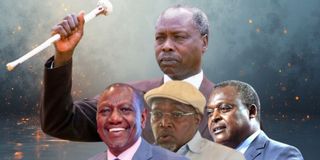
Former President Daniel arap Moi (background), President William Ruto (left), Kipruto Kirwa and Cyrus Jirongo. 

Photo credit: Nation Media Group

“I wanna live fast

Love hard

Die young

And leave a beautiful memory

I wanna live fast…”

— Conway Twitty, former American king of country music


“The chopper was ready at Wilson Airport. Mzee Jaramogi [Oginga Odinga] was waiting for me to pick him at his house. Mzee [Daniel] Moi was waiting for us in Kapsabet, where he was to open the Agricultural Society of Kenya show. Jaramogi had agreed to be his Vice-President after the 1992 election. He was to be a ‘surprise’ guest at the ASK show. Then someone called Raila [Odinga] and warned him that his father would die in an air crash that morning. Raila was in his father’s house ahead of me. When I arrived, he chased me away. They would not listen to me, even when I explained that I, too, would be on that plane.’’

That was vintage Cyrus Jirongo, the man who, when I asked where all the money that bankrolled the infamous Youth for Kanu ‘92 (YK92) came from, he slyly answered: “I don’t know, Moi knew. We would just be called to State House, and in the waiting room, I would see metallic boxes like the ones you journalists use to carry your equipment off-loaded from a Land Rover. Then Mzee would walk in and say‘sasa pesa imefika, endeni mufanye kazi’. (The money has arrived, now go and campaign for me).”

Now, an early disclaimer—the people of my generation who grew up before the digital age and were avid readers would probably remember James Hadley Chase’s spellbinding novels, and especially the 1975 issue Believe This, you will Believe Everything. Believing is a choice, but truth is like a mole; you fill its hole in one corner of the shamba, and it reappears from another. I believed him; I had no reason not to. After all, I was talking with Jirongo when he was broke, ostracised by the system, hounded by auctioneers, dumped by the love of his life (relax, we will come to that) and living in fear of hitmen.

I am writing this story while well aware of the scepticism and cynicism that hovers around any mention of Jirongo, the man who in the 1990s stood as the epitome of all that was wrong and rotten with Kenya’s politics. The mention of his name stirred the bitter memories of the economic decadence triggered by the printing of campaign funds to finance Moi’s re-election in 1992, which caused massive inflation. However, and most respectfully but analogously, let me just say every dog has its day (please don’t take this literally).

According to Jirongo, Moi in 1992 was scared stiff that he was going to lose the election to the united opposition. He strove to divide them, particularly the Jaramogi, Kenneth Matiba and Mwai Kibaki groupings. Jirongo’s first assignment in this regard was the arrival of Matiba from London, where he was on treatment. Through his YK92 underground army, he ferried hundreds of youth dressed in Forum for the Restoration of Democracy (Ford) colours to the airport to welcome Matiba of the “let the people decide” clarion call. From the Jomo Kenyatta International Airport, just like Kibaki would in 2002, and Raila in 2013, the ecstatic youth escorted Matiba at a snail’s pace through Eastlands to their welcome rallies in the city.

Cyrus Jirongo and Daniel arap Moi

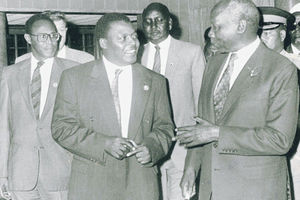
In 1993, Mr Jirongo was one of the most untouchable people on the land. He chaired the Youth for Kanu 1992 (YK-92) campaign group that had successfully campaigned for President Daniel Arap Moi’s re-election a year earlier.

Photo credit: File | Nation Media Group


“Even Matiba was surprised at the number of people waiting for him; he didn’t know that we in Kanu ferried youth in huge numbers so as to scare Jaramogi that he was not as popular as Matiba. We wanted him to feel threatened and politically vulnerable,” Jirongo revealed to me.

The next step was to woo Jaramogi, but the stumbling block was his son Raila, Paul Muite and James Orengo, as well as the fiery politicians around him such as Gitobu Imanyara, Dr Oki Ombaka, Dennis Akumu, Ahmed Bahmariz, George Kapten and Kijana Wamalwa. Old, disillusioned and deflated by the shakedown in the political arena and splintering of Ford, however, Jaramogi became easy prey for deep-pocketed Kanu with its manipulative and imperial tendencies, coupled with the power of incumbency.

“I can’t tell you everything but that is how it was, Moi was so unhappy with me but I still believe that crossover was leaked by someone in the system. It was part of power games to scuttle this. But anyway one day I will also reveal Moi’s inner circle’s hand in the emergence of Kibaki as a candidate. It was done so discreetly even Kibaki didn’t know,” Jirongo said.

He went on to say, that it had everything to do with the Kenyan political elite. The fear was that Matiba would take over lands owned by the big owners and also kick out the Asians Idi Amin-way. And as they say, the enemy of your friend is also your enemy! I can’t vouch for this, because it was Jirongo speaking, and he was the creature crawling out of Kanu’s treacherous and at times dangerous political woodwork.

Modern betting parlance

What I got from him on Kibaki’s Boxing Day ‘gift’ to Moi in 1991, was that it was a decision and political conspiracy within the larger Jomo Kenyatta family to spread their risks, not believing there is something called “sure-bet” , in modern betting parlance. Moi was mad when he learnt of Kibaki’s resignation and formation of Democratic Party, and even had a KTN duty editor fired for broadcasting the news coming from a hotel in Nyeri Hotel (I think it was White Rhino).

When I asked if this was the truth, he laughed as he puffed his cigar, and chuckled: “I have told you this was not Moi’s direct hand but the Kenyatta’s. Just ask yourself the trajectory Mr George Muhoho (Mama Ngina’s brother) and Kibaki dieheard Njenga Karume took, and then the road Mama Ngina and her son Uhuru took – Kanu! It is called spreading your risks.”

There is something else he said; that a vehicle stuffed with stacks of Kenya shillings notes had already left Nairobi for a secret rendezvous with Jaramogi’s handlers and that it was recalled somewhere around the sloppy descent to Mai Mahiu. This I leave to the younger crop of journalists to seek the truth, for as they say of every journalistic claim, trust but verify. 

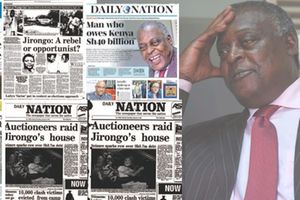
To put everything in context I would like to point out three things in staccato pace. I only met Jirongo just before the 1997 elections, not ahead of the 1992 elections when he was moneyed and bribing all and sundry. In his heyday, I was just a university student. When I arrived in the newsroom in late 1995, all I would hear was how he and Kamlesh Pattni of the Goldenberg notoriety had held newsrooms hostage and made everyone suspicious of the other. At this time, he had gone through Kanu’s horror machine with his businesses closed and properties seized. At one point, auctioneers descended on him at the city centre and took away his Mercedes Benz. Henceforth, he would ride around in vehicles with logbooks bearing his friends’ names.

YK92 stalwarts

In the 1997 elections, two of the YK92 stalwarts were elected to Parliament. Current President William Ruto in Eldoret North, which had produced two political giants—William Saina and Reuben Chesire (mark the latter’s name, it would play a pivotal role in this story)—and Jirongo in Lugari. Both happened to be friends of my buddy, Kipruto Kirwa, and so through him I met them frequently, often over lunch in their homes; Ruto in Karen, Kirwa in Lang’ata and Jirongo in Kitisuru, or, was it Runda?

You must at this point note that the trio, alongside former MP Peter Maundu, were seen as ‘Kanu rebels’, a new crop of young, restless and ambitious politicians that the older cadre felt uneasy and suspicious about. Almost every week, Moi would harangue them with the symbolic but dire restrain: “Nawasihi muende pope pole!” (tread carefully!)

Now, I have told you that I was introduced to Ruto and Jirongo by Kirwa, and, on record, I was the first journalist to profile the three of them when they joined Parliament. Kirwa came earlier, but Jirongo and Ruto in 1997. Kirwa was my hero from my college days. I will never forget the excitement with which I learnt that the legendary Dr Gitobu Imayara’s Society Magazine (then perceived to be anti-Moi) had published an article I sent via Mogotio Post Office.

It was a request to Kalenjins then to let Moi and his powerman Nicholas Biwott retire and nurture Kirwa to be the spokesman of the community. That excitement of reading my printed piece quickly dissipated when those inside the sanctums of power—especially late “permanent” Baringo Kanu Executive officer Hosea Kiplagat (he had not then become the Co-op Bank chairman) and late “Mayor” Philemon Chelagat, were told the author was a village boy from a place called Noiwet, Mogotio sub-district then.

Before we wrap up the story of the trio, I would like to share something about each of them. Kirwa lived in Lang’ata. I had a common friend with him then who worked at KTN, while I was at Nation Media Group. One day, Kirwa “vanished” and headlines were that he had been abducted by the system. It was an eerie story, like that of the late Robert Ouko—of a white vehicle following him. So, the story went that as he approached Nakuru, someone called his friend Kipkorir Arap Menjo in Eldoret to tell him that Kirwa was being trailed and may not survive the day. The wife, who lived in Kitale, was informed that her husband was missing and something serious could have happened.

Former President Daniel Moi, Agriculture Minister Kipruto Kirwa, Trade and Industry Minister Mukhisa Kituyi and other mourners follow proceedings during the burial of the late Karoli Lwanga Muliro son of the late Masinde Muliro in Sibanga, Cherangany yesterday.


When he started the journey, Kirwa was going to Kapsabet (again!) for the burial of the son of Moi’s friend —the hilarious and humongous Ezekiel Barngetuny. But it seems Kirwa changed course. He neither reached Kitale nor the burial. I was scared stiff they could have taken him. Before then, he had confided in me that he wasn’t sure he was safe.

In his words, he had been invited for lunch at State House and was very hesitant as he didn’t consider himself one of the people who should get the honour of sharing a meal with Moi. He was given a good welcome. He sat back and waited for the tearing of ribs and gulping of mursik to start. But then Moi walked in and greeted him as “Makokha”! That was the message that the lunch date came with: that you are not one of us. Why Makokha? Because Kirwa came from a cosmopolitan constituency called Cherangani, which the late doyen of opposition politics, Masinde Muliro, once represented and Kirwa inherited a bigger chunk of the Luhya vote. Now it also happens that Muliro had been felled following a petition by John Rotich, and Kirwa won the by-election. Of course, by now you remember that Muliro died on a flight from London to Nairobi. And guess who was also on that flight? Biwott. Conspiracy theorists had a field day.

Near-death experience

The Nation newsroom was tense that morning. The late Mutegi Njau shouted at me as I walked into the office: “You always pretend to be a friend of Kirwa, can you go to Lang’ata and check if he is in the house or his Pajero is in the compound.” I almost collapsed. He was my hero. He had just visited me in my modest shared house in Nyayo Highrise Estate following a near-death experience following a candle fire.

I went to Lang’ata, but there was no sign of Kirwa. The gate was locked. Speculation and rumours spread. Do not forget that at the time, there were no mobile phones or emails. You were either next to a landline or not. And so the nation sagged under the weight of speculation that the future Agriculture Minister—a portfolio that later went to his friend Ruto—could have been abducted and even possibly killed.

Mutegi then ordered me, via the car radio call—Nation’s fleet had those police-like gadgets—to pass by Nyayo House, specifically KTN offices, and ask our mutual friend whether she had seen Kirwa. When she walked out of KTN to meet me, she was all smiles. I told her: “Everyone is asking where Kirwa is.” She replied: “But he is okay, he dropped me out there this morning and is now on his way to Eldoret.” My people, the Kalenjin, have a saying, “kunur oret ab muren (a man’s road is zig-zag).

When I returned to the office, sweaty and yet relieved, I found my editors, Mutegi and Mr Caleb Atemi in laughter, especially when I told them Kirwa was in Nairobi that morning. Apparently, Mutegi had finally reached a top spymaster who spilt the beans!

When Kirwa reached Eldoret, he called a press conference at Sirikwa Hotel (then managed by the defunct parastatal African Tours and Hotels) and declared that the rumours about him missing were the testing of the ground by the government’s hideous security network on what would happen were they to take him down like Ouko. Finished and assured of headlines, my friend now drove towards Cherangani.

Now, before we move to Jirongo and Ruto—gosh these two had stories of their own that could constitute a PhD thesis—let me take you back to a dusty road in the maize plantations of Kitale, far much later. Kirwa is involved in an accident, his leg broken, and to this date, the limp is unmistakable. But whose vehicle did his driver ram and whose mistake was it? When the dust settled, turns out the mzee in the other vehicle was the father of Moi’s revered, feared and little-spoken about “personal aide” nicknamed Jesus Christ because of his initials—Joshua Chelelgo Kulei. He is the kind of guy who my former boss used to tell me the angrier he got, the more his voice dropped.

Kirwa believed then, and I am sure he still does, that he was lucky to escape with a broken foot and that he was not on the steering wheel. His driver spent some time in the cells “assisting” police with investigations. Over lunch in Bunge, Kirwa would confide in me: “Clearly, these people (Moi’s) would have been happier if I am the one who died. But I had not the power to choose who survives or dies.”

Common denominator

Now let us go back to Jirongo and Ruto, bearing in mind that the common denominator in this relationship is Kirwa, who if I am not wrong, was with Jirongo in Mang’u High School. Of course, the son of Sugoi is a younger man and a product of both Wareng and Kapsabet High School. And it so happens that the three of them decide to form a political party—UDM—and the symbol is bicycle. Now you know where Ruto would, over two decades later, get UDA, “bottom-up” slogan and the wheelbarrow!

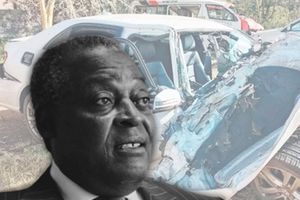
Meetings are being held in Jirongo’s Loita House office. Kirwa arrives in his cream Mitsubishi Pajero, Ruto in his Range Rover, Jirongo in his green Mercedes Benz (not the one that gave him his last ride on this earth), and myself on “two-wheels”, that is, walking.

Cyrus Jirongo

Former Member of Parliament for Lugari Constituency the late Cyrus Jirongo.

Photo credit: File


By the way, and for comic relief, something else I learnt from another close friend of Jirongo: Because of Luhya supremacy tussles, he would at times share Uhuru Kenyatta’s “uji” with now Prime Cabinet Secretary Musalia Mudavadi, but when one of them went to the washroom, he would discreetly order a new glass to drink from. It so happens that one of their kinsmen and MP, Apili Wawire, had made the mistake of having too much at a function. When he rose to speak, he collapsed. All he managed to say once he took the mike was: Hii sprite!” (this soda!). And what was the basis of the trust deficit? I suspect it is because Mudavadi was considered close to Moi because his father, the late Moses Mudavadi, was the former president’s boss in Kabarnet when he was a teacher, and the senior Mudavadi was the one who nudged Moi to join politics, with the guarantee that if things did not work out, he would just come back to his job. What had paved the way for Moi to join the Legislative Assembly? It so happened that his predecessor, Dr John Tameno, a veterinarian, had taken too much “uji” and became its slave.

Now, in this Jirongo office, hanging on the wall, was the picture of a young girl in a white dress handing Moi a bouquet of flowers on arrival at Jomo Kenyatta International Airport. We didn’t pay so much attention to this, especially me and fellow political writers Peter Leftie (The People) and Martin Mutua (The Standard), until one day when, behind the cloud of smoke from his cigarette, Jirongo dropped a bombshell. Only Kirwa was in the room with me.

“You know, guys, I wish I could trust Ruto, but I am no longer sure. You see that girl over there; I had her with Zipporah Kittony’s daughter. Now you know, despite this, I chose to support Ruto in the Eldoret North seat race against Chesire (Zipporah’s brother).” With a tinge of bitterness, he said some other things that I can’t for now reveal (as in the song of that time by Mr Bombastic, they are explosive and close to the first name of Twitty the singer!). I apologise to Jirongo, though he is not with us anymore, because he buried his daughter with Carolyne Kittony Waiyaki, Lorraine Jelagat Jirongo, last March. He often would candidly speak about how forlorn he was after she left him, blaming ogling “big” eyes and philandering.

But the rope of the ties that bind the three gentlemen is not over yet. Kirwa’s biggest political nightmare in the late 90s was that Moi was keen on propping the son of Zipporah, the nephew of Chesire, who was giving Ruto nightmares in the North Rift, against him in Cherangani. That son is the respected businessman, lawyer and chairman of Nairobi Stock Exchange, Mr Kiprono Kittony.

Now this is an interesting one. Like Mama Zipporah, her late husband Paul and son Kiprono, as well as senior Chesire, I come from the Tugen sub-group of the Kalenjin community. But the side I come from is the former South Baringo (now Mogotio and Eldama Ravine constituencies), and our dialect is closer to Nandi, which is Kirwa’s and Ruto’s. And unknown to me, Kirwa always thought I was Nandi. And so we sit for a cup of tea, and he is not himself. So I ask him why, and he blurted in mother-tongue: “These Tugens are just foolish and like conspiring. Moi through Zipporah is pushing Kiprono against me, and also Chesire against Ruto. These Tugens should go run for political seats in Baringo, where they belong. In fact, as if that is not enough, they are also fighting to monopolise businesses in Eldoret and Trans Nzoia. Meanwhile, their people in Baringo are queuing for relief food.‘Hii tu ni ujanja ya Moi!’” (This is trickster Moi’s plan).

The parting shot for today: in the Nation newsroom, I had one close ally and neighbour of Kirwa as my boss, Tom Mshindi. And it so happens that in 1995 or 1996, thereabout, both gentlemen were voted among the most influential under 40 men. Guess who, Mshindi, the son of Cherangani, assigned to do the story? Yours truly.

And, by the way, the Jaramogi, Raila and Jirongo story is something else; it is the subject of a future journalistic inquiry because the dead tell no tales.

Fare thee well, my friend, CJ.

Follow our WhatsApp channel for breaking news updates and more stories like this.

Mr Tanui is a veteran journalist, columnist, political commentator, and member of the Kenya Editors Guild.

TOMORROW: Day Moi confronted Jirongo over his escapades, the many bad political gambles he played, debts and systemic deconstruction …